
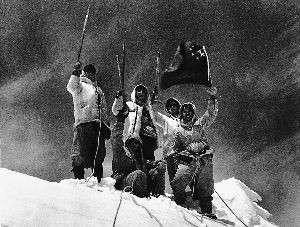
In 1957, Shi Zhan Chun and his teammates successfully climbed Mount Gongga.
At 9:00 AM on March 13, 2013, at No. 9 Tiyuguan Road, Beijing. A special memorial service without banners was held at the Mountaineering Sports Management Center of the General Administration of Sport of China, dedicated to one person — a name forever engraved at the pinnacle of New China’s mountaineering history: Shi Zhan Chun.
To me, it felt more like a pre-summit rally: veteran mountaineers, coaches, deputy team leaders, and old journalists who had covered the team back then had reunited, quietly waiting for their familiar team leader. Though everyone knew he would never lead them up Mount Everest again, there remained a deep, heartfelt yearning. In memory, even in his later years confined to a wheelchair and unable to speak, whenever he heard of Chinese athletes winning gold medals, Shi Zhan Chun's eyes would light up as he gave a thumbs-up to both new and old friends. That unforgettable gesture of pride became his final and everlasting heroic image in Chinese sports.
Even in his twilight years, his ambition never faded. Moved by this, Lu Guang remarked: “In the history of New China’s sports, Shi Zhan Chun is the one most deserving of a thumbs-up!”
1
“If the nails are worn out, we’ll be the nails ourselves.”
Not every historical moment has a voiceover, but there are always untold stories behind the scenes.
In 1960, when news broke that China’s Mountaineering Team, which had been established for less than five years, was preparing to tackle the world’s highest peak — Mount Everest — the shockwaves it sent through the global mountaineering community were comparable only to the detonation of China’s first atomic bomb four years later.
Behind the scenes, a 31-year-old man with a northeastern Chinese accent stood before Marshal He Long — he was Shi Zhan Chun, captain of China’s Mountaineering Team. The Marshal had summoned him simply to ask one question face-to-face: “The Soviet team has pulled out. What will you do?” The originally planned joint Sino-Soviet expedition had fallen apart when the Soviets backed out at the last minute, leaving China to attempt the summit alone. The loss of the climbing equipment previously promised by the Soviets added to the challenge. For Shi Zhan Chun, who was both team leader and Party committee secretary, the implications were obvious. “We’ll go. We’ll go ourselves!” Upon hearing Shi’s resolute reply, Marshal He nodded. This captain, who had never served in the military, inspired in him the trust of a good general leading good soldiers.
By then, Shi Zhan Chun was already a national-level athlete, yet his mountaineering resume was straightforward: in 1955, he went to the Soviet Union to study climbing techniques, and the following year he became captain of the All-China Federation of Trade Unions Mountaineering Team, tasked with New China’s first climbing mission. He successfully scaled Mount Taibai, which stands 3,767 meters above sea level. He then conquered Mount Muztagata, known as the “Father of Glaciers” at 7,546 meters, and Mount Gongga, the “King of Mountains” at 7,556 meters, quickly drawing widespread attention from international media. Some said that compared to Europe, which had a century of mountaineering tradition, China’s first mountaineering team captain was not only young but also bolder. In 1957, Shi Zhan Chun and his teammates were invited to give lectures in 14 cities across the country, delivering 53 talks. One detail was deliberately left out: during the climb up Taibai Mountain, due to insufficient technical gear and lack of specialized climbing boots, they nailed large iron spikes to the soles of their rubber-soled shoes. By the time they descended, the spike shoes had been worn down to flat soles. “If the nails are worn out, we’ll be the nails ourselves.” In extraordinary times, extraordinary measures are needed, Shi Zhan Chun said with a laugh.
This time, with the support of Marshal He Long, Shi Zhan Chun secured the first foreign exchange funds for China’s Mountaineering Team. With $700,000 approved by Zhou Enlai and Liu Shaoqi, he hurried to Switzerland to purchase equipment needed for climbing above 8,000 meters. It was a little-known overseas trip. Gazing out the plane window at the winding mountain ranges below, the corners of his mouth tightened. For China, in the midst of the most difficult period of the three-year natural disaster, this extremely precious foreign currency brought not only substantial financial support to him and his team, but also an unshirkable sense of duty and mission. Lowering his gaze, Shi Zhan Chun took a deep breath, silently repeating two words in his mind: the north slope.
2
The First Person to Spend a Night Above 8,000 Meters Without Supplemental Oxygen
Shi Zhan Chun never expected that the north slope would become a life-or-death battleground where he and his teammate Wang Fengtong would risk everything and set two world-first records.
Known as one of the “Three Poles of the Earth” by explorers, Mount Everest is at its most perilous on the north slope. Data shows that in the century-long history of Everest expeditions, hundreds have perished here. In 1924, the British climber Mallory, among the most famous of those who failed, became a grim warning on the north slope. Until the arrival of the Chinese Mountaineering Team led by Shi Zhan Chun, no one had succeeded.
In the footage: at 12:00 PM on March 25, 1960, the Chinese Mountaineering Team held a flag-raising ceremony at Everest Base Camp, and Shi Zhan Chun issued the order to ascend via the north slope. A simple Chinese voice, transmitted through basic amplification equipment, was heard loud and clear by the entire world — unmistakably.
The confidence etched on Shi Zhan Chun’s face did nothing to improve the harsh weather. He and his teammates advanced through blinding white glare, braving temperatures of minus 50 degrees Celsius and hurricane-force winds exceeding Category 12, repeatedly navigating brief windows between avalanches and icefalls, finally securing the first two of the “Four Major Battles” by crossing 6,400 meters and 7,600 meters. Different from the previous two, the third battle before the summit was the most critical and unpredictable. For this reason, as team leader, Shi Zhan Chun gave himself an order: personally lead a reconnaissance mission to assess the mountain conditions and routes ahead of the final push.
According to the overall plan, the goal of the third battle was to reach 8,300 meters. To give the team members tasked with the summit a better chance of success and to refine the final ascent strategy, Shi Zhan Chun and Wang Fengtong pressed on to a new height of 8,695 meters. At this point, they were just 149 meters from the summit of Everest. Looking up, the legendary northern peak seemed close enough to touch, like a massive frozen cloud. Yet he could not raise his arm, nor could he express the excitement surging within him. His frostbite was worsening, and dizziness caused by oxygen deprivation made him feel as though he had entered a fairytale ice world...
This wasn’t his first brush with death in the high mountains. While climbing Mount Gongga, had it not been for a protruding rock that stopped his fall, he would have plunged into the abyss. Later, he named his son after that rock, so future generations would remember the history of mountaineers. I asked Shi Zhan Chun’s son, Shi Yan, how his father described that night. Shi Yan shook his head: “He didn’t say anything. He wouldn’t pass on fear to the next generation, nor would he boast about his contributions as personal treasures.” In 1922, a British mountaineering team reached 8,320 meters using supplemental oxygen. A foreign mountaineer recalled in his memoirs that he had taken off his oxygen mask for just 15 minutes at over 8,000 meters to take photos and nearly passed out. That night, to be safe and ensure they could continue reconnaissance the next day, they decided to stop using their limited supply of artificial oxygen. Beyond that, no one knows how Shi Zhan Chun overcame all odds at nearly 8,700 meters — except Wang Fengtong. What is known is that his Northeastern Chinese nose was nearly frostbitten, to the extent that Premier Zhou Enlai later asked him if it had healed.
Before Shi Zhan Chun, no one had ever spent a night at the so-called “death zone” of 8,000 meters, let alone survived a night without supplemental oxygen.
3
He Made the Historic Decision to Send Tibetan Female Climber Pan Duo to Stardom
The spirit of China is inspiring because, in its most trying moments, there were people like Shi Zhan Chun.
At 4:20 AM on May 25, two months to the day after the order to advance on Everest was given, Chinese mountaineers Wang Fuzhou, Gongbu, and Qu Yinhua successfully reached the summit, achieving the first-ever ascent of the world’s highest peak from the north slope in 200 years since its discovery. Hearing this thrilling report, Shi Zhan Chun let out a long sigh of relief. Chinese confidence needed to be demonstrated through action — and they had done it. This successful ascent of Everest not only laid the foundation for China’s mountaineering endeavors but also ushered in a new era for Chinese sports.
Fifty years later, a grand commemorative meeting for the first Chinese ascent of Everest was held at the Great Hall of the People in Beijing. Wang Fuzhou, Gongbu, and Qu Yinhua, who had first summited Everest from the north slope, gathered once again before the world. Compared to that glorious moment fifty years prior, they were no longer young, but Shi Zhan Chun’s gaze toward them remained filled with pride. A reporter quietly asked another: if Shi Zhan Chun, who had already climbed nearly 400 meters beyond the original target of the third battle, had gone just 149 meters further to reach the summit, what kind of feat would that have been? An unrepeatable miracle was Shi Zhan Chun’s demonstration of the “human ladder” spirit at its utmost.
History always offers opportunities to the strong. In the face of ongoing skepticism from certain foreign media about the first Chinese ascent of Everest, Shi Zhan Chun, who had recently returned from a “May Seventh Cadre School,” immediately communicated with his old teammates and formally submitted a request to the Party Central Committee to attempt Everest again. The request was quickly approved by Comrade Deng Xiaoping. When he led the team on the 1975 expedition, Shi Zhan Chun specially selected a Tibetan woman who would later stun the world. The mountain was the same, but the path was not. His goal was clear: the Chinese Mountaineering Team would not only summit Everest from the north slope again to prove China’s sporting prowess to the world, but also make the international community sit up and take notice of Chinese female mountaineers.
The summit push continued. As deputy team leader, Pan Duo tackled dangers one by one and climbed step by step. She didn’t know that back at base camp, a special meeting concerning her political fate was taking place. At this unprecedented Mount Everest Party Committee meeting, a minor doubt on Pan Duo’s membership application materials appeared like a sudden glacial crevasse, blocking everyone’s path. With the summit push at a critical stage, Shi Zhan Chun understood that stabilizing morale was as important as boosting it. He decisively ruled: “If there are doubts, we’ll clear them up immediately!” In extraordinary times, extraordinary responsibility is required. After the meeting, he immediately assigned two comrades to descend from base camp. Within just two days, they cleared the final hurdle for Pan Duo’s Party membership. As soon as the Party Committee approved her application, Shi Zhan Chun picked up the radio and delivered the good news directly to Pan Duo as she continued her brave ascent. It was a detail that no news outlet captured at the time, but it made Pan Duo the first person to join the Party “on the front lines” at the world’s highest peak. Putting Party spirit above all, Pan Duo fulfilled her oath through her actions in the final push to the summit. Upon returning victorious from the north slope, she told Shi Zhan Chun that during the final climb, she had nearly ground her teeth to dust.
Pan Duo and eight male teammates successfully summited, once again proving Shi Zhan Chun’s decision right: Chinese female mountaineers could also conquer Everest from the north slope and claim world-first glory.
4
He nearly swung a chair over the joint mountaineering effort.
For Shi Zhanchun and the Chinese Mountaineering Team, the “Reform and Opening-Up” was undoubtedly a rare opportunity for development.
Once again, he took the lead. If the Chinese Mountaineering Team’s first ascent of Everest from the north side was a tremendous success in showcasing the Five-Star Red Flag to the world, then the high-altitude mountaineering project opened up in 1978 — strongly supported by Shi Zhanchun — became a benchmark for China’s sports reform. In 1980, the first foreign mountaineering team entered Tibet. The move proved that opening high-altitude mountaineering not only set a strong precedent for the reform and opening-up of China’s sports industry but also promoted the region’s opening-up and economic development.
At the beginning of the opening-up, all kinds of skepticism and incomprehension came their way. As the leading figure in China’s mountaineering endeavors, Shi Zhanchun didn’t rush to explain. From the perspective of high-altitude exploration alone, having one more foreign mountaineering team meant gaining an extra group equipped with high-tech gear to assist China in high-altitude scientific research — what could be wrong with that?! In private, he frankly told everyone, “Opening our doors to let foreign mountaineering teams in actually gives us a chance to study abroad without leaving the country. Not only do we not have to pay tuition, they even pay us. Isn’t that worth it?!” Shi Zhanchun’s hearty laughter quickly resonated with others.
Mountaineering is a shared cause of humanity. Seizing the moment, Shi Zhanchun re-planned and actively promoted international mountaineering cooperation.
In 1985, 1988, and 1992, he served as the head of the Sino-Japanese Namcha Barwa Joint Mountaineering Team, the Sino-Japanese-Nepalese Everest (Sagarmatha) Friendship Mountaineering Team, and the Sino-Japanese Namjagbarwa Joint Mountaineering Team respectively. Under his meticulous organization and leadership, the teams achieved repeated successes — Chinese, Japanese, and Nepalese athletes accomplished the remarkable feat of reaching the summit of Everest from both the north and south sides and meeting at the peak for the first time. At that moment, he could finally rest easy, having fulfilled Marshal He Long’s grand vision proposed in 1960 for a “north-south double crossing of Everest.”
Marshal He Long might never have imagined that this meticulous and broad-minded military genius would almost swing a chair during this double-crossing mission. The reason was simple: a certain national team within the joint mountaineering effort, because two of its sub-teams had not summited from both the north and south simultaneously, demanded that Shi Zhanchun allow them to attempt another summit. After weighing all risk factors, Shi Zhanchun rejected the request. They threatened to express their dissatisfaction through the extreme act of seppuku. It wasn’t until the other party backed down that Shi Zhanchun let go of the chair and bluntly said, “I can’t be holding a celebration while also holding a memorial service!”
At the celebration, Shi Zhanchun raised a glass full of respect for all the athletes in the joint mountaineering team. After the event, he was received by the highest leaders of Nepal and Japan and awarded national medals...
5
“My life was given to me by your father!”
Westerners like to call mountaineers “madmen,” yet hold them in especially high esteem.
This reverence was vividly displayed at Beijing Capital Airport: a prominent political figure who would later become Japan’s prime minister was visiting China. The moment he stepped off his chartered flight, he spotted Shi Zhanchun standing behind the officials. He immediately rushed over, disregarding all diplomatic protocol, threw his arms around Shi Zhanchun, and shouted, “Brother, you’re here too!” The translator trailing behind was dumbfounded, unable to believe his ears. That political figure had served as an advisor to his country’s mountaineering team within a multinational joint expedition, and he deeply admired Commander Shi Zhanchun’s leadership and charisma — their relationship had always been strong.
The process of reaching the summit of high mountains is the most perfect display of human nature. In Shi Zhanchun’s eyes, the higher one climbs, the purer everything on the mountain becomes, and the easier it is for the soul to be purified. He was never a poet, but one of his analogies gave poets new inspiration: “A high mountain is a person written in capital letters!” Following his words and looking into the distance, the north and south faces of Mount Everest together form a giant “人” (person) character.
What would Shi Zhanchun have done if it were truly for one person? Once, when the second assault team of the Sino-Japanese Namcha Barwa Joint Mountaineering Team began their push toward the summit, Japanese climber Tsuneyuki Kakuya suddenly fell unconscious due to illness at 7,420 meters and urgently needed to descend. Upon hearing the news, Shi Zhanchun immediately issued a rescue order to the Chinese members of the third assault team, using increasingly urgent language: speed up, fastest possible speed, push forward with all you’ve got. As one of the most famous rescue operations in mountaineering history, Chinese rescuers Shang Ziping, Li Zhixin, and Liu Cunsheng covered in just 70 minutes what would normally take over two hours at high altitude. Years later, when Kakuya met Shi Yan in Japan, he still bowed in gratitude: “My life was given to me by your father!” Another time, Wang Fuzhou, the first man to summit Everest, fainted during the climb. Shi Zhanchun immediately took off his own oxygen mask and pressed it to Wang’s mouth until he regained consciousness. To save his teammates, Shi Zhanchun lost his voice more than once, shouting, “You must guarantee with your Party spirit that you’ll get him down!”
Mountaineering has no nationality, but life and death are bound by great love. His son, Shi Yan, vividly remembered his father’s words: “Even just playing a ball on the court earns you cheers — all we have are bonds forged in life and death.”
6
At the crucial moment, he ran onto the UIAA podium
Premier Zhou Enlai’s words, “There are no small matters in foreign affairs,” earned Shi Zhanchun another title beyond his many accolades — that of a sports diplomat.
In 1985, when the Chinese Mountaineering Association officially applied to join the International Climbing and Mountaineering Federation (UIAA), it faced the same complex issue that China did upon rejoining the United Nations — Taiwan had already taken a seat. Thanks to the unremitting efforts of Shi Zhanchun and others, the UIAA finally agreed to China’s reasonable request to join the federation and remove Taiwan’s seat. Unexpectedly, before the official vote, the speech by the UIAA president did not follow the direction previously agreed upon with the Chinese side. A Swiss who spoke French, his remarks needed to be translated into English, and with multiple national representatives unclear about the fundamental difference between the People’s Republic of China and the Republic of China, allowing his speech to continue could have led to irreparable damage. Reflecting on it today, Ying Daoshui, the English interpreter for the delegation at the time, still sounded tense and uneasy: “The vote was about to happen. If he couldn’t explain clearly and the delegates didn’t understand, one wrong raise of hands and everything would be ruined!”
Shi Zhanchun suddenly stood up and decisively told interpreter Ying Daoshui, “Go, we’re going up!” “Up where?” “To the podium!” Ying was momentarily stunned before being pulled onto the stage by Shi Zhanchun. The UIAA president, who had never encountered such a situation, was astonished to see the renowned Chinese mountaineer before him. Smiling, Shi Zhanchun spoke loudly into the microphone: “Mr. President, I understand the three points you just made. First, you accept the Chinese Mountaineering Association as a member of the UIAA; second, Taiwan can only join as an observer; third, the flag and name of Taiwan will be changed according to IOC regulations. Is that correct?” At that moment, daring to turn the offstage negotiation into a fait accompli and presenting it all at once on stage — no one expected Shi Zhanchun to pull such a move. “The UIAA president hesitated briefly, then immediately said ‘yes.’ After we passed smoothly, the Taiwan delegate ran up crying, saying it was wrong, but it was too late.” Ying Daoshui still spoke with visible excitement: “We really admire Old Shi’s wisdom. That battle was fought brilliantly!”
For Shi Zhanchun, both national and international affairs were always serious matters. In 1988, when the Sino-Japanese-Nepalese Joint Mountaineering Team achieved the double crossing of Everest and created another mountaineering miracle, the Yomiuri Shimbun broadcasted the live footage of the summit. Soon after, Shi Zhanchun, who was commanding from the base, noticed that the footage only showed Japanese climbers. After taking a closer look, he understood everything. He immediately called over the responsible Japanese officials and clearly pointed out that the trilateral joint mountaineering effort wasn’t like the Romance of the Three Kingdoms — there should be no favoritism. Then, word by word, he asserted his authority as head of the team: “If your footage still only shows the Japanese team, I’ll pull them out!” After hearing this reprimand, the footage immediately changed. Soon after, Deng Xiaoping’s office called to say they could see the Chinese mountaineers.
Behind the camera, Shi Zhanchun was just such a Chinese sports figure who could not be underestimated.
Today, as I revisit the mountaineering monographs authored by Shi Zhanchun — such as *China’s Mountaineering Guide*, *Climbing the Highest Peaks of Our Inland*, *Treading Through Gongga’s Eternal Snow*, and *We Conquered the World-Famous Peaks* — and recall how he later formed China’s short-track speed skating team and achieved the breakthrough of winning the country’s first Winter Olympic gold medal, I suddenly realize that he created not only unsurpassable athletic achievements and irreplaceable spiritual wealth, but also an inseverable historical sentiment. I also understand what his greatest insight from reaching the mountaintop and the pinnacle of life truly is.
As the head of the team, Shi Zhanchun said, “Some say the Chinese Mountaineering Team is a red-flag unit that can fight tough battles. I say it’s a heroic team that doesn’t need mobilization to fight hard. Why? The height of the mountains is the best rallying cry.”
As a person, Shi Zhanchun said, “What kind of mountaineer doesn’t climb a ‘mountain’ when there’s one to climb?”