Written by: Zui Xue (Drunk on Snow)
Photography by: Bai Fen’er & Zui Xue
This winter season was an unusually snowy-deficient one in North China over the past sixty years. Addicted to deep powder snow, Bai Fen’er, JANY, and I, overcome by our "addiction," hastily got together before the 2011 Chinese New Year and flew to the legendary deep powder mecca in the United States – the Snowbird & Alta Ski & Thermal Resort in Utah – to binge on that “white gold” during the holidays. We skied non-stop for five full days, the entire trip taking about a week, and for the first time in our lives, we skied so much deep powder that we actually felt sick from it. Truly.
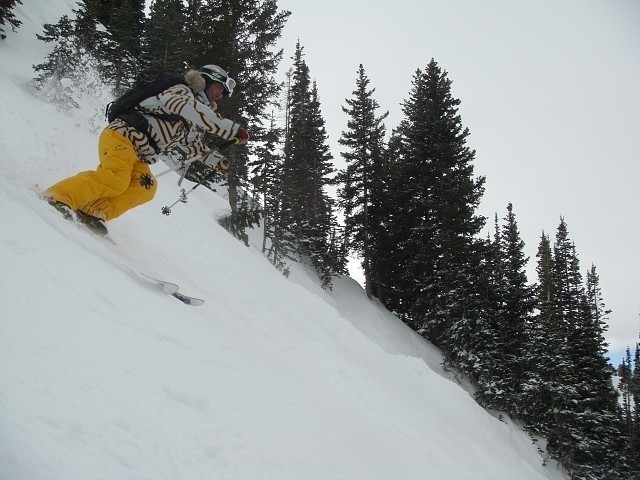
The Snowbird & Alta Ski & Thermal Resort is a mountain valley favored by top-tier and elite skiers in the United States. Thanks to frequent snowfall, high-quality powder, and diverse terrain, in recent years it has consistently ranked among the top in reader-voted surveys conducted by major American skiing and outdoor magazines such as SKI, SKIING, Freeskier, and Outside.
“Snowbird” is situated in the Little Cottonwood Canyon of the Wasatch Mountains, perfectly positioned to catch large amounts of fluffy white powder. In winter, when warm, moist air masses from the Pacific cross the Nevada Desert plateau and gradually cool and sublimate into beautiful, light powder snow over the Wasatch range, it falls in torrents onto the peaks, slopes, valleys, and forests of “Snowbird,” unstoppable. Utah is the second driest state in the U.S., so it offers incredibly dry snow quality. Cold and dry conditions are essential for producing lightweight, flaky snow and perfect needle-like powder. The proximity of the Snowbird area to the Great Salt Lake means it doesn’t lack water vapor in winter, somewhat akin to the special relationship between Beidahu and Songhua Lake. When Pacific storms pass over the Great Salt Lake, they carry warm, moist air rising from the lake’s surface into the Snowbird mountains. The lake effect significantly boosts the total snowfall in the Snowbird region, averaging about 500 inches per season.
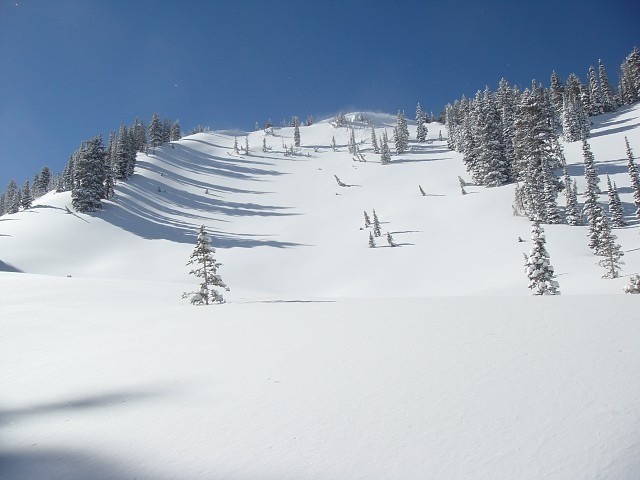
The aforementioned high-rated “Snowbird” includes the neighboring Alta Ski Area, which has its own distinct character. Together, they offer a total of 4,700 acres of skiable terrain. Aside from a small number of artificially developed beginner, intermediate, and advanced groomed runs, the majority of the skiing area consists of extremely steep bowl-shaped off-piste slopes, forests, cliffs, chutes, and couloirs. The deep powder covering these areas is considered a natural treasure by true backcountry skiing enthusiasts in the U.S. The number of beginner and intermediate groomed runs at Snowbird may account for less than one-tenth of the resort’s total skiable area. Ski trail maps often mark these with signs advising “SLOW.” If anyone dares to carve aggressive turns or charge straight down groomed runs, their lift ticket will be revoked by resort management, and those acting aggressively may even be detained by local police. All runs at Alta, both inbounds and out, are divided into just two categories: intermediate and advanced. The difficulty of the advanced runs is seriously challenging—enough to make even those self-proclaimed “experts” on groomed runs back home soil their pants. Most of Alta’s chairlifts have no safety bars. Think you’re an expert? Then you should be skilled enough not to fall off, heh. Oh, you're a snowboarder? Tough luck—this is SKIS ONLY!
The complex terrain also serves as a crucible for forging world-class athletes. Angel Collinson, the women’s champion of the 2010 Freeskiing World Championships, is a local talent born and raised at “Snowbird.” Her younger brother Johnny Collinson is equally impressive—he climbed all Seven Summits, including Everest, at just 17 years old last year. Johnny also loves skiing at “Snowbird.” He commented, “After traveling the world, I realized how lucky I am to live at ‘Snowbird,’ where I can ski on one of the best mountains in the world right from my doorstep!” The vast mountains have been the siblings’ backyard for play and adventure since childhood.
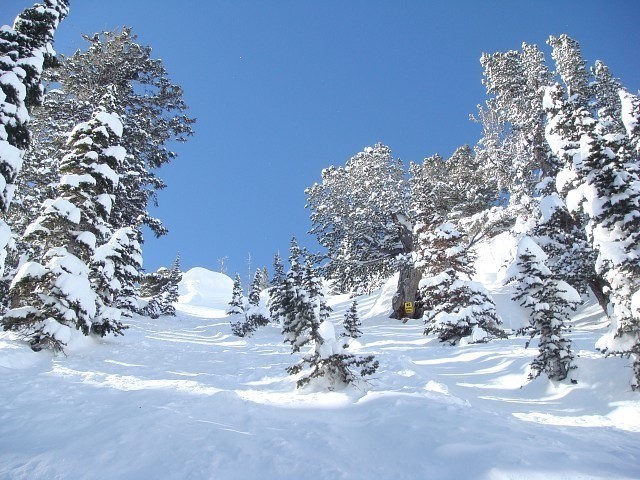
The combined ski area features over twenty lifts, capable of transporting skiers from the base elevation of 7,760 feet up to the summit at 11,000 feet. During our five days of off-piste skiing at “Snowbird,” Bai Fen’er and I spent two half-days skiing at ALTA. We mostly traversed across icy wind-loaded slopes from the top stations, side-slipping, side-slipping, and side-slipping again, then crossing ridgelines to drop into 40–50-degree chutes for carving turns. The chutes are sheltered from the wind, with thick, soft snow that makes skiing feel as safe as swimming in a baby’s bathtub full of soap bubbles.
Bai Fen'’er spent most of his time accompanying his pose-loving wife JANY, searching for the perfect scenic spots and camera angles. Meanwhile, I often tagged along with complete strangers—local American experts—to explore challenging off-piste terrain. On one lift ride, a futures trader from Chicago remarked, “Vail and Aspen are vacation destinations where wealthy Americans and middle-class families enjoy relaxed skiing, but Snowbird & Alta is where American expert and pro-level freeskiers often hang out.” I noticed quite a few ski bums, both men and women, asking passersby for cigarettes. Most of their spare cash went toward lift tickets.
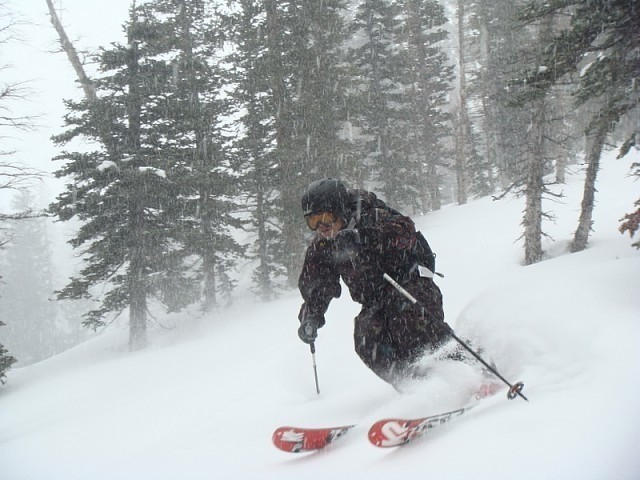
After an entire night of blizzard, our final skiing day was POW DAY. As the storm cleared, I joined three pro-level young Americans as we stubbornly traversed and side-stepped uphill to the western ridge boundary of Snowbird – the edge of THUNDER BOWL – reaching a steep slope of about 40–50 degrees. There, we sat down for a smoke break. Seeing that I was just smoking a regular cigarette, the trio burst into laughter. They were smoking weed—we weren’t even in the same league. After their high kicked in, they leaped off the cliffs like birds pouring out of a nest, flying down the rocky faces and disappearing instantly into the vast forest. I, on the other hand, stuck to my own rhythm, descending solo through steep, open forest sections with one jump turn after another. My fat powder skis sliced delicately through the thick snow, and the white chunks peeled away like soft tofu. I floated up and down rhythmically chest-deep in snow waves, as if drifting in an underground river—absolutely magical.
Our trio of Chinese skiing enthusiasts had a rather simple diet while celebrating the New Year in the U.S. Because JANY had bitten into a Chinese apple at San Francisco airport customs, she drew the attention of U.S. customs officers, who searched our luggage and confiscated more than half of our New Year goods. As a result, the three of us could only cook instant noodles with canned luncheon meat using the hotel coffee maker for breakfast, eat burgers at mountain fast-food joints for lunch, and dine at the hotel’s Mexican bar on spicy grilled meat, burritos, or at a Japanese restaurant on various sashimi and sushi for dinner, accompanied by sake. Though prepared by American chefs, the Japanese food was fresh and authentic. A Japanese meal for three, including tip, cost about $120—a price well worth it for a nice meal after a day of battling deep powder in a foreign land.
Spring arrived in 2011, a bit earlier than usual. More and more skiing enthusiasts from Beijing and other regions began flocking to Beidahu and Changbai Mountain in Jilin, and Altay in Xinjiang, in pursuit of deep powder. Taking this opportunity, here’s a brief introduction to a few essential techniques for becoming an off-piste powder expert:
A. In deep powder, maintain a neutral stance with your weight centered over the arches of your feet—neither leaning back nor forward. Bend and extend your knees rhythmically, think in 3D, and allow your powder skis to float freely up and down. Let the skis rise slightly above the snow surface to “lighten up” before turning. The key, the absolute key, is finding the sweet spot.
B. Keep your upper body relatively still and stable, especially keeping your hands in front of your body—that is, in the O FRAME (circular arm position). In deep powder, never swing your arms wildly like doing “long fist” martial arts. Always remember: when poling, flick your wrists lightly!
C. On steep slopes and in the trees, keep your legs and skis close together, distributing pressure evenly between both skis—ideally 50/50. Keep your hips and upper body aligned straight down the fall line, and rotate your skis parallel only with ankle, knee, and thigh movements. When turning on steep powder slopes, pulling your heels slightly back toward your hips helps even more. Give it a try—it’s really EASY!