Early next year, Anji Hello Kitty Park (Hello Kitty Park), a key tourism development project under Zhejiang Province’s 12th Five-Year Plan, will grandly open to the public. Currently, preparations are in full swing. The opening of the world’s largest and China’s first Hello Kitty-themed park in Anji will mark the official arrival of the Cultural Tourism 3.0 era. After the 1.0 era, which focused on visiting cultural and historical sites, and the 2.0 era, characterized by appreciating foreign traditional cultures, the 3.0 era of cultural tourism aims to provide novel and unique experiences. Its objectives will be clearer, themes more distinct, and demands on tourist participation and immersive experience even more stringent.

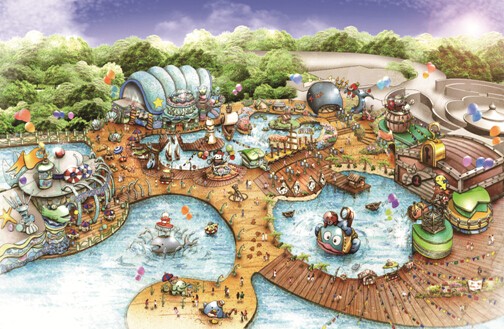
Hello Kitty Park (Hello Kitty Park) Happy Harbor
Of course, beyond the Hello Kitty cultural theme, Anji’s existing cultural characteristics will also be a major draw. As the only county in China to receive the UN-Habitat Scroll of Honour Award and China’s first ecological county, Anji’s mountains and bamboo seas, along with its unique tea culture, are truly captivating. The culture-focused Hello Kitty Park (Hello Kitty Park) has even more carefully integrated Hello Kitty culture with Anji. While retaining Kitty’s original cultural essence, you’ll find that the Hello Kitty in Hello Kitty Park (Hello Kitty Park) now carries a hint of Chinese flavor. Anji’s bamboo forests and traditional Chinese brushstroke designs are highlighted in Kitty’s imagery, giving her more localized Chinese characteristics and truly embodying the cultural tourism trait of “internationalizing China and globalizing China.” It also signals that Hello Kitty Park (Hello Kitty Park) will embark on a journey of localization in China while inheriting Kitty’s original culture, presenting high-quality experiences and delightful entertainment to Chinese fans and visitors with a brand-new look.
Industry insiders analyze that culture is the core of tourism resources, and tourism needs culture to enhance its depth. The potential for tourism development largely depends on the charm and appeal of culture. As living standards improve, more people are traveling and exploring, creating a market for tourism. Initially, people might have been drawn simply by beautiful landscapes—a lower level of tourism. But as times evolve, people seek higher-level tourism experiences. They hope to gain more insights, enjoy unique experiences, and indulge in distinctive pleasures—that’s cultural tourism.
According to forecasts by the World Tourism Organization, by 2020, China will become the world’s largest tourist destination, attracting 140 million international visitors annually. Researchers from the U.S. Economic Research firm ERA state that China’s theme parks “have the potential to attract at least 100 million visitors per year, a figure currently untapped.” With the rise of China’s economy and the acceleration of urbanization, as cultural tourism becomes an increasingly favored method for stimulating domestic demand with vast potential, the prospects for Zhejiang Anji’s Hello Kitty Park (Hello Kitty Park), centered around themed culture, are extremely promising.