In the race among major budget hotel chains to reach 1,000 hotels, Home Inns took nine years, 7 Days Inn six years, but Shangkeyou achieved this milestone in just five years, becoming the only new brand in the industry post-2009 to surpass 1,000 outlets. Many find it unbelievable—compared to brands like Podinn and 7 Days Inn, Shangkeyou is less well-known, and in terms of development time, it started 5–7 years later than brands like Home Inns and Hanting. How did Shangkeyou pull off 1,000 hotels in just five years?

Strict Cost Control: Saving 15,000 RMB per Room
After decades of development, China’s budget hotel chains have significantly reduced costs and accumulated considerable experience. But is there really no other way to cut costs further? Shangkeyou’s success lies in its skillful control of renovation expenses, striving to design the most attractive hotels for third-tier cities with the most economical investments.
According to Shangkeyou’s chief designer, the design team began “cutting costs” during the room design phase, carefully considering every detail such as layout and materials. Under the premise of maintaining the same renovation effect, they compared various materials to achieve the most beautiful results at optimal prices.
Moreover, Shangkeyou’s approach to supply and renovation management is different. Most domestic hotel chains tightly control supplier resources and force investors to make secondary purchases, profiting from the price difference and acting more like intermediaries. Shangkeyou, however, functions more like Tmall, rigorously vetting and onboarding suppliers and decorators with strong brand reputations and certifications to build a platform. When investors purchase materials, Shangkeyou recommends 7–8 qualified suppliers for them to choose from.
Shangkeyou has also established long-term partnerships with over 100 decoration companies nationwide. Through rigorous training, ongoing collaboration, and numerous successful projects, these partners have a precise understanding of Shangkeyou’s decoration standards, enabling them to deliver faster, higher-quality services, significantly shortening investment cycles and saving on renovation costs.
From design to procurement to renovation, Shangkeyou strictly controls costs, saving at least 15,000 RMB per room in decoration expenses compared to other budget hotels.
Product Focus: Four Upgrades in Five Years
After more than a decade of rapid growth, the budget hotel sector now faces challenges of consumption upgrades and severe homogenization. Breaking away from uniformity, upgrading products, and continuous innovation have become the key strategies for survival. And innovation is another cornerstone of Shangkeyou’s success.
Since its inception, Shangkeyou has continuously analyzed market demands and customer pain points, undergoing four upgrades over five years—from U1 to U2, then U3, with U4 on the horizon. The brand is committed to integrating the latest trends into its rooms to meet the rising expectations of consumers.
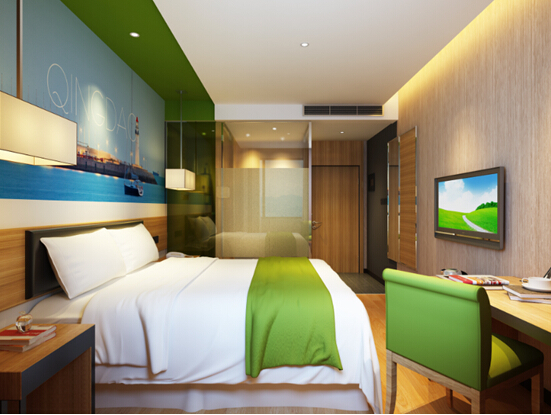
Compared to consumers in first- and second-tier cities, those in third-tier cities care more about appearances, and a significant portion of guests are there for family visits or business entertainment, placing different demands on a hotel’s hardware and services. To address this, Shangkeyou adopts a sleek and modern overall style, featuring lobbies over 100 square meters that are more luxurious than those of other chains, along with higher-quality front desk service, making third-tier city customers feel fashionable, affordable, and classy—precisely matching their needs.
With fewer hotel options in third-tier cities, Shangkeyou offers more diverse room types to meet varied consumer demands. For instance, in the U3 upgrade, it introduced “Movie Rooms” themed around films, “Romantic Rooms” combining love and fashion, and “Wellness Rooms” focused on health. In terms of design, Shangkeyou incorporates different color schemes throughout the hotel, balancing aesthetics and practicality. From the layered feel of the lobby to the finest details, every aspect is meticulously designed to be both visually pleasing and aligned with diverse consumer preferences.
Industry insiders note that a hotel’s vitality lies in continuously innovating its business philosophy, models, products, and services. Leveraging its precise positioning in the third-tier city market, unique management model, relentless cost control aimed at ensuring profitability, and commitment to product innovation, Shangkeyou has successfully executed a “flanking strategy” in the hotel market, propelling its rapid rise as a budget hotel giant with 1,000 outlets in just five years—a true business legend.