Free movies, free games, free app downloads, even free antivirus software—“free” is one of the most frequently used words in the internet world. But have you ever heard of free hotel stays?
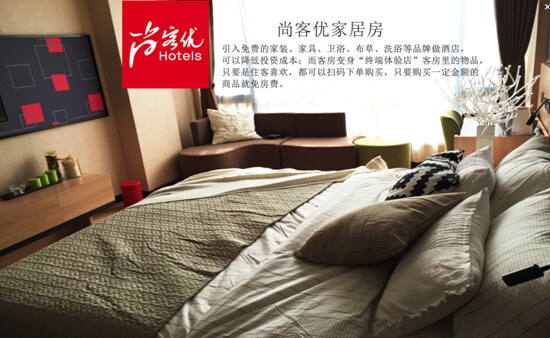
Shangkeyou has become a pioneer in China’s hotel industry to experiment with the free model. It is building a lifestyle sharing platform where, from the moment customers enter the lobby or guest rooms of a Shangkeyou hotel, they can purchase items they like through their mobile phones by scanning QR codes. These items include sofas, lamps, and various decorations in the lobby, as well as mattresses, pillows, bed sheets, small ornaments, towels, bath towels, toiletries, drinking glasses, furniture, and even wallpaper in the guest rooms. As long as customers buy items equivalent in value to the room rate, their stay is free.
This is also a new approach for the hotel industry to embrace internet thinking. It’s not hard to see that this model overturns the traditional product-centric operation logic of the hotel industry, shifting instead to a new model centered on customers and focused on experience. This model gives customers greater choice. Customers are no longer just staying at a hotel—they are exploring one. What they enjoy is no longer just accommodation services, but a comprehensive consumption experience that includes both experience and shopping. On one hand, it meets the diverse consumption needs of customers; on the other, it provides Shangkeyou with greater room for imagination in its profit model.
Breaking the homogeneous competition pattern
In recent years, the hotel industry has seen continuously rising operating costs, with expenses such as labor and raw materials increasing steadily, squeezing profit margins. More importantly, the products and services offered by the hotel industry are largely uniform, leading to severe homogeneous competition, which greatly limits brand premium potential and makes profits increasingly slim.
Shangkeyou’s “stay in hotels for free” model breaks this deadlock. The lobbies of Shangkeyou Select Hotels are equipped with U-shop gift selection areas where customers can purchase gifts by scanning QR codes via WeChat. Shangkeyou will also introduce free home decoration, furniture, bathroom, linen, and toiletry products for in-house guests to experience deeply. As long as guests like what they try, they can purchase these items by scanning QR codes with their phones. For Shangkeyou, this adds new revenue streams.
Traditional economy chain hotels mostly offer very limited services, generally just accommodation and dining—with dining often provided for free. To gain a differentiated competitive edge, hotels can only lower prices to attract customers, making the entire industry prone to falling into the “price war” trap. Coupled with OTA platforms like Ctrip engaging in “price wars” to attract users, the profitability crisis in the hotel industry has become increasingly evident.
From its inception, Shangkeyou has won by adopting a differentiated competitive model. Its positioning as an economy hotel in third-tier cities has allowed Shangkeyou to avoid direct competition with major players in the hotel industry, while the 60-room scale maximizes return on investment, attracting a large number of franchisees and achieving the legend of “a thousand stores in five years.” The launch of the “stay in hotels for free” model will now lead the development path of the hotel industry in the internet+ era.
Whether it’s Tencent, Shanda, or Qihoo 360, the business model of offering basic services for free and charging for value-added services has proven to be highly successful and has become synonymous with internet thinking. However, as a traditional industry, if the hotel industry were to let customers stay for free, it would obviously lead to losses. By adopting an experience + purchase model with diversified products, Shangkeyou has actually built a platform, gaining greater operational flexibility and thus realizing the classic internet free model of “the wool comes from the pig”—applying it to the hotel industry. If this model succeeds, Shangkeyou will not only become a “hero” of the hotel industry but also a leader in the next wave of industry transformation.
Platform model expands the hotel industry’s potential
Shangkeyou’s free model effectively integrates the entire hotel industry supply chain, including suppliers, forming a platform for the industry. According to Ma Yingyao, the post-80s president of Shangkeyou, the company plans to develop a super APP in the future that will allow customers to book rooms from multiple, or even most, hotels in the industry through a single app, greatly facilitating travel for consumers.
It is clear that Shangkeyou’s platform strategy aims to achieve both horizontal and vertical integration. Using the internet as a tool, customers as the target, and openness and sharing as principles, it seeks to realize resource complementarity in the hotel industry and foster a collaborative and win-win industry ecosystem.
Additionally, Shangkeyou is exploring advertising models in the hotel industry. The smart TVs in Shangkeyou guest rooms hold potential advertising value. Given the fast product iteration of Shangkeyou, the TVs in its hotels are largely already smart, allowing Shangkeyou to develop various advertising services such as startup ads to serve advertisers.
With over a thousand outlets and high foot traffic, Shangkeyou has become a physical traffic gateway similar to Walmart. Once guests check in, they tend to turn on the TV and watch for extended periods, making these screens highly valuable for advertisers. Previously, this resource was underutilized, but Shangkeyou has put it to new use. This refined operational mindset is also reflected in other areas. For example, the multifunctional lobbies of Shangkeyou’s boutique hotels include various formats such as noodle bars, Chinese fast-food restaurants, and cafes, all open to the public. This makes full use of previously idle lobby spaces and creates a diversified profit system.
Shangkeyou’s advertising model is expected to broaden the ecological coverage of the hotel industry. Previously, Shangkeyou’s ecosystem was mostly limited to suppliers, hotel operators, customers, and franchisees. But once the advertising model succeeds, the hotel industry’s ecosystem will extend to various sectors of the broader economy, significantly expanding the industry’s flexibility and opportunities.
Overall, Shangkeyou is rooted in the inherent characteristics of traditional industries while helping franchisees maximize return on investment and achieving win-win outcomes across all links of the industrial chain. At the same time, it continues to innovate its business models to improve and expand the industry ecosystem. The future looks promising for creating new legends.