Among the four great scenic wonders of Shu (ancient Sichuan), the grandeur of the Three Gorges lies in eastern Sichuan; the wonder of Jianmen Pass is in northern Sichuan; the elegance of Mount Emei is in southern Sichuan; and the seclusion of Mount Qingcheng is in western Sichuan.
What a captivating word — “seclusion”!

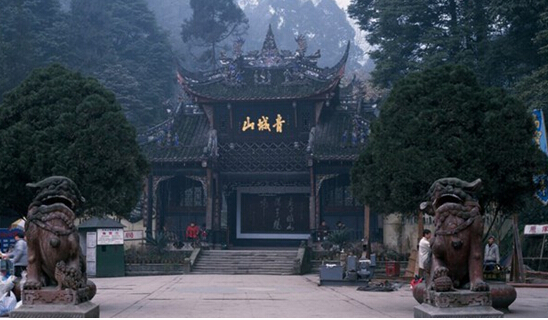
The goal of a summer retreat is to escape the heat, but “as one declines, another rises.” As a famous mountain that combines natural scenery, Taoism, and culture, Mount Qingcheng allows visitors to slowly appreciate its profound humanistic richness during the summer retreat.
“A mountain need not be high; it is famous so long as there is an immortal.” In the year 143 AD, Zhang Ling, the founder of the Celestial Masters Daoism, came to Mount Qingcheng. Using the doctrines of Huang-Lao, he established the Way of the Five Pecks of Rice, later known as the Celestial Masters Daoism. Mount Qingcheng has been recorded in history as the birthplace of Daoism and the ancestral mountain and temple of the Celestial Masters Daoism.
In the Ancestral Hall, listen to legends about Iron-Crutch Li, Lü Dongbin, the True Martial Ancestor, and the recluses of the Tang and Song dynasties; in the Celestial Master Cave and the Chaoyang Cave, read couplets such as “The sky is near with the red sun overhead, the earth loathes the breadth of the colored palace” and “The hollow cave welcomes the shining light, while ancient cliffs often see phoenixes come to greet”; outside the Celestial Master Cave, closely observe the three long knife marks on the “Demon-Subduing Stone,” and imagine the thrilling tales of demon subjugation from legend; at the Upper Clear Palace, about 500 meters from the mountaintop, shout into the valley and listen carefully for the faint echo — step by step as you climb up the mountain, even ordinary people gradually come to understand the Taoist beliefs of tranquility, following nature, and peaceful self-discipline.
Mount Qingcheng is also hailed as a treasure trove of calligraphy. Numerous inscriptions shine with humanistic brilliance that even the greenery cannot conceal. Mention any one, and you’re talking about a figure of great renown in Chinese history. Going far back, there are Du Fu and Cen Shen of the Tang Dynasty; closer to our time, there are Yu Youren and Feng Yuxiang from the Republican era. Master painters such as Zhang Daqian and Xu Beihong came to Mount Qingcheng to sketch, leaving behind exquisite masterpieces.
You don’t need to bring mineral water or various functional drinks when climbing Mount Qingcheng, because it has a unique specialty — “Dongtian Tribute Tea.” The tea is of excellent quality, with clear juice and a mellow fragrance. The green tea offered along the way at various Taoist temples is simply too delightful — a cup of clear tea fills your mouth with fragrance. Amidst the gentle mountain breeze, a warm feeling rises straight to your heart, fatigue fades away, and what remains is a sense of leisurely tranquility.
In addition to the unique “Dongtian Tribute Tea,” the famous dishes of Qingcheng also include: second, “Braised Chicken with Ginkgo,” with thick soup and exceptionally delicious chicken; third, “Qingcheng Pickles,” crisp, tender, fresh, and lingering in flavor; fourth, “Dongtian Dairy Wine,” with a strong yet not harsh taste, sweet but not greasy. Beyond these “four wonders,” the old-style cured meats from rural western Sichuan, smoked with pine branches, are definitely not to be missed.
“The serenity of the mountain is evenly divided” refers to the back of Mount Qingcheng, including natural landscapes such as Golden Wall Granary, Immortal-Welcoming Pavilion, Echoing Water Terrace, White Stone Mill, Three Dragons Pavilion, Flying Immortal Temple, Fairy Cave, Yellow Crane Bridge, and White Cloud Cave Cluster. Its greenery, seclusion, and wild charm surpass those of the front mountain. Walking along the plank walkways woven from thick wood, the moss on the surrounding rocks and the ancient trees and vines intertwine in layers. The waterfall, playfully dubbed the “Golden Baby,” cascades down like a baby fish, hanging straight down the mountainside, winding delicately and charmingly, especially eye-catching. Occasionally, you might encounter a few playful monkeys frolicking here, adding a bit of lively joy to the serene atmosphere for visitors.
Qingcheng — the seclusion of the world. No wonder Mr. Yu Youren, even on his deathbed, couldn’t forget to write the poem: “Bury me on the high mountain, where I can gaze upon my hometown. My hometown is out of sight, but I will never forget!” Intoxicated by the tranquility and mystery of the mountain, one can't help but merge into this sea of green. Only when dusk falls do we reluctantly bid farewell to Mount Qingcheng.