I just attended the Nanjing Asia Outdoor Exhibition. This year marks the 10th anniversary of the event, and anniversaries ending in zero or five always raise high expectations—as if they should be milestone moments. Indeed, this edition gathered a wide array of well-known brands, industry heavyweights, and a richly varied program of exciting activities.
I am Zhuge Qi from Shenzhen Intime Magic Audio Technology Co., Ltd. As someone who has just started a business making portable outdoor audio equipment, and as a newcomer and outsider to the industry, this was my first time attending the Asia Outdoor Exhibition. I gained a lot from the experience, so I’d like to organize and share some thoughts, and exchange ideas with veterans in the field.
Overall: under the profound influence of the internet and mobile internet, the industry is undergoing significant changes. The trend of “culture+; internet+” is very evident.
I. The “Culture+” Trend
The concept of culture is very broad. Here, we narrow it down a bit—culture roughly equates to the “outdoor spirit.” If a product, service, or club lacks culture, it lacks soul and fails to leave a strong impression. In today’s era where users “pay for feelings rather than function,” the notion of “culture+” has emerged. Let’s take a look at some trends we observed from the exhibition:
1Only with sharing platforms can outdoor culture accumulate
Dangke, a group of young and inexperiencedITmen, reportedly managed to gather5000clubs across the country on their platform within just three years. Only a platform with culture can attract such a large number and wide range of outdoor clubs.
Hangzhou Dangke had a fairly large booth in the club area. Instead of using it to showcase products, they built an interactive platform to exhibit outdoor culture. Every day’s schedule was packed with sharing sessions, all fully attended, with speakers from all over the country—various grassroots influencers and eccentrics. If earlier outdoor influencers had rich “outdoor experience,” these post-80era influencers have abundant “outdoor thought.”80,90Let’s see what topics they shared: “How Clubs Can Apply Internet Thinking,” “What Management Can Bring to a Club?”, “How Can Public Welfare and the Outdoors Be Combined?” and so on.
Some booths also hosted such sharing sessions. For example, the Subaru booth invited travel enthusiast “Xiao Si Zhe Si.” Xiao Si spoke in a relaxed and humorous manner, sharing the touching story of how he and his girlfriend set off from Shanghai, spentISOmonths traveling across Asia and Africa, overcame countless hardships, reached Cape Agulhas in Africa, and ultimately got married on a dilapidated……
2Outdoor leaders become the spokespersons of outdoor culture
Green Field Network launched the selection of outstanding outdoor leaders at the Asia Expo--- The Compass Award. On one hand, team leaders indeed determine the quality and experience of outdoor activities. At the same time, who should spread outdoor culture? Who should represent the outdoor spirit? Team leaders are undoubtedly the most important. A compass not only points the way forward but also guides the right outdoor spirit.
This time at the Asia Outdoor Show,4Booth [number redacted] set up a large “Happy Teahouse” with a strong Zen vibe—absolutely amazing. It felt rustic, natural, and embodied the beauty of harmony between man and nature. It resembled a teahouse deep in the mountains where wandering martial artists gathered to chat and laugh. This made me think: was the spirit of the martial arts perhaps the “outdoor spirit” of the Chinese people in the past? Our modern outdoor spirit shouldn’t simply borrow everything from Europe and America—can’t we also explore elements from our own traditional culture? For example, studying items from martial arts novels and developing related products could bring a unique charm.
4Outdoor Enthusiasts Care About Public Welfare and Environmental Protection
“Environmental protection and public welfare are the conscience of outdoor people!”
At the exhibition site, many clubs showcased their environmental and public welfare initiatives. For example, the Xi’an Shanshui Outdoor Club, together with the China Water Purification Bird Federation, launched a charity sale aimed at protecting the environment and birds.
Outdoor enthusiasts are truly the most caring community. Perhaps they enjoy unpolluted environments and also pursue the purest of inner selves.
Many of the sharing topics at the Dangke Salon also revolved around environmental protection—definitely worth giving them a thumbs up.
5Excellent Brand Culture and Corporate Culture
Kailas’s booth was the busiest at the show, featuring various talks, activities, and giveaways. This company, which originally started with foreign trade, places great emphasis on brand building. After ten years of hard work, it has now become the most influential outdoor brand in China. It’s said that even the cleaning staff at Kailas regularly participate in outdoor training. Kailas’s “Outdoor Coach Growth Program” has also inspired many outdoor enthusiasts to become professional coaches and, in turn, influence more people to love outdoor sports. This is a far-sighted approach to branding.
Many companies in the outdoor industry started with foreign trade because the outdoor lifestyle originally came from abroad. With the improvement of living standards, a vast domestic market has emerged. But if the mindset of making products doesn’t shift to building brands, having a large market doesn’t mean much. That’s why, seeing many manufacturing exhibitors—also originally in foreign trade—with undeniably high-quality products, yet lacking that spirit, that outdoor essence, spending most of the exhibition days simply selling products on-site. For them, times are indeed getting tougher.
Statistical data shows:2014The number of core outdoor brands in [year redacted] increased by2013rose by11.5%compared to [year redacted], demonstrating that a large number of companies are focusing on brand development. Meanwhile, the Asia Outdoor Show this year saw the establishment of theCOA(China Outdoor Brand Alliance Co., Ltd.), which released the “Trinity Declaration”: committing to building three platforms and one standard going forward—namely the “Asia Outdoor Exhibition,” theCOA“Outdoor Sports League,” theCOA“Outdoor Summit Forum,” and one standard: theCOA“Outdoor Product Quality Standard.” This is believed to play a significant role in fostering the growth of more outdoor brands.
6The Trend of Outdoor-Oriented Youth Education
The exhibition featured a dedicated section for youth outdoor activities. For example, Shanghai Wild Kids Nature Experience Camp. Product manager Xia Tian introduced it as a platform for parenting, the outdoors, and growth. Through outdoor experiences, children learn about natural science, acquire outdoor skills, receive life safety education, improve parent-child communication, and grow into confident, self-disciplined, and resilient “wild kids.” Considering the current issues faced by urban children, this concept seems quite promising, with great economic efficiency and social significance.
There’s also a Nanjing-based adventure company offering the “Little Knights Training Camp,” aiming to broaden children’s exposure to nature and widen their horizons through courses such as horseback riding, archery, rock climbing, and camping, while also instilling stronger teamwork awareness.
Forward-thinking companies need to pay attention to and invest in this area—only then do they have a future.
7The Entertainment Industry Enters the Outdoor Sector
During the exhibition, there was reportedly a special screening and talk for the movie77“Tian” (tentative title), said to be the first outdoor-themed film shot by Chinese filmmakers. I missed the talk, but friends said it’s definitely something to look forward to. Soon, cycling enthusiasts are expected to start a “Breaking Wind” craze. Movies, as an important cultural medium, have also begun entering the outdoor market.
8Smart Outdoor Products Fell Short of Expectations
Betwentyfour AGis Europe’s largest outdoor product distribution platform. I had the chance to meetCEOHe was asked: What is the biggest difference between the outdoor markets in China and Europe? He replied: It might be in the smart outdoor segment. Because China is very strong in smart manufacturing; also, Chinese outdoor users are relatively young, love to play, and are adept at using smart outdoor equipment. Unlike Europe, where the aging population is severe and less receptive to such innovations.
I make portable outdoor speakers, and it’s a pity that I didn’t see any related products, nor did I see any smart hardware on the list of the Asia Outdoor Industry Awards. I’m wondering what the reason might be? Perhaps it’s because people still categorize these products as “consumer electronics” from a product technology perspective, rather than as “outdoor products.” Personally, I think this non-consumer-oriented distinction method is incorrect. Since smart outdoors is a new trend, then exhibition spaces also need to attract and encourage such manufacturers to participate.
In comparison, JD.com is very forward-thinking. Although it is an e-commerce platform for home appliances and digital products, it has embraced the outdoor industry by establishing a large smart outdoor business unit, which has been growing rapidly every year!
When we talk not just about products but about brands, industries, and ecosystems, it becomes necessary to discuss the issue of outdoor culture. What is outdoor culture? The words of Lao Xie, a seasoned hiker and reporter for “Outdoor Exploration,” were very enlightening to me. She was originally the HR director of a company, and she noticed that some new employees were impetuous, selfish, lazy, pessimistic, irresponsible, not united, not good at sharing, and lacking ambition. Then she realized that the outdoors provides all the spiritual nourishment they need. Culture may seem abstract on the surface, but it is actually very important. Just like air, which feels intangible, yet is indispensable. The abstract nature of culture requires us to refine and comprehend it, and then implement it in specific product design, brand planning, and community building.
Second, the trend of the “Internet+”
1, New Trends in Community Organization
“Birds of a feather flock together.” The outdoor community is one of the most sincere and straightforward groups. Therefore, with the development of the internet, many hikers’ social circles have expanded nationwide. They get to know each other through WeChat and communicate for long periods. The Asia Outdoor Show is a great offline gathering platform. As the saying goes, “seeing” someone makes the relationship feel more “intimate.” So, taking this opportunity,8264, events like Dangke host large-scale group meetups. Such rare gatherings are believed to enhance the stickiness and interaction of online groups for a long time afterward.
Through interactions and exchanges during the exhibition, many new thematic communities will also emerge. These communities are cross-regional, carry great momentum, and have immeasurable potential.
2, The Cross-industry Trend and Entrepreneurship Wave Triggered by the Internet
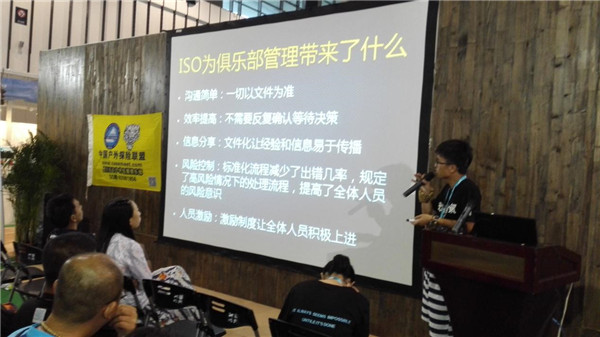
I recently met Wu Zewei from Shanghai Pudong Travel.COOHis presentation titled “ISOWhat Can Management Bring to a Club?” caught my attention. Later, I learned that he was originally aISOsystem certification engineer at a company. Because he loved the outdoors, he later turned it into his career. Some non-traditional outdoor activities have attracted traditional outdoor enthusiasts to cross over into the outdoor industry due to the “internet+”. This is a fortunate development for the outdoor industry!
Speaking of it, the mindset of the internet circle really aligns well with that of the outdoor circle. They yearn for freedom, love life, understand mutual help and sharing, and value learning and growth. ManyITpeople, because of their internet background and passion for the outdoors, resolutely joined the outdoor circle amid the entrepreneurship wave. They easily find like-minded teams and often possess innovative thinking and clear business models, making them attractive to investors and enabling them to rise quickly. Especially in cities with a developed internet culture like Hangzhou, Hangzhou Molidou Technology (Dangke) is a great example.
3, Mobile Vertical E-commerce Platforms, and the Emergence of New Business Models
At this exhibition, Tianjin’s “7+2” was a star. They first held a smart outdoor launch event. In terms of business model, they emphasize “connection”—connecting suppliers, connecting clubs, connecting users, connecting terminal stores, and building aITsystem platform. This aligns very well with Pony Ma’s concept of “connecting everything.”
By the way, this system was developed on a EuropeanB24platform, tailored to the actual conditions of the Chinese market.B24It is an outdoor goodsITplatform that has been in operation for nearly twenty years, reportedly connecting tens of thousands of stores in Europe.
4The Year of Club Standardization and Commercialization
Due to the development of mobile applications like WeChat, the cost of organizing outdoor activities has decreased, leading to rapid growth in the scale of local clubs in recent years. However, this has also brought a major issue: large-scale groups require scientifically structured management systems — at the very least, you need a small team dedicated to operations and services. Moreover, while clubs can grow quickly, they can also become loosely organized if member experience is not prioritized. A good activity experience, in turn, requires a capable team and sufficient financial support. In the early days, clubs were small, and everyone had fun organizing activities, mostly just gathering to eat and drink wherever they went. But with larger teams and higher expectations for activity experiences, sustainable and healthy club operations now demand commercial viability.
However, in previous years, the combination of clubs and commerce was generally not very successful. There were multiple reasons: first, team members who came together around anti-commercialization values tended to resist commercialization; second, commercial operations did not balance the experiences of both merchants and members. For example, sponsors would provide support, only to find that they didn’t even receiveLOGOa single event photo in return. On the other hand, excessive commercialization can alienate members. Third, without established models, club commercialization is prone to issues due to lack of trust among participants.
With the arrival of the consumer democracy era, members now expect higher-quality event organization and products. They are willing to pay, as long as it’s transparent, fair, and reasonable. Meanwhile, the development of mobile internet has made such transparency even easier to achieve.
By leveraging existing communities and appropriately tapping into community dividends, some clubs have begun to explore commercialization. For example, the aforementioned “7+2” boasts8264such a large community — it would be a shame not to develop its commercial value. Similarly, Beijing-based Shifeng Outdoor has accumulated numerous club members and developed a vertical platform for Shifeng Outdoor, showing promising prospects. Even the well-known outdoor platform---Mafengwo, which has long championed the anti-commercialization banner, has surprisingly started to embrace the “deepVallure,” launching some promising initiatives: the “Mafengwo× Product” Mafengwo Best-Seller Incubation Program evokes comparisons to joint brand efforts like Sennheiser and Adidas launching sports headphones. Zhi Dao Bao is another product designed to help recommend outdoor gear, and Mafengwo’s open platform is willing to share its accumulated outdoor expertise, data, and resources with businesses in the mobile internet era.
The commercialization of outdoor clubs is not about making money their sole master, but rather about injecting momentum into the healthy development of clubs.
Therefore, in addition to existing platforms like Sanfo Outdoor and Toread, we will see a new wave of e-commerce platforms with club backgrounds emerge, sharing the dividends of community-driven business.
The core of community economy is mutual benefit, openness, and transparency. Trying commercialization under these premises is not only promising but also highly profitable.
5Where is the new high ground in the industry?
My answer is: new high grounds will emerge in regions with developed outdoor industries, widespread outdoor sports culture, and advanced internet infrastructure. Take Hangzhou, for example: the Jiangsu-Zhejiang region, represented by Hangzhou, has always had a strong light industry; it also benefits from favorable economic conditions, superior natural surroundings, and booming outdoor sports. Furthermore, its internet infrastructure is excellent. The outdoor community thrives best in the soil of the internet because of its potential for sharing and dissemination, enabling quicker activity organization and broader outreach. At the same time, the involvement of internet startups has made this trend of industrial high grounds even more unstoppable.
“Culture+builds products, services, and communities; the internet+handles marketing and promotion.” These two aspects complement each other. Only by excelling in “culture+building products and services” can “internet+marketing and promotion” be truly powerful. The former is the “1foundation,” the latter is the “0amplifier,” and their intersection is the “outdoor user,” connected by the bridge of “the internet and mobile internet.” The internet enables the flow of information and needs between outdoor users, businesses, and fellow users, thus driving the continuous evolution of outdoor culture. This culture, in turn, inspires businesses to create new products and services, which can spark a new round of internet sharing.……
Due to the profound impact of the internet, today’s exhibitions have shifted their focus from mere “display” to “gathering.” Pure product showcases no longer align with current expectations, as the convenience of the internet allows people to access product info easily. Plus, given outdoor enthusiasts’ playful nature, they want exhibitions to become big parties. During the day, it’s a “meeting”: forums, salons, meetings with vendors. At night, it’s another “gathering”: nationwide revelry with fellow travelers — isn’t that delightful?
Zhuge Qi, Founder of Shenzhen Intermage Audio Technology Co., Ltd.
Contact WeChat:zhugeqi