Peking University 2015 Camel Mountaineering Team: All current students summit the main peak of Anyemaqen Mountain
At 09:13 AM on August 7, 2015, on the Anyemaqen Snow Mountain in Guoluo Prefecture, Qinghai Province, three members of the camp-guarding team from the 2015 Peking University Camel Mountaineering Team successfully reached the summit of the 6,282-meter main peak and safely descended back to the base camp around 11:00 PM that evening. With this, all 14 current students from Peking University’s Mountain Eagle Society successfully summited the main peak of Anyemaqen Mountain, Majianggangri, completing this challenging and high-difficulty summer mountaineering mission. On the same day, the mountaineering and scientific expedition teams cleared their living traces and departed from the mountain, bringing the 2015 summer mountaineering and research activities to a perfect close.
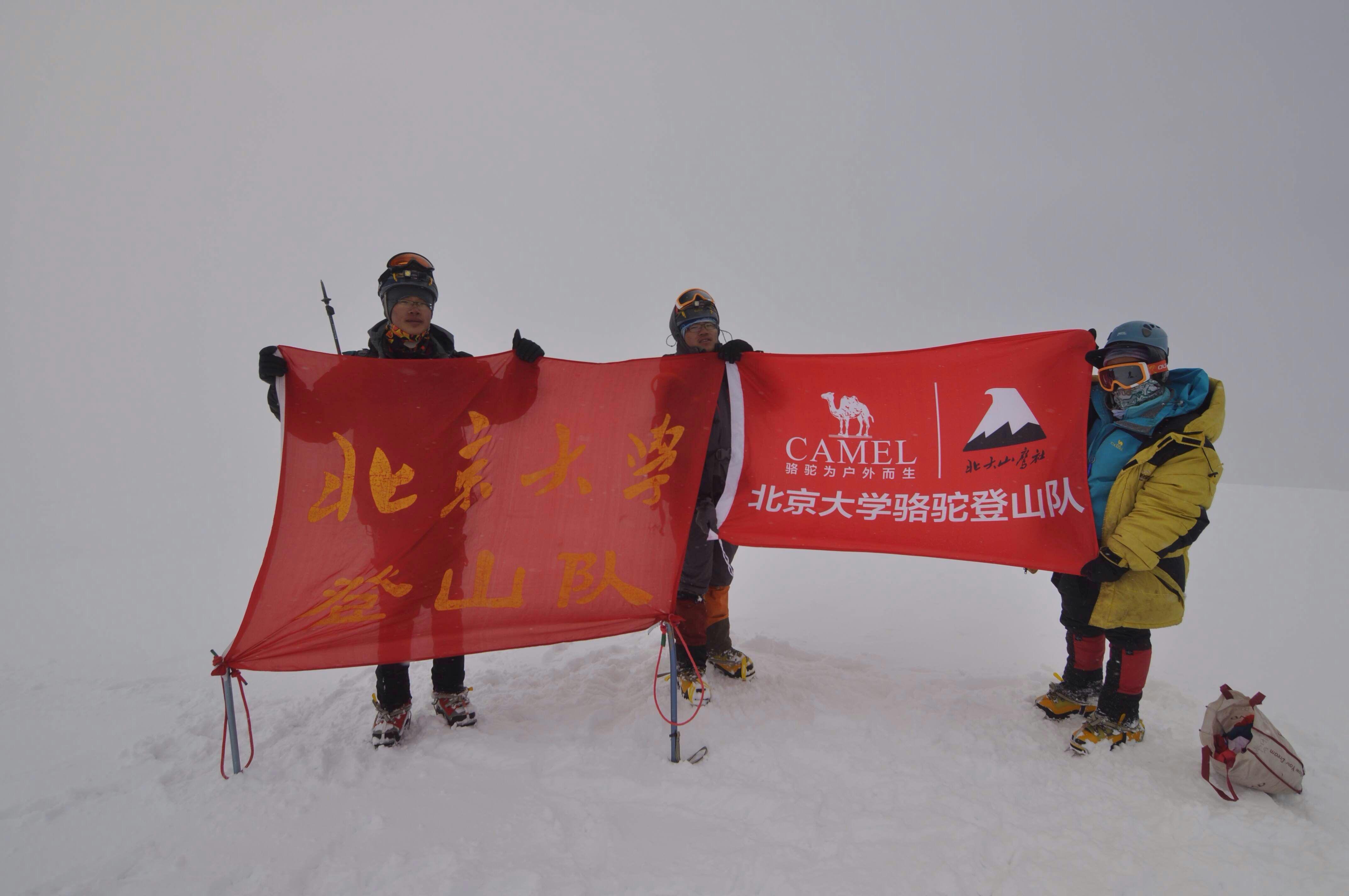 Note: On August 7, overall equipment manager Qiao Ximing led two new camp-guarding team members to successfully reach the summit.
The Path to the Summit
This climb was an arduous journey—facing the highest level of difficulty encountered by the Mountain Eagle Society since Bogda Peak in 2006. The process was full of twists and turns, constantly capturing the hearts of many. On the morning of August 5, amidst anticipation and concern, school contacts received news of success from the front line. A single WeChat message quickly spread across the country: the first group of scouts, led by climbing captain Zhou Zechen and Qinghai Mountaineering Association coach Bin Bin, completed an alpine-style rapid ascent over two days, reaching the 6,282-meter main peak of Anyemaqen, Majianggangri, at 08:10 on August 5, 2015. This ended nearly 20 years without a successful summit of the mountain.
On the same day, at the temporary assault camp near the end of the route rope, climbing team captain Pi Yudan and overall equipment manager Qiao Ximing extended the route up to Camp C2. Early the next morning at 04:50, team leader Pi Yudan, logistics leader Zhang Zijin, and coach Long Zhou led Groups A and B, totaling eight members, in an assault on the summit. They reached the top successfully at 11:21 and 12:13 respectively. This was the fourth summit attempt for female team leader Pi Yudan; she had narrowly missed the summit in her previous three attempts, making this victory especially hard-won.
On August 6, Groups A and B successfully summited under adverse weather conditions.
Unity and teamwork have always been the core values passed down through the Mountain Eagle Society—they never abandon any member easily. Upon hearing the news of Groups A and B’s successful summits, veteran scout Zhang Zhongyi—who had just returned from the summit to base camp—immediately led the remaining two new members of the camp-guarding team toward Camp C2. On August 7, guided by veteran Qiao Ximing, the two newcomers successfully reached the summit.
Note: Descending from the summit
The Past and Present of Anyemaqen
As recorded in the "Tribute of Yu," “The Yellow River flows from the Mountains of Ji to Longmen.” The Mountains of Ji refer to Anyemaqen Snow Mountain at the source of the Yellow River. The mountain range runs from northwest to southeast and features three independent peaks over 6,000 meters, with the 6,282-meter main peak, Majianggangri, located at the northernmost end. For a long time, due to miscalculations of its height, Anyemaqen was believed to be the world's tallest mountain—until 1960 when the Beijing Institute of Geology Mountaineering Team summited Anyemaqen II Peak, gradually changing public perception.
After the reform and opening-up in 1981, three foreign teams arrived at Anyemaqen almost simultaneously to attempt the main peak, Majianggangri. Ultimately, the Japanese team made the first ascent via the northeast ridge (some sources say the southeast ridge), followed by three Americans and a joint German-Australian team also summiting from the northeast ridge. In the mid-1980s, there were no recorded climbs of the mountain until 1994, when the Beijing Youth Mountaineering Team experienced China’s first civilian mountaineering tragedy during their descent from Anyemaqen II Peak.
In 1996, predecessors from the Peking University Mountaineering Team successfully summited Majianggangri via the Halong No. 2 Glacier. Since then, for 19 years, there were no more recorded summits of the main peak. Attempts by two teams in 2004 and 2005 failed. In 2010, a student mountaineering team from China University of Geosciences Beijing Campus successfully summited Anyemaqen II Peak. Anyemaqen features fragmented rock formations, rugged glaciers, and steep ridges, but most challenging of all is the severe lack of reference materials.
After multiple evaluations and discussions, the Mountain Eagle Society selected the challenging and high-difficulty Anyemaqen as their target. The climbing team consisted of nine veteran members and eight new members, along with a physical education instructor. Among the veterans were three highly experienced alumni and five second-year students who had just summited the headwaters of the Yangtze River at Geladandong and Xuebao Ding. Pi Yudan, then serving as the female team president, had already undertaken three climbing expeditions before becoming the climbing team leader. After nearly half a year of preparation, the team departed from Beijing on July 14 and headed to Guoluo, Qinghai.
Note: Photo of the departure from the south gate of Peking University
A Twisting and Turning Climbing Journey
On July 20, 2014, the mountaineering team established the base camp beneath the east ridge of the main peak. After two days of reconnaissance, they decided to abandon the original plan to climb via the scree slope at the end of the east ridge and instead proceed along the Halong No. 2 Glacier. Camp C1 was set up at an altitude of 5,200 meters. The veterans split into two groups to scout possible routes up to the ridge and ultimately decided to ascend directly along a snow chute on the southern side toward the east ridge col. The route was quite challenging. Teams A and B alternated in ascending and route-setting. On the 27th, news came that Team A’s reconnaissance attempt had failed. On the 28th, after discussions between veterans and coaches, the team decided the risks of falling rocks and avalanches along the route were too great to continue, so they chose to descend. The news of the setback reached Beijing, leaving many deeply disappointed. A week of effort ended just dozens of meters below the ridge.
Note: The failed attempt to summit via the Majianggangri East Ridge
On July 30, all members dismantled the route and returned to the base camp. Three graduating veteran members and the instructor left early due to work commitments, while the mountaineering team from Renmin University’s self-travel association set up camp at the same location. The two teams exchanged food to foster camaraderie.
Note: The girls took a group photo with the veteran members preparing to leave the mountain.
The Path to the Summit
At the beginning of August, the remaining 14 current students decided to continue trying another route—the northeast ridge—through a snow training model. The team split into two groups, with four new members in each group assigned to set the route on the ridge. Veteran members took turns leading in rope teams to provide guidance. After the relatively easier first 15 rope lengths were completed by the new members, the veterans tackled the next eight rope lengths in the crevasse area, opening the route up to the top of the 5,800-meter snow slope.
Note: New members practicing route-setting
On August 2, veteran members Zhang Zhongyi and Xia Fan from Group A ascended to 5,270 meters to join climbing captain Zhou Zechen and coach Bin Bin, forming a four-person scouting group. They carried tents and high-altitude provisions for an alpine-style rapid ascent, with members of Group A providing route support behind them.
Note: Coach Long Zhou and female logistics leader Zhang Zijin transporting supplies up the mountain
On August 3, the scouting group camped at 5,900 meters. Group A set up Camp C1 near the top of the snow slope at 5,740 meters. On August 4, the scouting group traversed a 150-meter ice wall along the northeast ridge, then descended 200 meters to the glacier on the western side of the ridge and switched to a northern slope route to continue climbing, camping at a temporary site that night. At 05:40 on August 5, the scouting group set out for the summit. Two and a half hours later, they stood atop Majianggangri, becoming the first visitors to the peak in nearly 20 years since the predecessors from the Mountain Eagle Society summited in 1996.
Note: Traversing the northeast ridge and descending to the northern glacier on the right
Dream of the Snow Mountain
The 2014 Camel Mountaineering Team from Peking University will return to Beijing and resume classes on August 14. This expedition to the main peak of Amne Machin lasted 30 days, filled with countless hardships and challenges. Despite the early departure of senior members, 14 current students relied on their own abilities, confidence, and courage. Upholding the Mountaineering Club’s training-oriented mountaineering model focused on snow mountains, they independently tackled route preparation and climbing throughout the journey—proceeding steadily and methodically. Ultimately, through sweat and determination, they earned the favor of the sacred mountain and achieved the perfect outcome of a safe summit for the entire team.
Note: Approximate illustration of the climbing route
Yellow: Planned climbing route
Red: Actual climbing route via the East Ridge
Blue: Route via the Northeast Ridge transitioning to the North Slope for the summit