Legend has it that the Paijiao people once had their own written language, which was inscribed on cowhide. Due to frequent migrations, the person carrying the scriptures rested by a river one day and accidentally noticed that the script resembled the curved marks left by fish lips on stones. He thought, if even fish could understand the Paijiao script, then wherever there is water and fish, there would also be their script and knowledge of astronomy and geography — humans can’t live without water. There was no need to carry such a heavy load, so in his overconfidence, he burned the scriptures. That’s why the Paijiao people now have their own language but no written script.
So, if the Paijiao people have no written language, how did they express, convey, and communicate in their living environment across generations? The answer lies in the green “secret code.” This “secret code” uses a combination of various natural plants and objects to visually convey meaning, achieving intended communication and objectives. This is the green “secret code” of the Xishuangbanna rainforest, where objects symbolize messages.

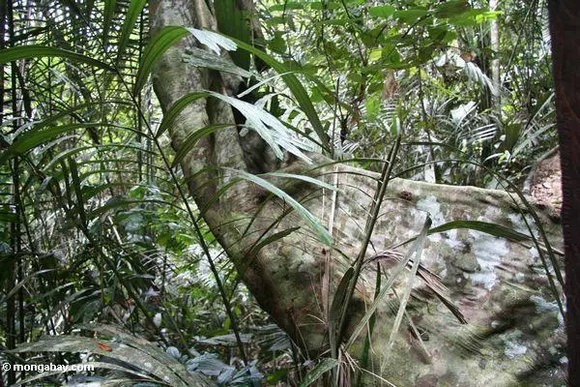
Symbolizes: “The Tree of Love and Luck.”
This tree has a twisted trunk, a long flowering period, and an especially fragrant aroma. There is a magical legend about this tree: a young man once rested under it and encountered a fairy, and the two later became a loving couple.