Waterproof and moisture permeable, waterproof and vapor permeable, windproof and breathable... Dear you, are you confused by these terms? Why does a hardshell jacket, which supposedly has excellent moisture permeability, often feel stuffy during actual wear? If moisture permeability equals vapor permeability, doesn’t that mean it’s also breathable? If air can’t even get through, how can we talk about breathability?
The moisture permeability of a fabric refers to its ability to allow moisture (vapor) to pass through. Also called water vapor permeability, it reflects the fabric's ability to help maintain the body’s thermal balance when sweating and dissipating heat. Simply put, it means rainwater from the outside can't get in, while sweat vapor from your body can escape through the pores in the coating or membrane.
Moisture Permeability Rate(Water-vapor transmission rate, abbreviated as WVT, with the unitg/m2/24h), refers to the rate at which water vapor passes through a sample under specific standardized laboratory conditions, where a certain humidity difference is created on either side of the sample. The water vapor moves through the sample into the drier side. By measuring the change in weight of the moisture permeation cup over time, parameters such as the water vapor transmission rate of the sample are calculated.
There are two testing methods for moisture permeability: upright cup and inverted cup.
Upright Cup Method:GB/T 12704.1-2009 "Textiles — Test method for water vapour permeability of fabrics — Part 1: Gravimetric (dish) method (absorption method)";GB/T 12704.2-2009 "Textiles — Test method for water vapour permeability of fabrics — Part 2: Gravimetric (dish) method (evaporation method) Method A".
Inverted Cup Method:GB/T 12704.2-2009 "Textiles — Test method for water vapour permeability of fabrics — Part 2: Gravimetric (dish) method (evaporation method) Method B".

The breathability of a fabric refers to its ability to allow gas molecules (mainly air) to pass through, resulting in air convection. To put it plainly, it's about whether air can physically blow through and be directly felt. This primarily affects the comfort of wearing the fabric—such as insulation, warmth, airiness, coolness—as well as its overall performance. In outdoor gear, breathability is usually combined with windproofing, i.e., windproof and breathable, to ensure that while the fabric blocks wind and retains warmth, it still allows a certain level of airflow to enhance comfort. In outdoor textile products, achieving a certain degree of breathability even when blocking winds of level 4–5 is feasible.
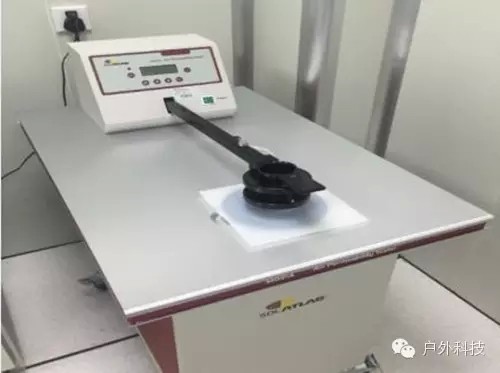
Breathability Rate R(Method Air Permeability): Refers to the ability of air to pass through the fabric. Under specified pressure difference conditions, the volume of airflow passing vertically through a given area of the sample over a set period is measured to calculate the air permeability. The airflow rate can be directly measured or calculated by determining the pressure difference across the flow aperture. This is what true breathability is all about.
Testing Standards:GB/T 5453-1997 "Textiles — Determination of the permeability of fabrics to air", with breathability measured in mm/s or m/s.