"Clear waters flow through streets lined with countless homes, and rainbows span the river over seventeen bridges"—this is the most succinct description of Anchang Ancient Town. With its diverse and charming bridges and quaint, elegant residences, Anchang Ancient Town quietly showcases the allure of a Jiangnan water town in the heart of Shaoxing. Architectural StyleThe town inherits the typical characteristics of a Jiangnan water town—situated by the water, simple yet elegant—and is a key historical preservation site in Zhejiang Province. Its specialties, Anchang cured sausages and pulled white sugar, are renowned far and wide.In addition to retaining the general traditional features of Shaoxing’s water towns, Anchang also boasts an old street stretching 1,747 meters in length. For centuries, it thrived as a hub for the trade of cotton, cloth, and rice, becoming a major market town in northern Yue. On the eve of the War of Resistance, there were still 933 shops here, making it the largest market outside the urban area. The small bridges of Anchang are particularly distinctive, featuring various styles such as arches, beams, and pavilions—each uniquely charming, simple, and elegant. The town is often praised with the saying, "Clear waters flow through streets lined with countless homes, and rainbows span the river over seventeen bridges."
Money ShopThe third-generation descendant of the Yu family. From the third-generation descendant of the Yu family, we learned that the father and son who founded and ran the money shop (the grandfather and father of the tour guide) were not just merchants but also scholars—they could both write and paint. Inside the money shop, in addition to displays ofancient coins, there are also calligraphy and painting works by the father and son. The depiction of the God of Wealth in the shop is completely different from modern representations: he holds three stacked ingots in his left hand, his right fist raised at chest level, dressed in traditional red-top blue-bottom attire, seated on a grand chair with a smile. Originally, it was placed inside a shrine facing the main entrance, beneath which the words "Uphold Faith and Integrity" were inscribed.
Stone Carving Museum:The museum displays over 200 precious stone carving artifacts, ranging from the Tang Dynasty to the modern era. These include stone lions from different periods,stone windows, stone basins, mills, tables, pedestals, and mortars, as well as 13 epitaphs from the Tang, Song, Yuan, Ming, and Qing dynasties inlaid into walls. There is also a stele from the Jiajing era of the Ming Dynasty commemorating the reconstruction of an ancient primary school in Shaoxing Prefecture, and more than ten other items, including a stele inscribed with the words "Tomb of Master Junzi Xiu and His Wife Lady Chen," calligraphed by the eminent scholar Cai Yuanpei. These stone artifacts feature unique designs, varied shapes, powerful calligraphy, and craftsmanship that is truly exceptional.
Flower Trading Fort:This is the earliest cotton industry center in Shaoxing. Local farmers engaged in spinning and weaving coarse cloth, which was known for its solid, fine, and even texture, earning it the name "Nansha Kersey." Hence, the Nansha Kersey branch exhibition displays various tools for hand-spinning and weaving, traditional cloth garments, along with twelve paintings from the "Imperial Cotton Weaving Chart" created in the 30th year of the Qianlong reign. Colorful bridal sedan chairs, opulent bridal chambers, and intricate dowry displays vividly showcase traditional Shaoxing wedding customs. The bridal room features a half-made bed with exquisitely crafted details, representing heirlooms of wealthy families.
Secretary (Legal Advisor) Museum:It is said that all secretaries (legal advisors) in China come from Shaoxing, but few know that most of them hailed from Anchang. Over 200 years, it is estimated that no fewer than ten thousand secretaries originated from this town, with numerous former residences of secretaries still scattered along the canals today. The Secretary Museum is based in the former residence of Lou Xintian, a secretary,showcasing the unique social group and political-cultural phenomenon of "Shaoxing Secretaries" during the late feudal period in Chinese history, as well as their deep roots in Anchang. Inside the museum, a set of colored clay sculptures depicts officials in a local Qing Dynasty yamen presiding over court cases—the plaintiffs and defendants kneeling before the bench,social groups, unique political and cultural phenomena, and their deep roots in Anchang. Inside the Shiyeh Hall, there is a set of polychrome clay sculptures depicting a scene from a Qing Dynasty local government office, where officials are presiding over a trial—plaintiffs and defendants kneeling before the bench,with the three squads of yamen runnersstanding by with rods. The magistrate sits upright under the inscription "The Mirror Is High," striking the gavel with an imposing aura, commanding silence with a single shout. But wait—the true "mastermind" is actually the secretary seated behind the magistrate. Without official status, the secretary could only listen from the back. Upon noticing any issues with the testimonies, they would send notes; if the magistrate acted impulsively, the secretary would promptly offer advice.
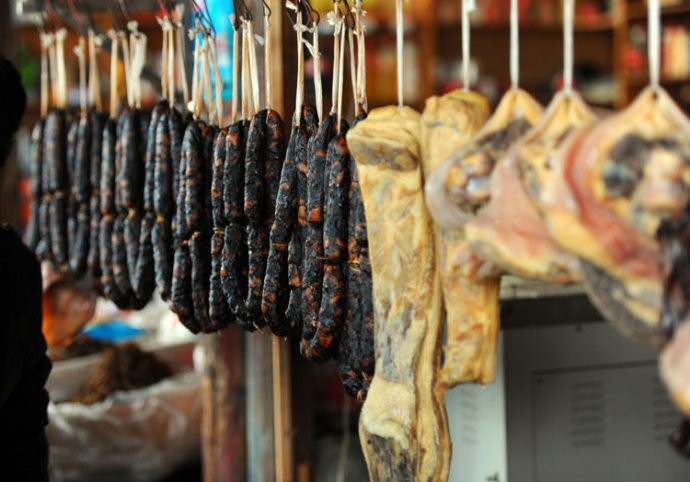
Today, Anchang Ancient Town still maintains the tradition of celebrating the Lunar New Year’s Eve month. Visiting now allows you to experience the local folk customs. Why not take a weekend trip before the festivities end?~!