Recently, the 13th edition of the "World's 500 Most Influential Brands" for 2016, compiled by World Brand Lab, was unveiled in New York. This year’s list includes 36 Chinese brands. Among them, China’s Maotai surpassed 351-year-old Saint-Gobain and 301-year-old Martell, earning the title of "Oldest Brand" with its remarkable history of 417 years. This is the world’s recognition and appreciation of Chinese liquor culture and Chinese liquor brands. However, looking into the reasons behind it, without Hailongtun, Maotai might not have such a long history today. So, what is the inseparable bond between Maotai and Hailongtun?
Geographically, Maotai Town, where the Maotai distillery is located, is very close to Hailongtun in Zunyi. However, to understand the relationship between Maotai and Hailongtun, there is an even more legendary historical story, which begins with the birth and development of Maotai liquor.
3,000 years ago, the Maotai region already had a deep-rooted drinking culture. In early 1994, pottery wine vessels—coarse pottery wide-mouthed jars—from the Shang and Zhou dynasties were excavated on the banks of the Dongmen River upstream of Maotai, serving as evidence of the brewing techniques of that time. 2,000 years ago, the Maotai river basin already had large-scale liquor production capabilities. By 700 years ago, the liquor production capacity in Maotai had reached a considerable level. 400 years ago, the Maotai liquor's “Hui Sha” (returning sand) brewing technique took shape. According to the Annals of China Guizhou Maotai Distillery Co., Ltd., “The Wu Family Genealogy from the Ming Dynasty, which records the Wu family in Maotai Village, marks the location of the village’s wine workshops—this is the most direct historical record of the wineries.” In modern times, Maotai liquor gained international fame due to the legend of “smashing the jar at the Panama–Pacific International Exposition to let the aroma out.”
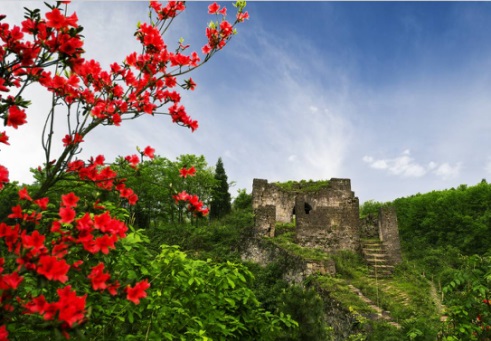
Hailongtun, as the best-preserved ancient military fortress in China, is surrounded by clustered mountains, deep canyons, and the towering Longyan Mountain. The canyon features the Baisha River, spanning an area of about 5 square kilometers, and is fortified by nine passes: Tongzhu Pass, Tiezhu Pass, Feilong Pass, Feifeng Pass, Chaotian Pass, Feihu Pass, Wan’an Pass, Xi Pass, and Yunfeng Tower. Known for its majestic presence, treacherous passes, and rich cultural relics, it is a significant natural and cultural landscape in northern Guizhou. In 2015, it was inscribed on the “World Cultural Heritage” list, becoming Guizhou’s only World Cultural Heritage site.
If you follow the “Guiyang – Zunyi – Chishui” travel route to explore the inseparable bond between Maotai and Hailongtun, you’ll pass by attractions such as the Site of the Zunyi Conference, Hailongtun Scenic Area, Tusi cultural ruins, and Maotai Town. Along the way, you can not only follow in the footsteps of the Red Army’s Long March but also experience the Tusi culture from 700 years ago.