Traveling in a hotel room / The entrance gate turns into a magic cube – a surreal scene from science fiction
Text and photos by Ding Yi, excerpted from *Traveling in a Hotel Room* published by Times Publishing
About Ding Yi
A passionate enthusiast of design, writing, music, architecture, photography, and travel, he loves backpacking and has spent years exploring the world in depth, leaving footprints in over fifty countries. Through the perspectives of various creators—musicians, writers, architects, painters, designers, poets, composers, photographers—he captures the subtle glow of hotel interiors and detects unique flavors.
Acclaimed by *Cheers* magazine as a “whimsical creative director with mind-boggling diversity,” he is a columnist for *PLAY* and has also written advertising and design articles for *Brainstorming* magazine. Currently the Executive Creative Director at Publicis Bangkok, his ten-year body of advertising work has won over two hundred international and local creative awards, with his campaigns featured in major international creative award yearbooks and design magazines.
My first encounter with Madrid was through Sanmao’s novel *The Story of a Drifter*.
Back then, the impression it left on me was profound—I saw it as a paradise amidst chaos. The warm and friendly Spanish people infused the city with a strong sense of humanity. Decades later, upon visiting the city from the novel, I could almost see the scenes Sanmao described amid Madrid’s chilly streets. I finally understood that her deep affection for the city wasn’t just born of sentimentality, but rather because the city’s creative thinking and poetic lifestyle had carved out a haven for artists.
Even before stepping through the doors of the Puerta America hotel, I was already overwhelmed like Granny Liu visiting the Grand View Garden. It’s a dreamlike place, interpreting architectural design through different cultures, using varied materials, colors, and shapes to break free from conventional hotel space concepts. Without even mentioning the construction costs, the sheer number of architects and designers involved—nineteen, all world-class masters—was unprecedented in the hotel industry.
A 360-degree canvas for creativity
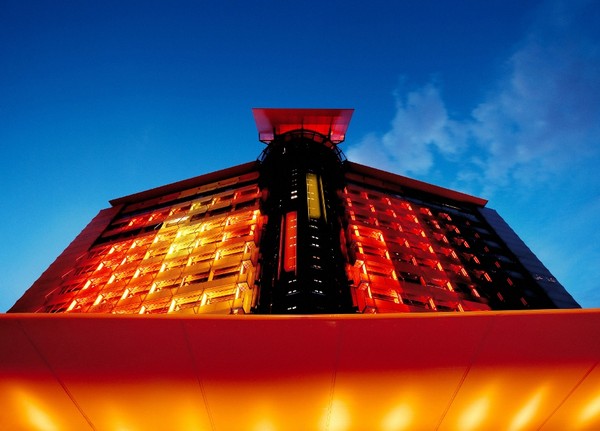
Starting with the hotel’s exterior, French architect Jean Nouvel wrapped the entire facade in a membrane of red, orange, yellow, green, blue, indigo, and violet. Inspired by the poem *Liberté* by French poet Paul Éluard, the membrane is imprinted with the verses in various languages, creating a hyper-modern literary illusion for the 21st century.
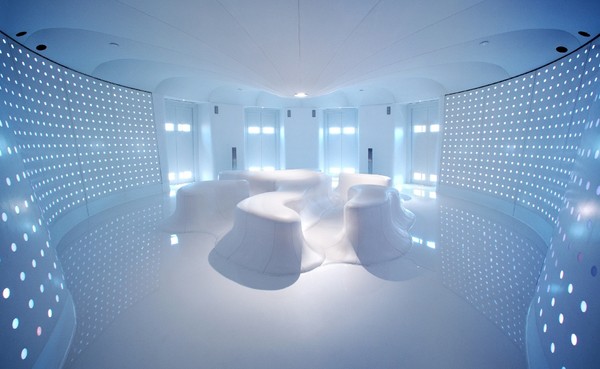
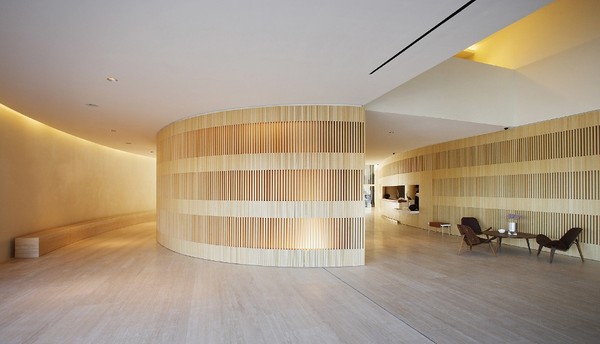
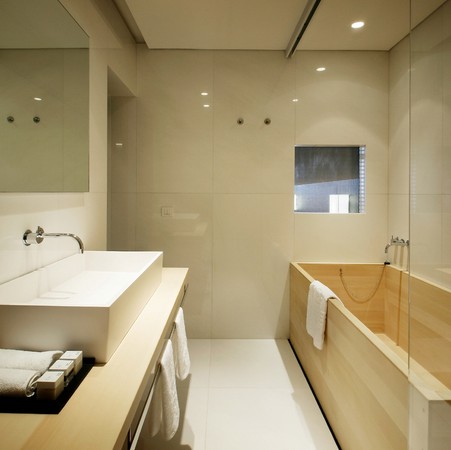
Moving inward, British minimalist architecture master John Pawson took over. True to his philosophy of simplifying and purifying living spaces, he used only light and large expanses of beige wood to craft an ethereal sense of tranquility. Natural light filters through traditional Japanese-style lattice windows, casting a uniquely soft glow. The interplay of white surfaces and curved ceilings creates an otherworldly atmosphere. The seamless integration of materials and forms results in a space that feels both weightless and immersive.
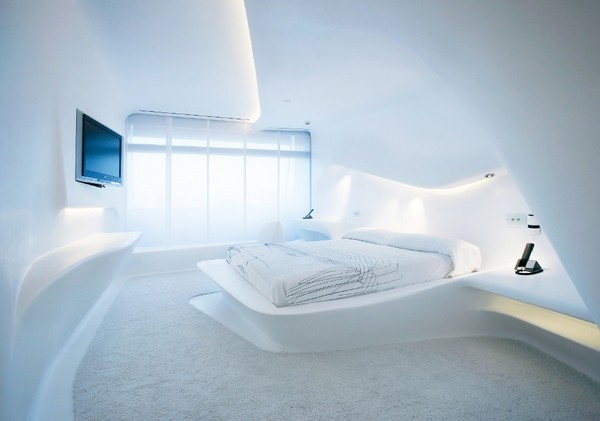
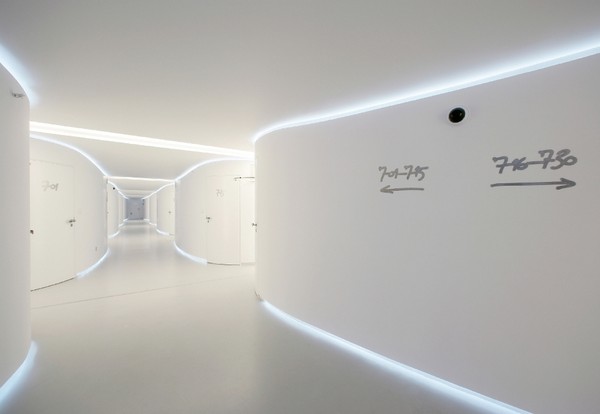
Further up, the first-floor guest rooms took the longest time and the most resources to complete, utilizing highly seamless LG Hausys artificial stone to create pure white suites reminiscent of Eskimo igloos. Such avant-garde and bold spatial design could only come from Zaha Hadid, who was born in Baghdad.
I dedicated my first night to this Middle Eastern woman. Lying on the pure white bed, I realized everything around me was a vast expanse of white—even the carpet was snow-colored. The table, chair, bed, bathtub, and sink seemed carved from a single block of stone, yet without any sharp edges. Halogen lighting immersed the entire space in a deep, silent realm. The suite felt like a masterpiece sculpted in one stroke by Rodin, or perhaps a scene from a Ni Kuang science fiction novel depicting time travel.
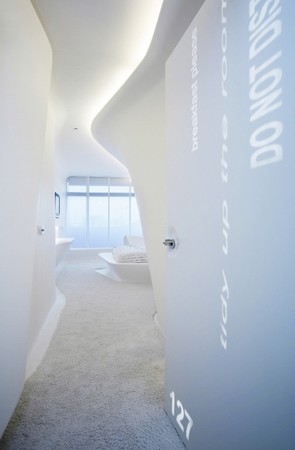
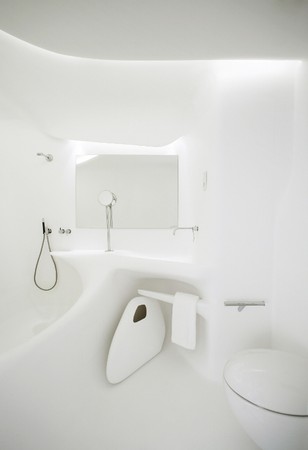
Taking a shower felt like being in the polar regions—I even worried the ice might melt from the steam. The toilet, designed by Stefano Giovannoni of Alessi, resembled a penguin hatching eggs. I couldn’t help but wonder: Is this really a room? Hadid’s design felt like transplanting the natural environment indoors, as if she were nostalgic for the landscapes of her homeland.
Back in the bedroom, I examined every inch in detail. The flowing, sinuous curves—lines like water—had always been the starting point of Hadid’s designs. Paired with innovative materials, they created visuals impossible to forget. She persistently shared her philosophy on architecture: If we have a 360-degree space to freely use, why focus on just a tiny fraction?
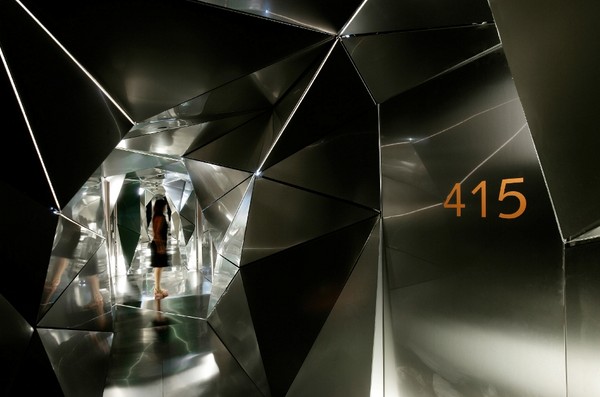
This idea resonated with two young British architects from Plasma Studio, Eva Castro and Holger Kehne. Cleverly employing fractal geometry, they designed irregular triangular stainless steel panels, with strip LED lights embedded within the folds. The entire wall appeared to be made of shattered glass, giving the sensation of floating in outer space and creating a dynamic spatial tension. This was the design concept for the fourth-floor rooms. If you’re still not convinced, keep exploring floor by floor. The fifth floor emphasizes playful fashion, with designers Victorio and Lucchino skillfully presenting a blend of classic and stylish Andalusian flair.
A room with no beginning or end
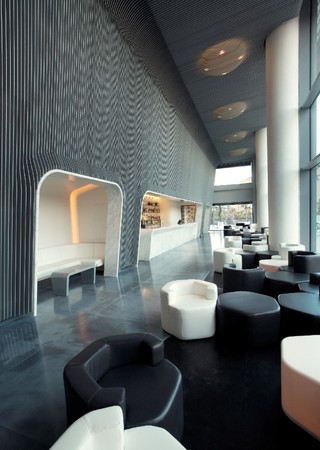
The sixth-floor bar focuses on simplicity, luxury, and comfort. Marc Newson, renowned for his chair designs, approached the space with a keen eye and unique perspective, using just black and white to create a rich sense of dimension.
The seventh floor is dominated by Israeli artist Ron Arad, whose famous quote, “Boredom is the mother of creativity,” earned him the title of “artistic enfant terrible.” In this room where it’s impossible to tell where it begins or ends, the cyclical space makes the ladder of creativity twist and turn endlessly.
Floors eight to eleven feature distinct theme suites crafted by Scottish architect Kathryn Findlay, American architect Richard Gluckman, Japanese architect Arata Isozaki, and Spanish designers J. Mariscal and F. Salas.
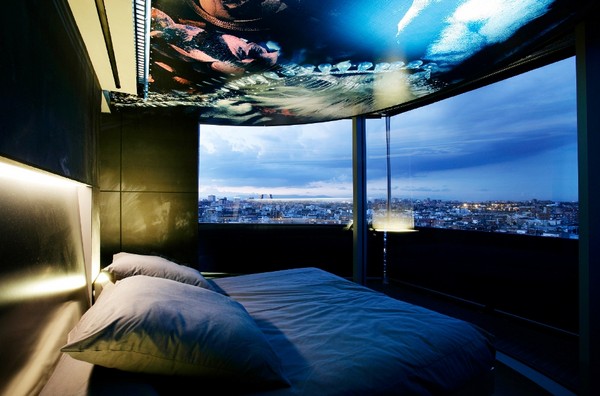
The top-floor luxury suite returns to French architect Jean Nouvel. Having witnessed his “Cucumber” towers (Torres S.) in Barcelona firsthand, I can attest to his extraordinary creative courage and unique vision. Even within confined spaces, Nouvel works wonders—several glass doors with photographic images can be freely rearranged to form private areas of varying sizes. The doors can also function as walls, transforming like a magic cube. The Madrid night skyline under the moonlight is fully visible, as if transparent wallpaper is pasted onto the floor-to-ceiling windows. Falling asleep in such an atmosphere feels like drifting into a dream.
I ultimately chose to return to earth and meet Sir Norman Foster on the second floor. The third floor, designed by David Chipperfield, felt a bit too ornate for sorting through my thoughts on my last night in Spain.
The only constant is change
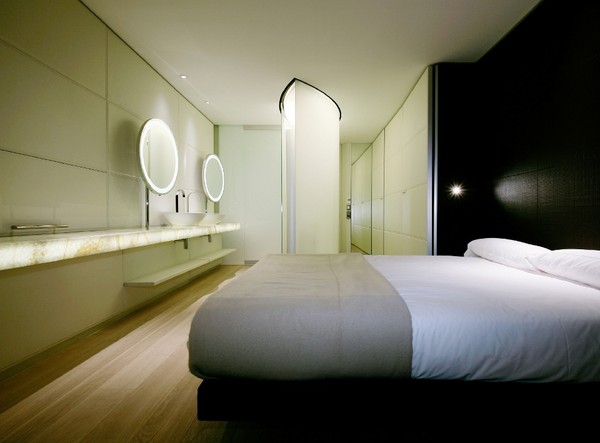
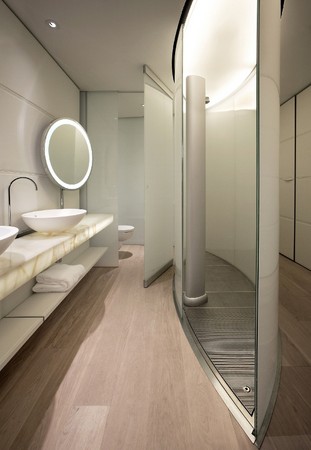
On my second night, in the second-floor room, I let the essence of architecture once again nourish my thirsty artistic soul. With simple lines and luxurious materials, the space aims to offer guests a tranquil retreat away from the city’s hustle and bustle. Foster maintained his signature use of metal and glass, paired with premium leather and white walls, creating a rich texture that balances strength and softness.
The high-tech arc-shaped glass bathroom in the center of the room resembles a door-less spaceship, becoming the visual focal point of the entire space. The onyx ivory marble sink, Molton Brown toiletries, oak flooring, leather white walls, and glass bathroom create an organically cohesive suite. Even someone as minimalistic as me couldn’t resist its allure.
Norman Foster excels at crafting serene spaces—monk-cell-like in their simplicity and elegance, spacious yet rich in refined subtlety. His work illustrates how little we truly need to live. Foster’s later works have grown increasingly profound in their understated elegance. The Swiss Re headquarters in London, Hong Kong International Airport, the Commerzbank Tower in Frankfurt, and the Imperial War Museum in Manchester are all weighty structures with simple exteriors but immense depth within.
“Architecture can elevate the soul of a city,” Foster once said. “In the creative process, never fear emptying your mind and starting anew. The only constant is change.” This has always been Foster’s guiding design principle. Plan for change, for it adds drama to the unexpected. “Coincidence” will always arise—it’s the framework for creativity and spontaneity.
All the characteristics of a place are sources of inspiration. Every possibility, every impossibility, is the soul of a place. Creativity is a momentary act of consciousness, wandering between past and future. Seventy-eight-year-old Norman Foster has achieved just that—his leather suite completely redefines traditional notions of hotel rooms.
The door to freedom is always open
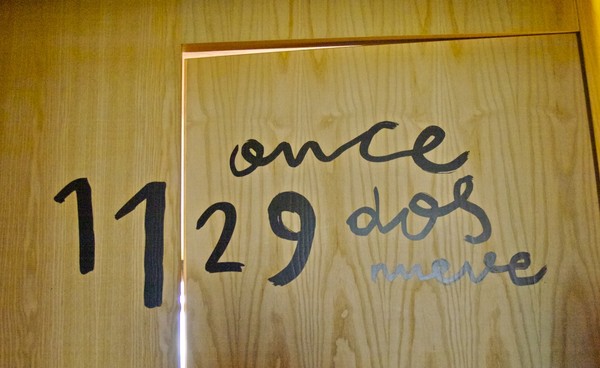
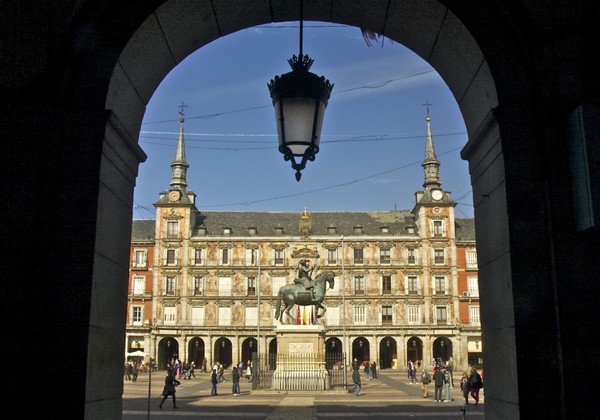
Thirty-four thousand square meters of open space, a cost of 750 million euros, nineteen globally renowned architects and designers, and six hundred and fifty contractors working tirelessly for three years to create a one-of-a-kind boutique fashion hotel—Hotel Puerta America. With twelve floors, twelve unique ways to experience architectural design, and twelve suites that make guests' architectural dreams come true. "Puerta" means "gate" in Spanish. This ever-open gate of freedom welcomes travelers from all over the world, leading to boundless creativity.
As the poem "Liberté" by Aragon goes:
“On the resolute journey, on the open road through the wilderness,
In the bustling crowd at the crossroads, I write your name.
In the guiding lamp, in the flickering candle,
In the house where we gather, I write your name.
In the split fruit, in my mirror, in the room,
In my shell-like empty bed, I write your name.
By the power of words, I am reborn.
I have known you since birth, and I gave you your name—Freedom.”
【Hotel Puerta America (The Gate of America)】
Address: Avenida de América, 41 Madrid 28002, SPAIN
Phone: +34-917-445400
Email: hotel.puertamerica@hoteles-silken.com
Website: http://www.hoteles-silken.com/hotel-puerta-america-madrid/en/
Visit Date: May 2011
Rooms: Zaha Hadid Room & Norman Foster Room
Share
This article is published by HowToTrip. Sharing and reposting are welcome — please credit the source.
Article URL: https://www.howtotrip.net/views-29334
Related Articles
- Shaoxing's "Grandpa Gourd" hangs the gourds back up: "If there are too many people, we'll interact less — just take a quick look from afar"
- Chinese authorities announce "reciprocal adjustment" to Japan visa fees — single-entry visa jumps from 2,250 to 16,750 yen!
- The "health stones" carried by a traveler were found to have radiation levels exceeding safety limits by a thousand times, potentially endangering fellow passengers on the same flight. Customs issues warning!
- Shenzhen Airport Issues Late-Night Notice: Unidentified Aerial Object Detected, Causing Widespread Flight Delays!
- “They only said it cost money after I opened the box and washed it!” 200g of grapes sold for 60 yuan on a high-speed train—12306 responds!
- Can't buy an airline ticket? Denied exit? Blocked from boarding? A large number of Chinese tourists have mysteriously become "discredited individuals"
- Adverse weather and economic fluctuations impact Colombia's coffee market
- Beach bathing area responds to 2 yuan/30 seconds fee for freshwater foot rinsing: Clearly priced!
- Taking off with an improperly closed cabin door? Wing malfunction? Multiple flights made emergency returns mid-journey!
- Experience the gifts of nature! A countdown of the world’s ten most stunning coastlines