China’s oldest architectural complex: Macau’s UNESCO World Heritage sites feel like a journey through time
Reporter Chen Ziying / Comprehensive report
When traveling to Macau, besides the world’s top gambling destination, the ancient architectural complex recognized as a UNESCO World Heritage site is absolutely not to be missed. Walking through the streets of the old city feels like stepping back in time, imagining the bustling trade and travel of those who came before, and feeling the real traces carved by history.
Macau is located along the southern coast of China, facing the South China Sea and backed by the Pearl River Delta. The entire region includes the Macau Peninsula as well as the two outlying islands of Taipa and Coloane. The whole of Macau is mostly hilly, with very little flat land. The Historic Centre of Macau is situated on the Macau Peninsula, and the vast majority lies within a narrow strip in the central to southern part of the peninsula.
The Historic Centre of Macau (Macau’s historic architectural complex) was inscribed on the UNESCO World Heritage List in 2005, becoming China’s 31st World Heritage site. The complex, comprising A-Ma Temple, the Old Protestant Cemetery, the Leal Senado Building, the Holy House of Mercy, the Sir Robert Ho Tung Library, the Dom Pedro V Theatre, the Ruins of St. Paul’s, the Na Tcha Temple, the Section of the Old City Walls, Mount Fortress, Guia Fortress (including the Chapel of Our Lady of Penha and the Guia Lighthouse), is the oldest, largest, most well-preserved, and most concentrated complex of Western-style architectural heritage in China. It also represents the most distinctive coexistence of Eastern and Western architecture. It stands as the most important testament to the history of Catholic and Christian missionary work in China, and an outstanding example of over 400 years of cultural exchange and multicultural coexistence between East and West. Most importantly, these historic buildings in Macau still serve their original functions today, becoming part of the daily lives of local residents. At the same time, they are also symbols of Macau, attracting tourists from around the world with their unique charm.
The Macau historic architectural complex was first established over 400 years ago and comes in diverse forms, including traditional Chinese temples and mansions, as well as Western-style churches, buildings, theatres, and fortresses. They reflect the continuity and transformation of Chinese folk beliefs in unique historical contexts, as well as the integration and evolution of Western culture—represented by the Portuguese—within China. These are the oldest and most intact examples of Western religious architecture and military facilities in China. They bear witness to the collision and dialogue between Western and Chinese cultures, demonstrating the enduring vitality, openness, and inclusiveness of traditional Chinese culture, as well as the possibility of peaceful coexistence between two distinct cultures. Most importantly, these historic Macau structures continue to function as they originally did and have become part of the daily life of Macau citizens. At the same time, they are symbols of Macau, drawing visitors from around the globe with their unique elegance.
A-Ma Temple
A-Ma Temple is an ancient building rich in Chinese national character. Its “A-Ma Pavilion” (also known as “Shan Shan Yi Dian”), built in 1605 (the 33rd year of the Ming Dynasty’s Wanli reign), is the oldest historical structure in Macau. Over the dynasties, many renowned scholars, painters, and poets have left inscriptions or poems after visiting A-Ma Temple, which are engraved on the stone cliffs in the hills—a valuable resource for studying Macau’s history and culture.
A-Ma Temple consists of a series of shrines, including the A-Ma Pavilion, the Zhengjue Chanlin, the Hongren Hall, and the Guanyin Pavilion, built in different periods. Among them, the Hongren Hall is said to have been built in 1488 (the first year of the Ming Dynasty’s Hongzhi reign), but the entire A-Ma Temple only took shape in 1828 (the eighth year of the Qing Dynasty’s Daoguang reign). Although the temple is primarily dedicated to the Goddess of the Sea (Mazu), it also houses altars to Guanyin, the Earth God, and Amitabha Buddha, fully reflecting the unique coexistence of folk temples and Buddhist monasteries in Macau.

▲ As Macau’s oldest temple, A-Ma Temple attracts worshippers and tourists from all over every year. (Photo provided by the Macao Government Tourism Office)
Leal Senado Building
The Leal Senado Building, also known as Quartel dos Mouros (Moorish Barracks), is a building with Indian architectural style. Constructed in 1874 (the 13th year of the Qing Dynasty’s Tongzhi reign) and put into use in August of that year, it initially served as barracks for the Indian-guarded police unit organized by the Macau police authority—the term “Mouros” being a colloquial name for Indians. This building now serves as the office of the Macau Maritime Administration.
Mandarin’s House
The Mandarin’s House represents a wealthy merchant’s residence in the traditional courtyard style from the late Qing Dynasty, built around 1881. It was the ancestral home constructed by Zheng Guanying with the help of his father. It was here that Zheng wrote his representative work “Words of Warning in a Prosperous Age” in 1894. This book, themed on national prosperity and salvation, had a profound influence on the Reform Movement, Sun Yat-sen, Mao Zedong, and others. The house mainly consists of two parallel siheyuan (courtyard) buildings, along with servant quarters and gatehouse structures connected via inner courtyards. Though primarily built in traditional Chinese style, the architecture features numerous elements of East-West fusion.
St. Joseph’s Seminary and Church
St. Joseph’s Seminary was founded around 1728 (the sixth year of the Qing Dynasty’s Yongzheng reign) and has trained hundreds of Catholic clergy over the past two centuries, making significant contributions to missionary work in Macau and even mainland China. Adjacent to the seminary is the Church of St. Joseph, built in 1746 (the 11th year of the Qianlong reign) and completed in 1758 (the 23rd year of the Qianlong reign). It is second in size only to the Church of St. Paul’s (the predecessor of the current Ruins of St. Paul’s), and thus is referred to locally as “São Paulo’s Little Brother.”
Dom Pedro V Theatre
Commonly known as the Monte Theatre, the Dom Pedro V Theatre is built in the neoclassical Greek Revival style. The circular auditorium is framed by a foyer and stage at the front and rear, with corridors on both sides offering rest areas and staircases leading up to the second-floor crescent-shaped balcony. Funded by Macau’s Portuguese community in 1860 (the tenth year of the Xianfeng reign), the theatre was built to commemorate Portugal’s King Pedro V. After its completion, it became the main assembly hall for Macau’s Portuguese population, hosting celebrations and gatherings. The venue has been used for plays, musical performances, and even film screenings, hence also known as the Macau Theatre or the Horse Theatre.
Leal Senado Building
The Leal Senado Building was formerly known as the “Leal Senado” or “Leal Senate,” originally built during the Ming Dynasty’s Wanli era (1573–1620) as a meeting place where Chinese officials met with Portuguese leaders to handle affairs related to the Portuguese community in Macau and convey imperial decrees. Later, the Macanese authorities purchased the site of the Leal Senado and the adjacent Chinese residences, constructing a municipal hall in the Portuguese style in 1784. The remodeled municipal building boasts strong romantic tones of Southern Europe, with white walls, dark green windows, and facades divided by granite moldings—giving off a solemn and serene impression.
Holy House of Mercy
The Holy House of Mercy was founded in 1569 (the third year of the Ming Dynasty’s Longqing reign) by the first Bishop of the Macau Diocese, Melchior Carneiro, to manage charitable relief for the Portuguese community. The Holy House of Mercy Building was constructed in the mid-18th century. Its original facade was very simple, but in the late 19th century, an arcaded section was added in the neoclassical style. Except for the granite plinth, the entire building is painted white, so despite its ornate decorative lines, it still gives off a quiet and elegant vibe.

▲ The Holy House of Mercy in Macau (Photo by reporter Chen Shichang)
Ruins of St. Paul’s
The Ruins of St. Paul’s are the surviving façade of the Church of Mater Dei, which was part of St. Paul’s College. Founded by Jesuit missionaries, St. Paul’s College was elevated to university status in 1594, becoming the first Western-style university in the Far East. The Church of Mater Dei was built starting in 1602 and completed between 1637 and 1640. In 1835, a fire destroyed St. Paul’s College and its affiliated church, leaving only the grand façade, much of the foundation, and the stone staircase in front. Since then, this site has become the world-famous Ruins of St. Paul’s.
The Ruins of St. Paul’s are built from granite, with the entire wall designed in the Baroque style. However, some designs and carvings exhibit distinct Eastern influences, such as Chinese characters like “The Virgin Treads the Dragon’s Head” and “Those Who Remember the Dead Are Without Sin,” as well as patterns like the chrysanthemum circle symbolizing traditional Japanese culture. These elements make this East-meets-West stone wall unique among Catholic churches worldwide.
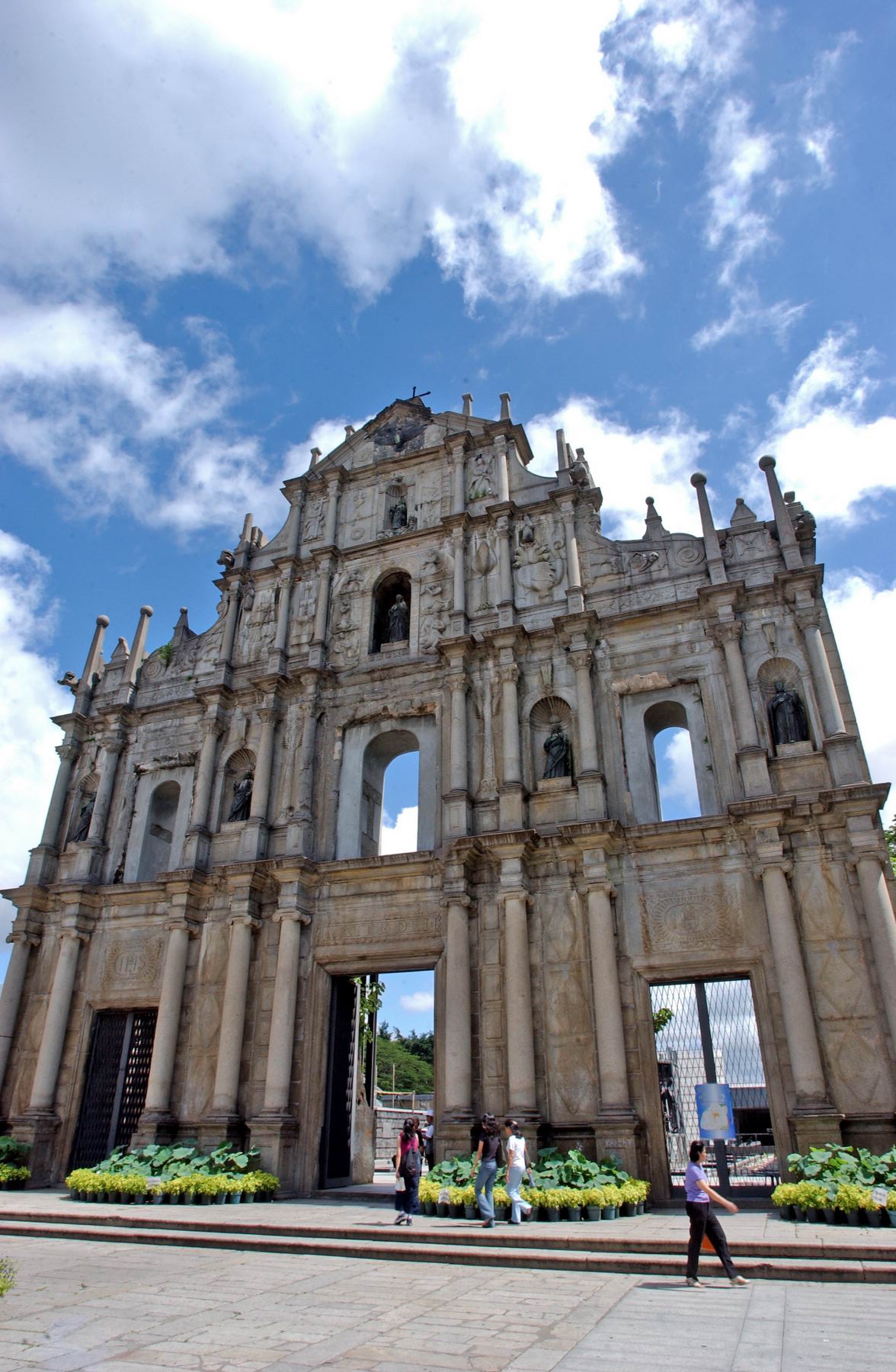
▲ The façade of the Ruins of St. Paul’s is Baroque yet infused with Eastern elements, making it an iconic landmark of Macau. (Photo provided by the Macao Government Tourism Office)
Na Tcha Temple of the Ruins of St. Paul’s
Located to the right rear of the Ruins of St. Paul’s, the Na Tcha Temple was established in 1888 and rebuilt in 1901. It is dedicated to the deity Nezha. Nezha is a mythological figure who has been worshipped by the local people of Macau since the late 17th century and is a highly localized folk belief in the region. Compared to surrounding structures, the Na Tcha Temple resembles a small architectural gem. Rather than competing with the old city walls or the Ruins of St. Paul’s in terms of massiveness and grandeur, it showcases its light and unique form through simple decorative materials and a play of solid and void contrasts.
Old City Wall Ruins
The old city wall is located to the left of the ruins of St. Paul’s Church, near the A-Ma Temple. It is a rammed earth structure built primarily with layers of silt, fine gravel, straw, and mixed oyster shell powder compacted together. Historically, the Portuguese authorities in Macao constructed walls multiple times, with the earliest dating back to before 1569. The 1632 map of Macao shows that walls were built around the entire city except for the western Inner Harbour, covering the northern, eastern, and southern parts. The existing old city wall ruins are part of those historical constructions.
Fortaleza do Monte (Mount Fortress)
Built in 1617 and completed in 1626, Fortaleza do Monte was the core of Macao’s defense system at the time. It formed an extensive artillery defense network covering both the eastern and western coasts, spanning approximately 10,000 square meters in an irregular quadrilateral shape. The fort remained a military restricted area and served as the residence of the Captain of the Fortress and the Governor of Macao from 1623 to 1740. It was opened to the public as a tourist attraction in 1966 after the meteorological observatory moved in, having been converted from the original barracks site in 1965.
Guia Fortress (including Chapel of Our Lady of Snows and Guia Lighthouse)
Guia Fortress is situated atop Guia Hill, the highest peak on the Macao Peninsula, offering a panoramic view of the entire area. Completed in 1638 (the 11th year of the Chongzhen Emperor in the Ming Dynasty), it has an irregular polygonal shape. The fortress was once a restricted military zone until 1976 when the Portuguese troops withdrew from Macao, after which it was opened to tourists. The Chapel of Our Lady of Snows inside the fortress, with a history of about 300 years, features biblical murals that incorporate Chinese painting techniques, representing a fusion of Chinese and Western culture and art. The Guia Lighthouse, built in 1864 (the 3rd year of the Tongzhi Emperor in the Qing Dynasty) and completed the following year, is the oldest lighthouse on the coast of China. Its ground coordinates also serve as Macao’s geographical positioning on world maps.

▲ The Guia Lighthouse and Chapel of Our Lady of Snows atop Macao Peninsula’s highest point offer sweeping views of the area. (Photo provided by the Macao Government Tourism Office)
[Macao Travel Information]
● Population: Approximately 590,000
● Climate: Marine subtropical monsoon climate; the most stable weather occurs from October to December each year
● Visa: All visitors to Macao must hold a visa or entry permit. Holders of Republic of China (Taiwan) passports may stay in Macao for up to 30 days without a visa. Those from countries not exempt from visas can apply for a visa on arrival at Macao Airport.
● Time Zone: No time difference with Taiwan
● Exchange Rate: Approximately 1 New Taiwan Dollar = 3.7422 Macanese Patacas
(Content not processable due to unrecognized characters.)
Share
This article is published by HowToTrip. Sharing and reposting are welcome — please credit the source.
Article URL: https://www.howtotrip.net/views-27033
Related Articles
- Shaoxing's "Grandpa Gourd" hangs the gourds back up: "If there are too many people, we'll interact less — just take a quick look from afar"
- Chinese authorities announce "reciprocal adjustment" to Japan visa fees — single-entry visa jumps from 2,250 to 16,750 yen!
- The "health stones" carried by a traveler were found to have radiation levels exceeding safety limits by a thousand times, potentially endangering fellow passengers on the same flight. Customs issues warning!
- Shenzhen Airport Issues Late-Night Notice: Unidentified Aerial Object Detected, Causing Widespread Flight Delays!
- “They only said it cost money after I opened the box and washed it!” 200g of grapes sold for 60 yuan on a high-speed train—12306 responds!
- Can't buy an airline ticket? Denied exit? Blocked from boarding? A large number of Chinese tourists have mysteriously become "discredited individuals"
- Adverse weather and economic fluctuations impact Colombia's coffee market
- Beach bathing area responds to 2 yuan/30 seconds fee for freshwater foot rinsing: Clearly priced!
- Taking off with an improperly closed cabin door? Wing malfunction? Multiple flights made emergency returns mid-journey!
- Experience the gifts of nature! A countdown of the world’s ten most stunning coastlines