A subterranean ancient palace in Changle, Mainland China, lay buried for a century—yet escaped the ravages of the Cultural Revolution.
▲ The Xianying Palace in Fuzhou, Mainland China, buried under sand for a century.
Reported and photographed by Huang Shiyuan / Fujian
In 1992, the State Council of Mainland China approved the construction of Fuzhou Changle International Airport. As part of the relocation process, residents rebuilding their homes around Xianqi Village stumbled upon a wall atop a sand dune. Within half a month, clay statues of deities in various sizes were excavated successively. Experts identified them as religious figures once venerated at the 800-year-old "Xianying Palace." The statues had been buried under sand for over a century, likely due to a catastrophic natural disaster such as a storm or tsunami—but were thereby spared from the Cultural Revolution.

▲ The above-ground palace of Xianying Palace.
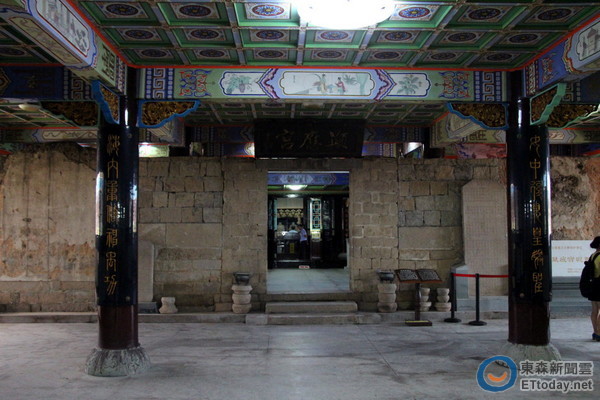
Xianying Palace is located in Changle City, Fujian Province, Mainland China, and is a nationally protected key cultural relic site. From the outside, it looks no different from ordinary temples in Taiwan, showing no signs of having been buried under sand. The reason is that the excavation of Xianying Palace unearthed not only statues but also architectural remains such as shrines, stone tablets, and earthen walls. Ancient architecture experts planned and designed the reconstruction, preserving the original ruins as an underground palace while constructing a new palace above it—the structure that visitors typically see first. The original, buried Xianying Palace is referred to as the "underground ancient palace."

Stepping into the underground ancient palace, the first thing you notice is the exquisitely painted and carved beams and ceilings, a result of the new palace being built atop the original site. Yet among them stands an old stone wall, preserved in its original state, with the plaque of "Xianying Palace" hanging prominently above the central entrance. According to a stone tablet unearthed alongside, the last major renovation took place in the 21st year of the Daoguang reign during the Qing Dynasty—1841 AD. The excavated clay statues have been placed inside glass cases over their original shrines, maintaining their original positions to prevent damage.

▲ The God of Sea Patrol.

▲ The Goddess Mazu statue and accompanying female deities.
As a national key cultural relic protected site in Mainland China, the clay statues unearthed from Xianying Palace represent the most complete, largest in number, and oldest group of such artifacts ever discovered in Fujian Province. According to the palace's introduction, the collection includes over 50 statues, such as Mazu, the God of Sea Patrol, Chen Jinggu, General Ma, as well as main deities like King Ruan Gaogao and King Gouchen. Temple guides explain that although these statues were buried underground with the palace for over a century, they were thereby protected from the Cultural Revolution, making them the oldest clay deity statues ever found in Fujian.
Share
This article is published by HowToTrip. Sharing and reposting are welcome — please credit the source.
Article URL: https://www.howtotrip.net/views-26830
Related Articles
- Shaoxing's "Grandpa Gourd" hangs the gourds back up: "If there are too many people, we'll interact less — just take a quick look from afar"
- Chinese authorities announce "reciprocal adjustment" to Japan visa fees — single-entry visa jumps from 2,250 to 16,750 yen!
- The "health stones" carried by a traveler were found to have radiation levels exceeding safety limits by a thousand times, potentially endangering fellow passengers on the same flight. Customs issues warning!
- Shenzhen Airport Issues Late-Night Notice: Unidentified Aerial Object Detected, Causing Widespread Flight Delays!
- “They only said it cost money after I opened the box and washed it!” 200g of grapes sold for 60 yuan on a high-speed train—12306 responds!
- Can't buy an airline ticket? Denied exit? Blocked from boarding? A large number of Chinese tourists have mysteriously become "discredited individuals"
- Adverse weather and economic fluctuations impact Colombia's coffee market
- Beach bathing area responds to 2 yuan/30 seconds fee for freshwater foot rinsing: Clearly priced!
- Taking off with an improperly closed cabin door? Wing malfunction? Multiple flights made emergency returns mid-journey!
- Experience the gifts of nature! A countdown of the world’s ten most stunning coastlines