Savor authentic Sanuki udon noodles — Affordable Marugame Taiwan invades the market
Reported by Cai Mengxiu / Taipei
Japanese noodles have made a big splash in Taiwan, with ramen being the most common. However, in recent years, udon has been on the rise. Especially after Japan’s largest udon chain — Marugame Seimen — entered the Taiwanese market, locals have gained another new option. Its “high quality at low prices” appeal allows many consumers to still enjoy foreign cuisine even during tough economic times.
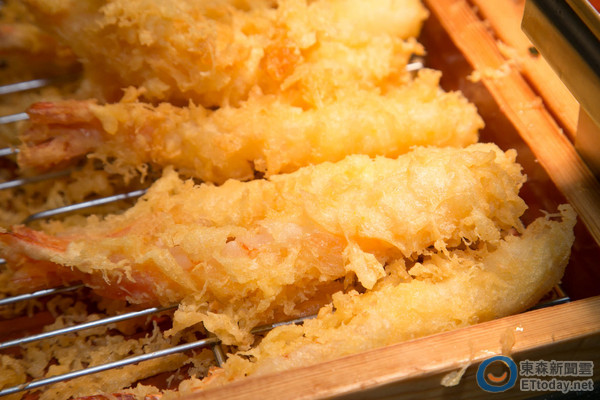
▲ Aside from udon, Marugame Seimen also offers a variety of fried items, priced between NT$25 and NT$35, making it very affordable. (Photo / Reporter Huang Kexiang)
Affiliated with Japan’s Toridoll Group, Marugame Seimen has 761 outlets in Japan, making it the country’s largest Sanuki udon chain and the second brand established under the Toridoll Group. Known for its affordability in Japan, the quality of the meals hasn’t been compromised, which is why it is especially popular among Japanese locals and tourists.
Amid eager anticipation by Taiwanese consumers, the Toridoll Group has also opened overseas branches in Taiwan. The first store grandly opened in May this year (2013) at B2 of Shin Kong Mitsukoshi’s Xinyi New Life Plaza. Even after crossing the ocean to Taiwan, Marugame Seimen remains affordable, even about 20% cheaper than in Japan, much to the envy of many netizens. Multiple coin-priced meal options have made Japanese cuisine more accessible.
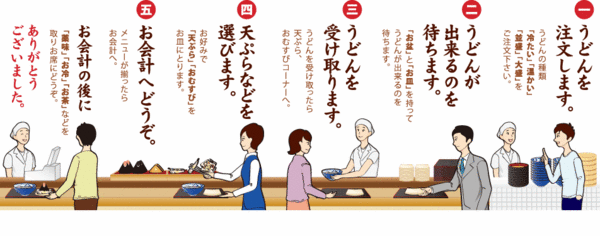
▲ Because Marugame Seimen adopts a semi-self-service model, there is a fixed procedure from ordering to picking up your meal. (Photo / Marugame Seimen)
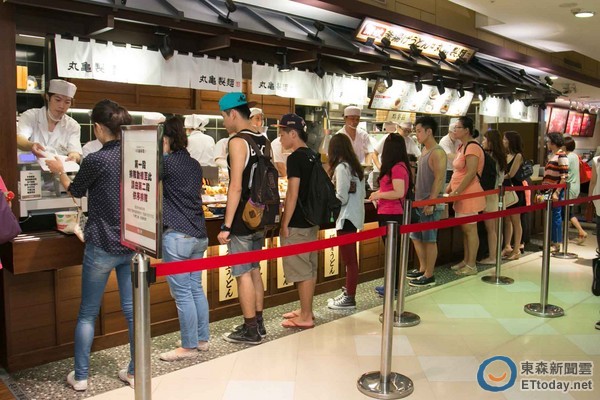
Marugame Seimen features Sanuki udon as its main highlight, using a semi-open kitchen that allows customers waiting in line to clearly see the kitchen operations, adding an interactive element between guests and the chefs. The clean kitchen environment and orderly food preparation process reflect the Japanese attention to detail. In addition, the restaurant offers meals in medium and large portions, with the cheapest starting at NT$69. Fried items range between NT$25 and NT$35. The entire process from ordering to pick-up is semi-self-service, making the flow of ordering, taking a tray, picking ingredients, paying, and collecting your meal quick and efficient.
Compared to ramen, udon has a relatively lighter taste. The noodles are made with only three ingredients: water, salt, and flour. The broth is also not as rich as that of ramen, making it suitable for those who prefer a lighter flavor. Take the store’s popular signature dish — pork bone udon — for example: it is purely simmered with pork bones until they break down into a milky white color, infusing the broth with the aroma of pork bones. Meanwhile, the clear broth of kake udon is made with ingredients such as kelp, bringing out a light and sweet umami taste.
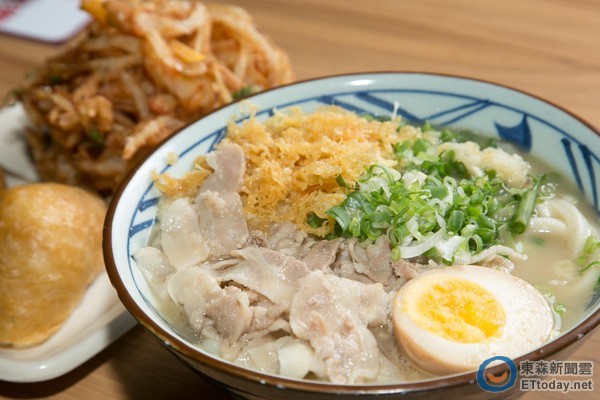
▲ Marugame Seimen’s pork bone udon is one of the store’s signature dishes. Pork belly with just the right amount of fat paired with a semi-soft golden egg is both visually and tastefully delightful. (Photo / Reporter Huang Kexiang)
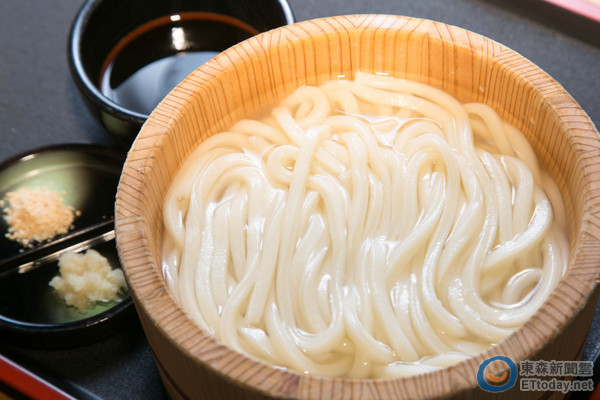
▲ Kake udon is just NT$69. The clear broth paired with udon delivers a refreshingly light taste, and it’s also a popular item. In addition, serving udon in a wooden bucket greatly enhances the dish’s texture.(Photo / Reporter Huang Kexiang)
Hiroshi Hisatake, Deputy General Manager of Toridoll Taiwan, said that although the ingredients of the noodles may seem simple, the proportion of each component must be adjusted according to the climate. For example, in Taiwan’s hot summers, noodles mature faster, so the water ratio must be reduced to shorten the maturation time. Conversely, in winter, when temperatures are low and noodles mature more slowly, the water ratio must be increased to speed up the process. Since opening, Marugame Seimen has continued to make adjustments.
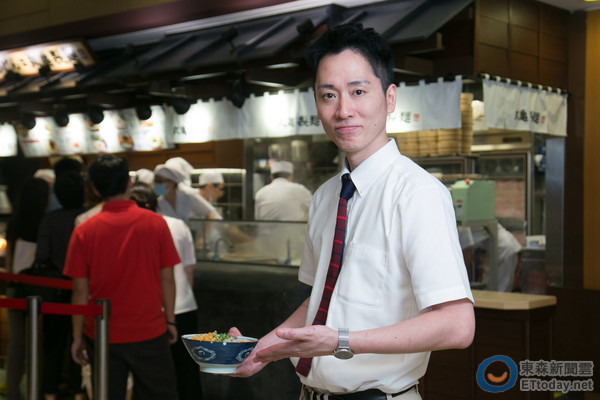
▲ The photo shows Hiroshi Hisatake, Deputy General Manager of Toridoll Taiwan. Having recently arrived in Taiwan, he is also actively learning Chinese.(Photo / Reporter Huang Kexiang)
If the broth is the soul of ramen, then the noodles are the essence of udon. To fully appreciate the chewy texture and aroma of the noodles, udon typically doesn’t add flavor enhancers like fish powder like ramen does, but instead preserves the original composition of the noodles. The broth is also lighter, aiming not to overshadow the unique characteristics of the noodles.
Taiwanese ramen shops have sprung up like mushrooms, and the northern market is nearly saturated. Now, with Marugame Seimen entering the scene, its “high quality at low prices” appeal has sparked another wave of noodle trends. Judging from the price and public acceptance, it also reflects how people are considering their wallets while enjoying good food. Whether more Japanese affordable udon businesses will enter Taiwan in the future is something consumers can look forward to.
However, for Marugame Seimen itself, it plans to open three stores by the end of this year. In addition to Shin Kong Mitsukoshi Xinyi New Life Plaza, Marugame’s second store recently opened at Shin Kong Mitsukoshi Nanxi Store, while the third branch is currently under planning.
Hiroshi Hisatake pointed out that Marugame Seimen has the potential to drive the udon market, shaping a scale second only to ramen. Within the next three years, Marugame aims to open around 30 stores, and the group also plans to introduce other dining ventures under its umbrella to Taiwan.
Share
This article is published by HowToTrip. Sharing and reposting are welcome — please credit the source.
Article URL: https://www.howtotrip.net/views-26457
Related Articles
- Shaoxing's "Grandpa Gourd" hangs the gourds back up: "If there are too many people, we'll interact less — just take a quick look from afar"
- Chinese authorities announce "reciprocal adjustment" to Japan visa fees — single-entry visa jumps from 2,250 to 16,750 yen!
- The "health stones" carried by a traveler were found to have radiation levels exceeding safety limits by a thousand times, potentially endangering fellow passengers on the same flight. Customs issues warning!
- Shenzhen Airport Issues Late-Night Notice: Unidentified Aerial Object Detected, Causing Widespread Flight Delays!
- “They only said it cost money after I opened the box and washed it!” 200g of grapes sold for 60 yuan on a high-speed train—12306 responds!
- Can't buy an airline ticket? Denied exit? Blocked from boarding? A large number of Chinese tourists have mysteriously become "discredited individuals"
- Adverse weather and economic fluctuations impact Colombia's coffee market
- Beach bathing area responds to 2 yuan/30 seconds fee for freshwater foot rinsing: Clearly priced!
- Taking off with an improperly closed cabin door? Wing malfunction? Multiple flights made emergency returns mid-journey!
- Experience the gifts of nature! A countdown of the world’s ten most stunning coastlines