Named for its long history, a Japanese hot spring inn blessed with a "spring source"
Photos and text / Japan’s 100 Famous Ryokan: The definitive guide to traditional inns by hospitality authority Kazuhiro Kashiwaya, featuring 100 selections of stunning scenery, hot springs, and gourmet lodging
Takotako — what a beautiful word: water that gushes forth ceaselessly, clear and pure, never ceasing. "Araya Takotako-an" bears a name that evokes a sense of enduring history, and just as the name suggests, it has carved out a long and storied legacy.

Kaga Onsen in Hokuriku is a well-known hot spring destination among people from the Kansai region, comprising three springs: Yamanaka, Yamashiro, and Awazu. In recent years, it has seen an increase in visitors from central Tokyo, all drawn here by the promise of high-purity hot springs and attentive service. The term "kakenagashi (gravity-fed) hot spring" gained prominence following the fake hot spring incident¹, and at Yamanaka Onsen, there is a kakenagashi hot spring inn that has safeguarded its hot spring source for eighteen generations — "Araya Takotako-an."
It is said that the monk Gyoki², on his way to the sacred Mount Hakusan, followed a purple cloud stretching across the sky and spotted a yatagarasu (a three-legged crow in Japanese mythology) healing its wing at a pond — thus discovering the hot spring source. This happened in the year 725 AD, right when the Japanese capital had just moved from Nagaoka-kyo to Kyoto. In other words, this hot spring has been flowing continuously for roughly 1,300 years.

Passing through the typical hot spring town streets, you arrive at a ryokan building that looks rather ordinary at first glance; but as soon as you step inside, the former opulence of Kaga Hyakumangoku³ still radiates with overwhelming splendor. The innkeeper greets guests in front of a yatagarasu folding screen painted by Rosanjin⁴. After receiving her warm welcome, I step into the entrance hall where every floor — even the elevator — is covered with Yuukyuu tatami mats⁵, making barefoot walking a comfortable experience. The inn’s wise decision not to provide slippers is truly commendable.
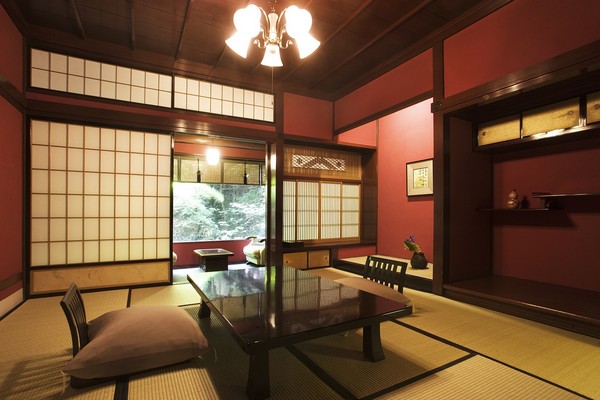
No matter how deep its history runs, an old establishment’s mission is to innovate with the times. The "Gojin-no-ma" is a guest room relocated and preserved from the Edo-period feudal domain era⁶, with walls in a rust-red (benigara) color⁷ that shine as brilliantly as ever; it presents a striking contrast to recently renovated rooms featuring open-air hot spring baths with an expansive sense of openness — a delightful juxtaposition. Rooms such as "Wakana-no-ma" and "Kutani-no-ma" offer spacious open-air baths and low-platform beds, with modern interiors that provide a relaxing stay, letting guests deeply feel that while the owner honors tradition, they have never neglected innovation.

The hot spring baths in the guest rooms already left me thoroughly satisfied, but having come to an inn with its own spring source, I simply had to visit the public bath to enjoy the ceaseless flow of water. The hot spring gushes up from just a few dozen meters below, with a daily flow of about 5.4 million to (approximately 100,000 liters) — an astounding amount. Soaking in the spacious open-air bath, with a cool breeze brushing my cheeks, filled me with an irreplaceable sense of happiness.
After the bath, I was treated to a culinary feast unique to the Kaga region. The seasoned head chef prepared dishes using seafood landed at the nearby Kaga Hashidate Fishing Port from the Sea of Japan, along with Kaga vegetables — a topic of much discussion in recent years — showcasing his masterful techniques. Kaga is also a famous sake-producing region, so the meal can be paired with local sake or, alternatively, with red wine personally selected by the owner. Both the food and wine carry the same grandeur as Kaga Hyakumangoku.
After dinner, I could head to the bar set up in the wooden annex for a nightcap. As the night grew deeper, all I could hear was the sound of the spring water bubbling up from its source, echoing throughout the inn.
Share
This article is published by HowToTrip. Sharing and reposting are welcome — please credit the source.
Article URL: https://www.howtotrip.net/views-23616
Related Articles
- Shaoxing's "Grandpa Gourd" hangs the gourds back up: "If there are too many people, we'll interact less — just take a quick look from afar"
- Chinese authorities announce "reciprocal adjustment" to Japan visa fees — single-entry visa jumps from 2,250 to 16,750 yen!
- The "health stones" carried by a traveler were found to have radiation levels exceeding safety limits by a thousand times, potentially endangering fellow passengers on the same flight. Customs issues warning!
- Shenzhen Airport Issues Late-Night Notice: Unidentified Aerial Object Detected, Causing Widespread Flight Delays!
- “They only said it cost money after I opened the box and washed it!” 200g of grapes sold for 60 yuan on a high-speed train—12306 responds!
- Can't buy an airline ticket? Denied exit? Blocked from boarding? A large number of Chinese tourists have mysteriously become "discredited individuals"
- Adverse weather and economic fluctuations impact Colombia's coffee market
- Beach bathing area responds to 2 yuan/30 seconds fee for freshwater foot rinsing: Clearly priced!
- Taking off with an improperly closed cabin door? Wing malfunction? Multiple flights made emergency returns mid-journey!
- Experience the gifts of nature! A countdown of the world’s ten most stunning coastlines