Challenge Myanmar’s buses! British-colonial-era vintage vehicles offer a unique experience
Photos & Text /Peri
A five-minute walk from Sule Pagoda brings you to Maha Bandoola Park, which could be described as Yangon’s multifunctional leisure hub for locals. Whether for strolling, picnicking, napping, dating, or kids’ activities, the options are endless.
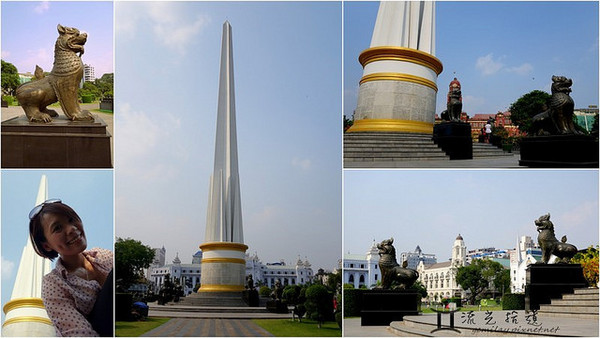
I was drawn to the towering Independence Monument (Myanmar-Yangon-Independence Monument, 48m, wiki) in the center of the park. With the blue sky as its backdrop, the snow-white structure guarded by Myanmar’s mythical beasts boldly reflected the sunlight, as if everything in the world were bright and radiant. It was striking and eye-catching, yet what it commemorated was Myanmar’s long and arduous struggle for independence, filled with blood and tears.
It reminded me of Jakarta’s National Monument (Monumen Nasional, Monas), which carries a similarly poignant history. Setting aside the tangled power struggles behind Monas, the modern history of Southeast Asia, constantly ravaged and plundered, always tugs at the heart.
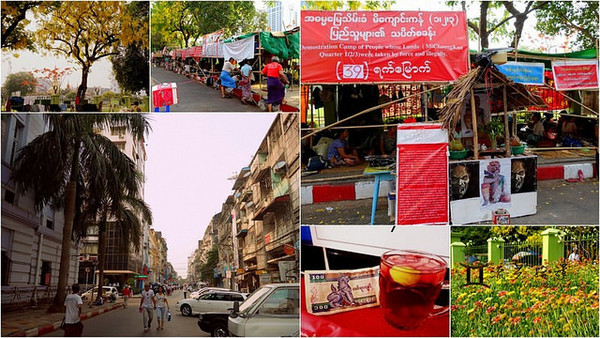
Outside the idyllic and picturesque Maha Bandoola Park, a corner had been occupied, with tents set up for a protest expressing views for reasons I didn’t understand. I stopped to watch but had nothing to say. “You are not a fish, how can you know the fish’s joy?” I’m not a protester—how could I understand their anger and pain? Perhaps it caused temporary inconvenience or obstruction, but there must have been reasons behind it. These days, I’ve learned not to jump to conclusions when dissenting voices emerge.
Sule Pagoda was planned as Yangon’s transportation hub during the British colonial period, with most city buses departing from here. Glancing at my overnight bus ticket to Bagan, and seeing I still had time, I thought I’d visit the Chaukhtatgyi Paya (Reclining Buddha Temple) and Nga Htat Gyi Pagoda (Sitting Buddha Temple) first. After contentedly finishing a 100K (~NT3) drink by the roadside, alright, let’s challenge Myanmar’s buses!
Myanmar’s buses are old, many being Japanese vehicles from the 1950s and 60s, blatantly displaying the traces of time. The age of the buses isn’t the issue—rather, the bus schedules are entirely written in Burmese, which I don’t understand!
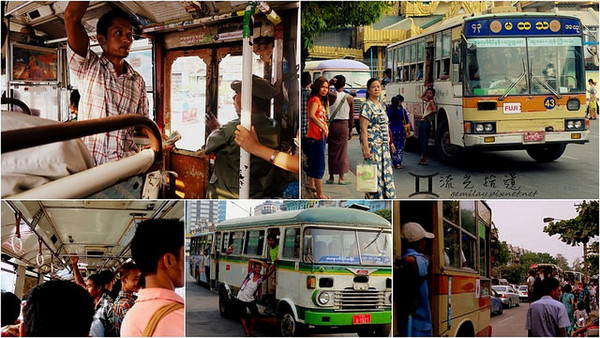
No problem, life always finds a way. I wrote the destination, Burmese numerals, and Arabic numerals in large letters on a piece of paper. Even though I was absolutely certain “this is the right bus!” I still held onto the conductor to confirm repeatedly. After being turned down by several conductors who didn’t want the hassle, I finally managed to board bus No. 43! As seen in the top right of the photo, writing the numbers together almost looks like a bow tie! The 4 and 3 are the only two Burmese numbers I recognize, haha!
Buses operate on a per-ride fare system, collected individually by the conductor. A one-way trip costs 100 or 200K (~NT3 or 6!), which is a very Myanmar-style price. In this day and age, there’s still a chance to ride a vintage vehicle left over from the British colonial era? What a life! Though old and crowded, it was really fun!
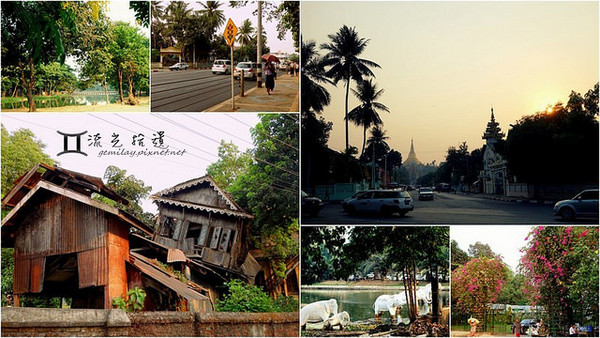
Bus No. 43 departs from Sule Pagoda and heads to the Aung Mingalar Highway Bus Terminal, passing attractions such as Kandawgyi Lake (Royal Lake) and Shwedagon Pagoda (the Great Golden Pagoda). I planned to get off at Royal Lake first, then walk to see the Sitting/Reclining Buddha Temple, and if there was time, head to Shwedagon Pagoda to watch the sunset before taking another No. 43 bus to the terminal for my overnight journey to Bagan.
But in reality? None of those destinations were reached! The Royal Lake Park didn’t meet expectations and charged an entrance fee, so I gave up on it. When trying to get to the Sitting/Reclining Buddha Temple, I got lost in the embassy district. I asked for help from an elderly lady selling things by the roadside. She pointed to herself “I, Myanmar.” and then to me “You?” Well, even though I didn’t get directions, at least another Myanmar person learned about Taiwan—that made it worth it. In the end, I relied on myself. As I walked, I passed some dilapidated-looking buildings and was surprised to see someone waving at me from the second floor?! Oh… maybe they wanted to invite me in for a look, but since I wasn’t sure I could keep my balance in a crumbling building, I politely declined… XD
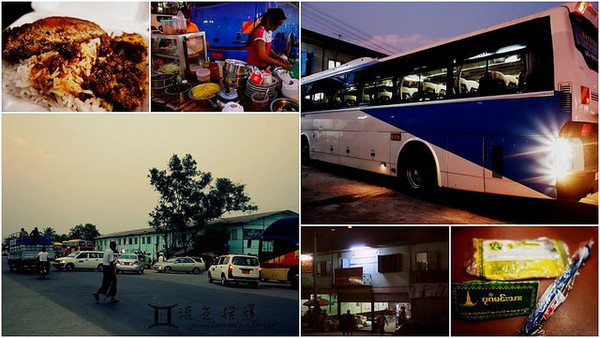
Thinking the time was about right, and hey, this little adventure was worth it XD I got back to the main road, hopped on a No. 43 bus, but in my excitement, I got off at the wrong stop. Panicking, I flagged down another No. 43! After several twists and turns, I finally arrived at the long-distance bus terminal. I breathed a sigh of relief and felt great about myself, like I’d just beaten another level in an RPG!
But it wasn’t over yet! Myanmar is vast, and long-distance buses are arguably the most important and common mode of transport between cities. As such, it’s no surprise that bus terminals are sprawling. But I never expected the layout to be so chaotic—you’d turn a corner and suddenly find yourself in a whole new world. Navigating the maze-like bus terminal, asking around, dodging the constant flow of people, vehicles, and buses, I sprinted all the way until I found the Bagan Minglar bus. When I saw the bus hadn’t left yet, I was just relieved: “As long as I made it, otherwise, I’d have to find another bus to Bagan!” I quickly bought some water and a fried fish rice box, then got on the bus only to find that eating wasn’t allowed—and every passenger had a 1.2L bottle of water. Hmm.
Such is life.
The bus started moving, and I ended up sitting next to a Myanmar girl of about ten. It was late at night, and despite the bumpy ride, sleepiness couldn’t be held back. But as she slept, she leaned against me. I wanted to shift positions but was afraid of waking her. At one point, she half-woke up, realized she was sleeping on my chest, and quickly apologized. “It’s fine.” I thought to myself, you slept however you wanted, and it’s in the past now. But she seemed to have misunderstood, nodded, and snuggled back into my arms, falling fast asleep. Alright, I guess I must be a broad-minded woman—sleep well, kid XD
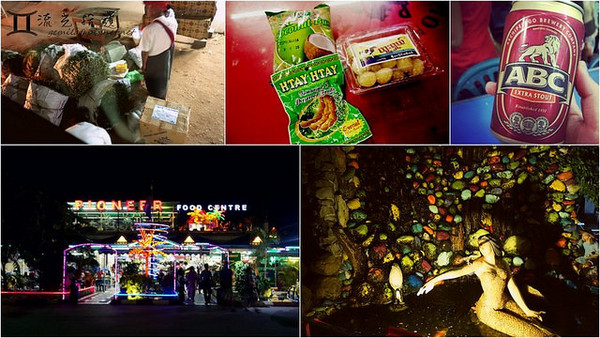
Inter-city journeys often last eight or nine hours, making rest stops along the highway a lifesaver for travelers. After soothing my tongue, stomach, bladder, and other organs, and easing my stiff limbs, I barely lingered before getting back on the bus, afraid it might leave without me.
Before long, the Myanmar girl came back too. After walking around and getting some energy, she chattered away, curious about “this foreigner.” What questions? I was more than happy to answer!
As we talked, I remembered there was a half-read travel magazine in my backpack. Showing pictures and telling stories is always simpler. “Look, this is Taiwan, my hometown. Taiwan’s ocean is beautiful, isn’t it! Oh, here’s Japan’s Buddha and temples—they’re quite different from Myanmar’s, aren’t they!” In the end, I gave her the magazine, hoping it would open a small window for her.
ⅡFleeting Moments
A female engineering student who grew up thinking she’d study Chinese.
Talks too fast, writes too slowly; opens her mouth like a comedian, picks up a pen like a pseudo-literary youth.
Loves setting off alone with a packed bag to stroll, drawing courage from the corners of the world, and encountering the starlight in travelers’ eyes.
Firmly believes that no plan is the best plan, and wonderful encounters can’t be calculated.
And then, just keeps on walking.
Peri
Share
This article is published by HowToTrip. Sharing and reposting are welcome — please credit the source.
Article URL: https://www.howtotrip.net/views-22016
Related Articles
- Shaoxing's "Grandpa Gourd" hangs the gourds back up: "If there are too many people, we'll interact less — just take a quick look from afar"
- Chinese authorities announce "reciprocal adjustment" to Japan visa fees — single-entry visa jumps from 2,250 to 16,750 yen!
- The "health stones" carried by a traveler were found to have radiation levels exceeding safety limits by a thousand times, potentially endangering fellow passengers on the same flight. Customs issues warning!
- Shenzhen Airport Issues Late-Night Notice: Unidentified Aerial Object Detected, Causing Widespread Flight Delays!
- “They only said it cost money after I opened the box and washed it!” 200g of grapes sold for 60 yuan on a high-speed train—12306 responds!
- Can't buy an airline ticket? Denied exit? Blocked from boarding? A large number of Chinese tourists have mysteriously become "discredited individuals"
- Adverse weather and economic fluctuations impact Colombia's coffee market
- Beach bathing area responds to 2 yuan/30 seconds fee for freshwater foot rinsing: Clearly priced!
- Taking off with an improperly closed cabin door? Wing malfunction? Multiple flights made emergency returns mid-journey!
- Experience the gifts of nature! A countdown of the world’s ten most stunning coastlines