The little frog no one dared to touch turns out to be an ultra-luxurious ingredient hiding deer antler velvet

▲ The famous northeastern forest frog dish is an exceptionally precious delicacy.
Text and photos by Nine-Five Evil Wife
When it comes to Chinese cuisine, many people assume that the Chinese will eat anything that flies, swims, or crawls, so while traveling in mainland China, you're bound to encounter some dishes that leave you unsure where to start.
While conducting interviews in China’s northeastern region, the local hosts warmly welcomed us—not only preparing a lavish spread of food and drinks but also serving us a dish unique to the northeast. As the waiter brought out a plate covered in jet-black, glistening items, our group of Taiwanese travelers was puzzled, until the local guide exclaimed, “This stuff is amazing!!”
The dish that earned such high praise from the locals turned out to be a plate of frogs—each about 7 to 8 centimeters long. These were actually the “Chinese forest frog,” revered as one of the “Four Mountain Delicacies” and “Upper Eight Delicacies.”
The Chinese forest frog mainly inhabits the forested areas of Changbai Mountain in China’s northeast. In traditional Chinese medicine, it is believed to have benefits such as replenishing weakness, moistening the lungs, nourishing kidneys, and supporting yin. Due to its high value, wild forest frogs have been listed as a nationally protected wild medicinal species, with strict controls on their population.
The local guide revealed that the most valuable part of the forest frog lies in the fat found between the fallopian tubes and ovaries of the female frogs.Once extracted and dried, it becomes the famous medicinal ingredient known as forest frog oil or snow frog.High-quality forest frogs can fetch up to 100–200 RMB (approximately 493–987 TWD) per frog in high-end restaurants—usually reserved as a special treat for honored guests. Additionally, it takes around 300 female forest frogs to produce just 1 kilogram of frog oil, so premium-quality frog oil can cost upwards of 1,000 USD per kilogram (approximately 30,097 TWD).
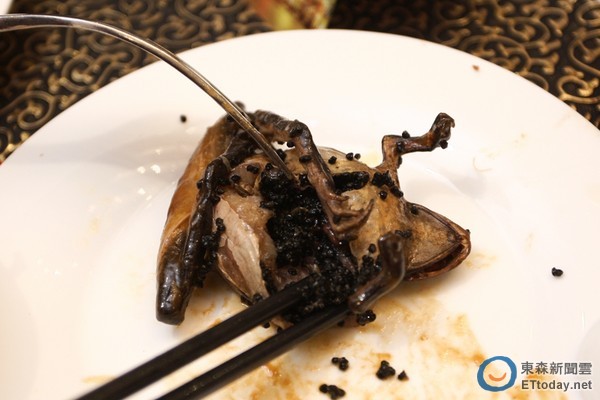
▲ Cut open the frog’s belly, and you’ll see dark frog eggs along with white fat on its underside.
Looking at the 16 or 17 forest frogs laid out on the plate, at 150 RMB each, this single dish was worth nearly 12,000 TWD—but many of the female members of our group were too scared to even lift their chopsticks.
One braver member of the group decided to cut open a frog. Out poured numerous black frog eggs, and underneath, there was a layer of translucent fat on the lower abdomen. The guide excitedly pointed out that this translucent fat was the most precious part of the frog—but still, no one dared to take a bite. I myself tried the frog legs first and found the meat tender yet firm, with a sweet flavor—no wonder it’s considered one of the “Four Mountain Delicacies.” But when it came to trying the frog fat, I chickened out just like everyone else.
Although to frog-loving gourmets, our reluctance might seem wasteful, everyone has foods they just can’t bring themselves to eat. Maybe next time food-loving travelers visit China’s northeast, they can seize the opportunity to try the region’s most famous delicacy—the Chinese forest frog.
Share
This article is published by HowToTrip. Sharing and reposting are welcome — please credit the source.
Article URL: https://www.howtotrip.net/views-21088
Related Articles
- Shaoxing's "Grandpa Gourd" hangs the gourds back up: "If there are too many people, we'll interact less — just take a quick look from afar"
- Chinese authorities announce "reciprocal adjustment" to Japan visa fees — single-entry visa jumps from 2,250 to 16,750 yen!
- The "health stones" carried by a traveler were found to have radiation levels exceeding safety limits by a thousand times, potentially endangering fellow passengers on the same flight. Customs issues warning!
- Shenzhen Airport Issues Late-Night Notice: Unidentified Aerial Object Detected, Causing Widespread Flight Delays!
- “They only said it cost money after I opened the box and washed it!” 200g of grapes sold for 60 yuan on a high-speed train—12306 responds!
- Can't buy an airline ticket? Denied exit? Blocked from boarding? A large number of Chinese tourists have mysteriously become "discredited individuals"
- Adverse weather and economic fluctuations impact Colombia's coffee market
- Beach bathing area responds to 2 yuan/30 seconds fee for freshwater foot rinsing: Clearly priced!
- Taking off with an improperly closed cabin door? Wing malfunction? Multiple flights made emergency returns mid-journey!
- Experience the gifts of nature! A countdown of the world’s ten most stunning coastlines