Unacceptable behavior persists without improvement: Ishigaki car rental company reiterates: Taiwanese tourists have a 40x higher accident rate
Reported by You [Name] / Taipei
Taiwan’s “unqualified travelers” have caused trouble again. Recently, ETtoday EBC News reported that a group of Taiwanese tourists traveling to Ishigaki Island by cruise rented vehicles locally, got into an accident, and abandoned the vehicle before leaving the scene. The Ishigaki Island car rental company then announced on its official website that it might stop renting to Taiwanese tourists. Unexpectedly, at the end of September, Taiwanese tourists were involved in two more traffic accidents, prompting the rental company to issue another statement on its official website: “The accident rate of Taiwanese tourists is more than 40 times that of Japanese customers.”
Abandoning car after accident, Ishigaki rental company announces: no more rentals to Taiwanese
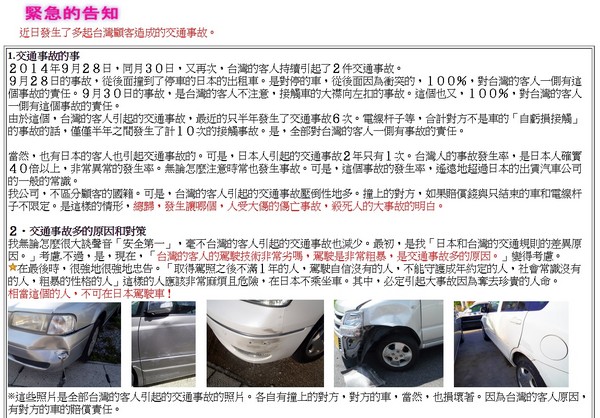
▲Ishigaki car rental company issued an urgent notice on its official website and published photos of the damaged vehicle after the Taiwanese tourist accident. (Photo / fromthe car rental company's website)
Recently, a group of Taiwanese tourists traveled to Ishigaki Island in Japan by cruise, rented a vehicle from a well-known local rental company, got into an accident causing vehicle damage, but refused to take responsibility and left the island directly by ship. The Ishigaki car rental company issued an urgent statement saying this kind of behavior from Taiwanese tourists is not the first time. “It is a fact that there are many people who show no responsibility,” and they are considering no longer renting vehicles to Taiwanese tourists.
Less than a month after the incident, the Ishigaki car rental company issued a new statement, reporting that Taiwanese tourists were involved in traffic accidents again on September 28 and 30. “Taiwanese tourists have been involved in six traffic accidents in the past six months.” The rental company stated that Japanese customers have only had one traffic accident in two years, while the accident rate of Taiwanese tourists is more than 40 times that of Japanese. In an urgent statement on its official website, the company used the phrase “Taiwanese tourists have an overwhelmingly high accident rate” to describe the situation with customer rentals.
In addition, the rental company also stated on its official website that even when tourists are willing to compensate after an accident, they often “bargain,” asking the rental company for a discount on the compensation amount, which is seen as annoying and disrespectful behavior. “Bargaining as if purchasing goods is not acceptable.” Many customers agree to compensate but claim to have no cash and promise to get in touch after returning to Taiwan, yet they never follow up, which is deeply disappointing.
“Initially, we thought it was due to differences in traffic rules between Taiwan and Japan, but now we can’t help but suspect whether Taiwanese people’s driving attitude is poor.” A reporter called the Ishigaki car rental company, where staff said they are still willing to rent to Taiwanese tourists, but the high accident rate is a reality. They hope Taiwanese tourists will properly assess their driving conditions. They also emphasized that they will strictly refuse to rent to novice drivers, those with bad tempers, or those lacking common sense.
The following is the full statement from the Ishigaki car rental company
1. About the traffic accidents
On September 28 and 30, 2014, Taiwanese customers were involved in two more traffic accidents.
On September 28, a Taiwanese customer hit a parked Japanese taxi from behind. It was a collision with a stationary vehicle from the rear, and the Taiwanese customer was 100% at fault. On September 30, a Taiwanese customer negligently sideswiped the left side of another vehicle. This accident was also 100% the Taiwanese customer’s fault.
As a result, Taiwanese customers have been involved in six traffic accidents in just the last six months. Including incidents such as hitting utility poles—accidents categorized as “self-inflicted contact” where the other party is not another vehicle—there have been a total of ten such contact accidents in the past half year, all 100% the fault of the Taiwanese customer.
Of course, Japanese customers have also been involved in traffic accidents. However, Japanese-caused accidents occur only once every two years. The accident rate of Taiwanese people is indeed more than 40 times that of Japanese, an extremely abnormal rate. No matter how much caution is exercised, accidents keep happening. Yet this accident rate far exceeds the general common sense of Japanese car rental companies.
Our company does not discriminate based on customer nationality. However, the number of traffic accidents caused by Taiwanese customers is overwhelmingly high. When collisions occur, the damage is not limited to just cars or utility poles that can be settled with money. If such incidents continue, it is clear that a major accident causing serious injury—or even fatalities—could occur.
2. Causes and countermeasures for the high accident rate
No matter how much we emphasize “safety first,” the number of traffic accidents involving Taiwanese customers has not decreased. At first, we thought it was “due to differences in traffic rules between Japan and Taiwan.” But now, we believe it is because “Taiwanese customers have very poor driving skills, drive aggressively, and that is why accidents are frequent.”
Finally, we strongly advise: “People who have held a driver’s license for less than one year, those who lack confidence in their driving, those who cannot keep adult promises, those lacking common social sense, and those with aggressive personalities”—such individuals are highly troublesome and dangerous, and should not drive in Japan. Among them, some will inevitably cause major accidents, even costing precious lives. People like these must not drive in Japan.
3. Compensation in the event of a traffic accident
Furthermore, even when the accident is clearly their fault, Taiwanese customers often refuse to accept the determined compensation amount and demand to “bargain” for a lower payout. The “actual costs” needed to recover losses from an at-fault party are not something you can “bargain” over like buying ordinary goods. This is not a unique business practice in Japan, but a universal social common sense around the world. Such behavior is not acceptable anywhere in the world.
Nor do Japanese people unfairly demand more than the actual necessary compensation costs. To guard against customer bargaining, we do not inflate prices or offer poor-quality services in advance. We do not bargain over the actual costs needed to compensate for the accidents customers cause. (Vehicle repair costs in Japan are about 50% higher than in Taiwan. Additionally, because Ishigaki is an isolated island, sourcing parts takes considerable time, during which vehicles cannot be rented out, resulting in loss of profit.)
“Bargaining” results in a loss for our company in terms of the actual repair costs required. Because of this, we sometimes wonder what business we are even in. Such behavior, judged by “my common sense,” is extremely disrespectful.
There are also some who promise to “wire the compensation after returning to Taiwan because they don’t have cash on hand,” but in reality, not a single person has followed through. I rent cars to Taiwanese tourists at the lowest possible rates in Ishigaki so they can enjoy Okinawa travel affordably. I hope you can understand our position a little. I am truly tired of negotiating compensation with Taiwanese customers. Despite all precautions, nothing improves, and to be honest, I’m almost fed up.
After causing a traffic accident, the Taiwanese customer did not properly handle the aftermath of the incident at all. On the same day, they boarded a ship and returned to their country. All the costs, apologies to the victims, complicated insurance procedures, as well as the work involved in dealing with police accident processing, vehicle repairs, or damaged cars—everything became our company’s burden. It required an enormous amount of effort and disrupted other work.
Share
This article is published by HowToTrip. Sharing and reposting are welcome — please credit the source.
Article URL: https://www.howtotrip.net/views-18574
Related Articles
- Shaoxing's "Grandpa Gourd" hangs the gourds back up: "If there are too many people, we'll interact less — just take a quick look from afar"
- Chinese authorities announce "reciprocal adjustment" to Japan visa fees — single-entry visa jumps from 2,250 to 16,750 yen!
- The "health stones" carried by a traveler were found to have radiation levels exceeding safety limits by a thousand times, potentially endangering fellow passengers on the same flight. Customs issues warning!
- Shenzhen Airport Issues Late-Night Notice: Unidentified Aerial Object Detected, Causing Widespread Flight Delays!
- “They only said it cost money after I opened the box and washed it!” 200g of grapes sold for 60 yuan on a high-speed train—12306 responds!
- Can't buy an airline ticket? Denied exit? Blocked from boarding? A large number of Chinese tourists have mysteriously become "discredited individuals"
- Adverse weather and economic fluctuations impact Colombia's coffee market
- Beach bathing area responds to 2 yuan/30 seconds fee for freshwater foot rinsing: Clearly priced!
- Taking off with an improperly closed cabin door? Wing malfunction? Multiple flights made emergency returns mid-journey!
- Experience the gifts of nature! A countdown of the world’s ten most stunning coastlines