The scenery of Lashi Lake in Lijiang, Yunnan is so beautiful that every photo looks like a postcard!
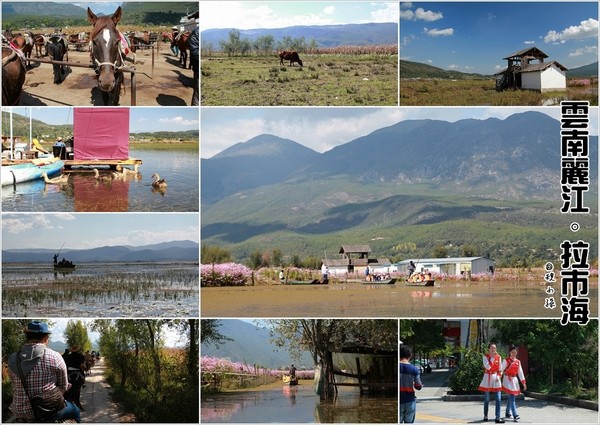
Text & Photos byKui Xiao Sun
After returning from a five-day trip to Lijiang, Yunnan, my memory card was already filled with over a thousand photos!! XD Just organizing these massive amounts of pictures truly made me relive the beautiful sights and that heavy-lidded feeling. Haha!!
Many individual attractions resulted in one or two hundred photos each—excluding the figures of my travel companions, flipping through them one by one really gave me the feeling that I hadn’t expected this overseas trip to end so soon.
Back in Taiwan, in just five short days, I felt like quite a few things had happened: the Ting Hsin scandal, the Penghu shipwreck—I felt like I had to quickly catch up on them just to keep pace with what was happening at home. Stepping back onto Taiwanese soil, I realized just how used to it I’d become. I say this because Lijiang has a very high altitude—the so-called flat urban areas are roughly 2,000 meters above sea level. It doesn't sound like much at first, since places like Qingjing and Hehuanshan are also that high. But it was the first time I personally experienced altitude sickness—shortness of breath, unable to walk quickly. Among my travel companions, only a few had similar symptoms XD
I can only say I underestimated it and forgot to prepare properly. But taking it slow was part of the experience too. After all, understanding your own physical condition is a pretty important aspect. I sorted out the itinerary for the five days. Since we flew directly to Lijiang, the first day’s flight was around seven in the morning, and the fifth day’s was at noon. So most of the sightseeing happened within the first four days. Actually, my overseas trips over the past two years have mostly been group travels with friends’ companies. The travel agency had contacted me privately many times since our Korea trip last year.
For certain reasons, I still won’t mention anything about that in these Lijiang articles. If you’re really interested, feel free to ask me privately!! XD Also, because it was a group tour, meals were mostly arranged by the travel agency. Plus, there were so many people, so I won’t be covering the food here. I’ll just say that the food in 【Lijiang】 tends to be salty and greasy due to the high altitude—they’re used to eating that way. But the food in the hotels was more suitable for our tastes, and everything was quite acceptable to eat. ^~^
Here's the content of the five-day itinerary. In this first story about Lijiang, I’m sharing it with everyone.
2014, Oct — Five Days in Lijiang, Yunnan:
D1: Arrived in Lijiang at noon, lunch > Lashi Lake: horseback riding, wetland tour > Lijiang International Hotel
D2: Hike to Wangfuging Tower, Mu’s Mansion > daytime and nighttime views of Dayan Ancient Town > Songcheng Lijiang Impression Show
D3: Jade Dragon Snow Mountain, Impression Lijiang Show > cable car to Muni Ping > electric cart tour of Blue Moon Valley, White Water River > Ganhaizi > Sea of Poppies > Yuquan Village
D4: Yunpu Tianxia > Black Dragon Pool, Yuquan Park > Baisha Murals > Shuhe Ancient Town > Pullman Resort Hotel
D5: Flew back to Taiwan at noon

On the first day in Lijiang, we drove straight into the city for a meal. We were really lucky during those five days in Lijiang—only the early mornings were a bit cold, but the sky got bluer as the day went on, and the beautiful light made every photo look even more magical!
When we got out of the car and walked to the restaurant, the scenery along the way. Besides the beautiful sky, the roadside trees with hints of autumn yellow added to the atmosphere and made me want to linger even more.


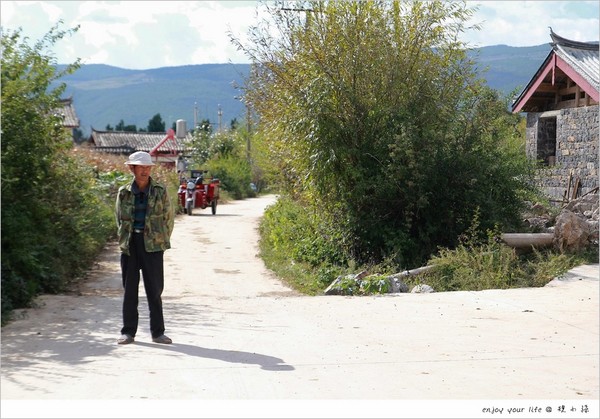
When visiting different countries or places, I think the locals are definitely worth photographing because seeing their clothing, smiles, and faces gives you an understanding and feeling of the place. The girls we passed, the kids on the street, or the dogs kept by different families—these local lives truly convey the warmth of the place. The locals in Lijiang are very simple, and women are especially the main workforce outside the home, as they maintain the belief that men should strive for scholarly honor.
During these five days of travel, many of us were bothered by some other tourists who had very low standards and no sense of public decency. But the locals in Lijiang were extremely humble and peaceful—it’s a great experience to soak in. Honestly, I only seemed to notice Lijiang this year. I remember the guide saying that the beauty of Lijiang actually gained attention because of the Sichuan earthquake. The international focus brought by the earthquake led to reports showcasing the beauty of this place.
As a result, the number of tourists has increased hundreds or even thousands of times in just the past few years.Here’s some info about 【Lijiang】 for everyone, source: Wikipedia
Lijiang City is a prefecture-level city in northwestern Yunnan Province, China. In 2002, the total population of the city was 1.11 million.
Among them, the ancient town area of Lijiang is a rare and well-preserved ethnic minority ancient city in China.
It concentrates the essence of Naxi culture and fully retains the historical appearance formed since the Song and Yuan Dynasties.
On December 4, 1997, it was listed as a UNESCO World Cultural Heritage site and also designated as a National Historical and Cultural City by the State Council.
Since ancient times, Lijiang has been a hub along the Silk Road and the Ancient Tea Horse Road.
Lijiang has the ancient town of Lijiang, built during the Southern Song Dynasty. Its Naxi name is “Gongben Zhi,” where “Gongben” means granary and “Zhi” means market. The ancient town of Lijiang was once a distribution hub for grain storage.
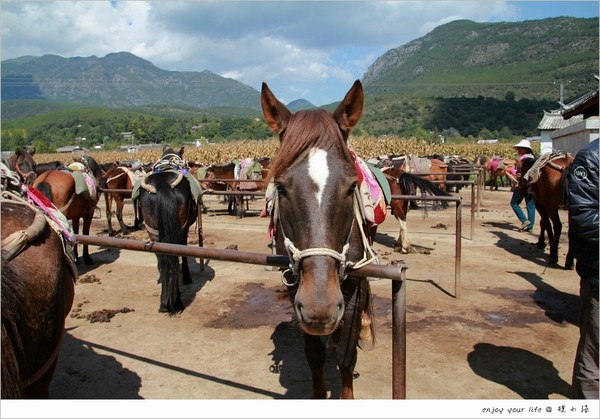
Lijiang used to be a relay station along the Silk Road and the Ancient Tea Horse Road, so the 【caravan culture】 is a very important part of Lijiang’s cultural history. I remember the guide vividly describing how out of a 100-person caravan, only about 60 would make it to the destination.
Because of the harsh weather, treacherous roads, and the most terrifying robbers along the way, nearly half the caravan members would be lost—but these challenges could not be avoided without relying on the 【caravans】 to obtain various essential materials and resources of the time.
After our first meal of the day, we headed straight to 【Lashi Lake】. This was also one of the experiences I was looking forward to. Honestly, one of the great things about coming to Lijiang is how close everything is—20 to 30 minutes is pretty normal, and the farthest is at most 40 minutes. It’s a great place where you don’t need to spend much time in the car, which makes group travel quite convenient. Also, there’s only one shopping stop in Lijiang, 【Yunpu Tianxia】, which we left to the adults in the group because they definitely went on a shopping spree XD
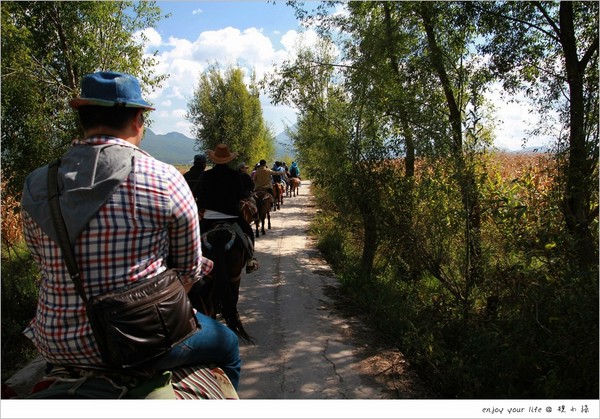
It felt like the first time I’d ridden a horse for such a long time. We passed through small paths around Lashi Lake, with everyone riding one after another to reach 【Lashi Lake】. Locals were responsible for leading and watching the horses, and interestingly, these horses seemed to understand English commands. "Let's go!" was the most common one XD
About Lashi Lake, from Wikipedia:
Lashi Lake (also known as Laxi Hai, a transliteration from the Naxi language, originally meaning Tiger Lake) is the core part of the Yunnan Lijiang Lashi Lake Plateau Wetland Provincial Nature Reserve.
It is located in the central part of Lashi Basin, 8 kilometers west of Lijiang City, Yunnan Province, on the southeastern slope of Jade Dragon Snow Mountain. "Lashi" is an ancient Naxi name, where "La" means barren land and "Shi" means new, signifying a newly formed barren land.
Lashi Lake is a famous gathering spot for migratory birds, with around 20,000 migratory birds wintering here every year.

There is no sea in Lijiang, so the locals call this 【Lashi Lake】 a sea. In reality, it’s a fault-formed lake. There are up to 57 species of migratory birds here, with around30,000 of them coming to winter each year. Among them, there are 9 rare and endangered species, including the bar-headed goose unique to the Qinghai-Tibet Plateau, and national first-class protected birds such as the scaly-sided merganser, black-necked crane, and others. There are 7 species of fish in Lashi Lake, along with 47 species of aquatic plants, including the nationally third-class protected plant, the water snowflake. (Wikipedia)

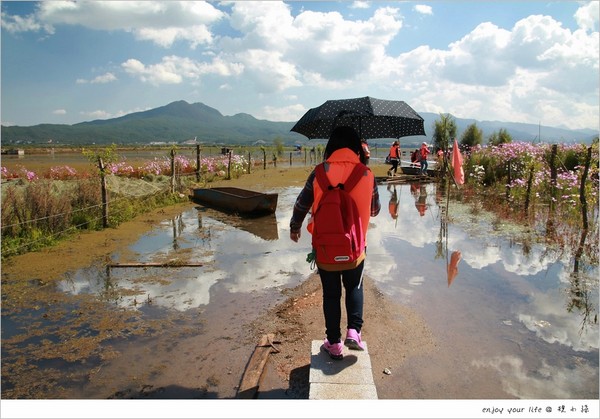
To this day, I still find it hard to describe the thrill I felt on the first day at 【Lashi Lake】. Before getting into the small boat, I was already awestruck by the vast wetlands before me. The landscapes in mainland China are truly beautiful—every scenic area can be described with just one word: “big.” Such boundless openness, the wetlands stretch far, far away from the distant mountains. Not to mention that in the silence of the moment, all you could hear was the sound of your own heartbeat. Just having come down from the excitement of riding a horse, my heart still felt the vibrations from the horse’s hooves, and then I was back on the real 【Lashi Lake】 wetland. As I stepped into the small boat, the surface of the water in the wetland was no more than 15 centimeters below us. We were so close, so incredibly close to the surface of the wetland lake. The excitement in my heart was simply indescribable!
Our group was split between two vehicles, with roughly fifty people in total. A small boat usually holds about 7–8 people, so we needed at least seven or eight boats. But once they all set off onto the vast 【Lashi Lake】, each one looked so tiny!
All that remained were us, sitting in the boats, not daring to rock them too much, all saying together: “So beautiful, so beautiful, so beautiful!” We really didn’t know how else to describe it other than “so beautiful.”
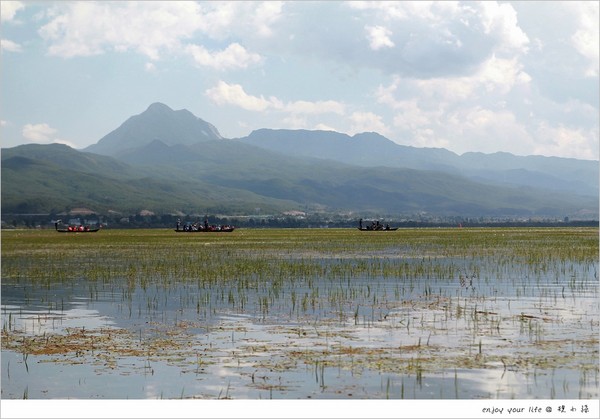
Reflections on the surface of 【Lashi Lake】 are very easy to capture. You don’t need to wake up early to wait for the distant mountains, the clouds in the sky, or the boats passing by—all of it is the most genuine and priceless scene here. Beneath the wetland lie countless aquatic plants, fish swimming by, and the undisturbed masters of the wetland: the birds.
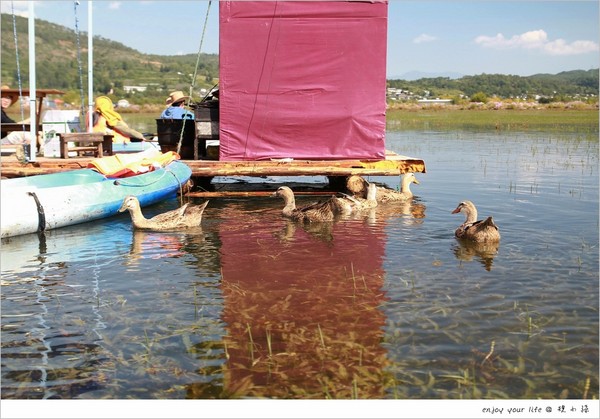
Actually, the most beautiful thing about 【Lashi Lake】 isn’t just those romantic scenes of a single boat gliding across the water.
The most beautiful part is when you’re sitting in the small boat, in the waveless and silent water, where beneath the surface, the water is so clear you can see the stretching aquatic plants and fish swimming through.
Unfortunately, the lighting was too complex. I can only describe it to you like this.
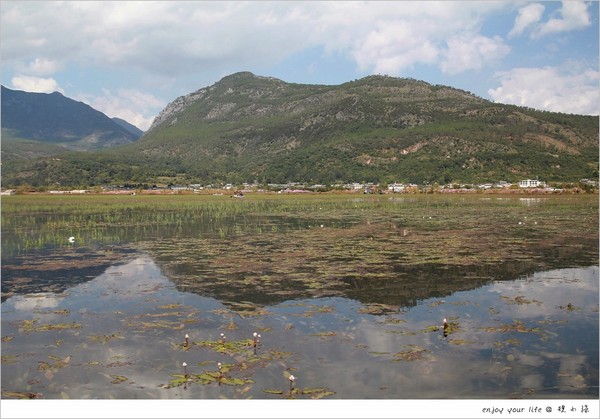
I imagine this place throughout the four seasons, even during the winter when the migratory birds pass through. Imagining tens of thousands of migratory birds resting here, imagining all kinds of creatures living on the lake, imagining the most precious operations of nature thriving beyond human presence. In truth, we are also migratory birds, just passing through this beautiful 【Lashi Lake】.

On one side of 【Lashi Lake】, there is a vast field of cosmos flowers. At the foot of the mountains in Lijiang, a field of cosmos may seem ordinary, but in reality, they grow as tall as a person’s chest or even as tall as a person, which is quite rare to see in Taiwan. The area is huge, allowing people to fully enjoy the view. Here, we encountered the first field of cosmos flowers on our journey, and this one alone had everyone “jumping” for photos XD
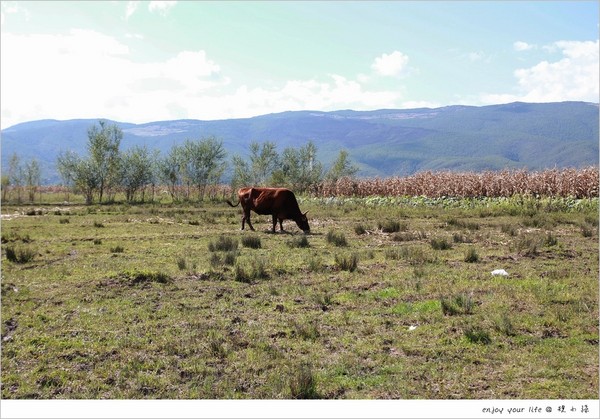
We didn’t see horses grazing on the large grassy fields, but instead came across a cow. It was used to seeing tourists and calmly continued eating grass on its own. We didn’t dare get too close, only wanting to stand far away and take pictures of this freely grazing animal.

On the way back, we passed by large apple orchards. In Lijiang, apples are abundant. But personally, I’m not a fan of apples, so I just strolled around taking photos. The houses in Lijiang aren’t very tall—even in the city area, most buildings are only three stories high. There might be a few hotels that go up to ten-plus stories, but overall, the view is never obstructed, offering endless vistas.
Back at the horse farm, since our group was so large, the shuttle vans had to move slowly. I also got the chance to admire the horses in solitude. Even though the smell was quite strong, being so close to the horses was truly a first in my life. Over the next three or four days, we often saw them—gentle and quiet—passing by us on the streets of the ancient town, gradually making us accustomed to their presence.

The story began on the afternoon of the first day, at a place I had been looking forward to even before leaving home: 【Lashi Lake】.
That day, I even posted photos to the fan page. It was a fairyland, a beautiful scenery, and a plateau wetland that shook the soul silently.
It nurtures countless living beings and has broadened my horizons immensely. Utterly satisfying.
2014, October – Five Days in Lijiang, Yunnan:
Day 1: Arrived in Lijiang at noon, lunch > Lashi Lake: horseback riding, wetland tour > Lijiang International Hotel
Day 2: Hike to Wangu Tower, Mu Palace > Scenery of Dayan Ancient Town in daytime and night > Songcheng Lijiang Impression Show
Day 3: Jade Dragon Snow Mountain, Impressions of Lijiang Show > Cable car to Niuwozi > Electric cart tour of Blue Moon Valley, White Water River > Ganganzi > Cosmos flower field > Yushui Temple
Day 4: Yunpu Tianxia > Black Dragon Pool, Yuquan Park > Baisha Murals > Shuhe Ancient Town > Pullman Resort Hotel
Day 5: Flew back to Taiwan at noon
[Enjoy life, don’t get bored. – Xiao Sun]
Share
This article is published by HowToTrip. Sharing and reposting are welcome — please credit the source.
Article URL: https://www.howtotrip.net/views-16105
Related Articles
- Shaoxing's "Grandpa Gourd" hangs the gourds back up: "If there are too many people, we'll interact less — just take a quick look from afar"
- Chinese authorities announce "reciprocal adjustment" to Japan visa fees — single-entry visa jumps from 2,250 to 16,750 yen!
- The "health stones" carried by a traveler were found to have radiation levels exceeding safety limits by a thousand times, potentially endangering fellow passengers on the same flight. Customs issues warning!
- Shenzhen Airport Issues Late-Night Notice: Unidentified Aerial Object Detected, Causing Widespread Flight Delays!
- “They only said it cost money after I opened the box and washed it!” 200g of grapes sold for 60 yuan on a high-speed train—12306 responds!
- Can't buy an airline ticket? Denied exit? Blocked from boarding? A large number of Chinese tourists have mysteriously become "discredited individuals"
- Adverse weather and economic fluctuations impact Colombia's coffee market
- Beach bathing area responds to 2 yuan/30 seconds fee for freshwater foot rinsing: Clearly priced!
- Taking off with an improperly closed cabin door? Wing malfunction? Multiple flights made emergency returns mid-journey!
- Experience the gifts of nature! A countdown of the world’s ten most stunning coastlines