Travel Q&A: Is It Possible to Open the Emergency Exit During a Flight?
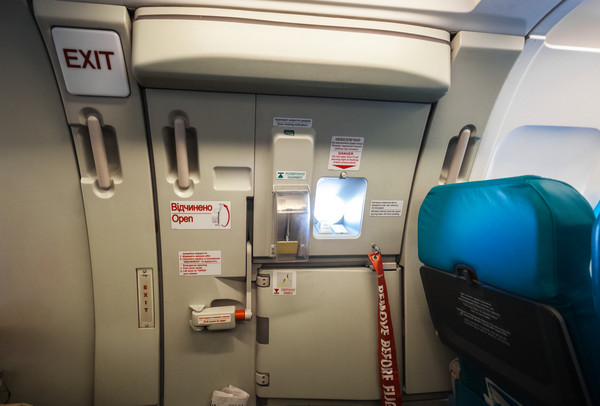
▲ Airplane Emergency Exit (Photo / Darzhi / Illustration)
By Rita
After a year of frequent aviation incidents in 2014, safety has become a top priority for many travelers. Natural disasters are unavoidable, but can accidents caused by human error be reduced? Whether emergency exits can be opened mid-flight is a common question,the travel website Trillist interviewed three pilots, and here is what they had to say.
Q: “Is it possible to open the emergency exit during a flight?”
A: As follows (Trillist interviewed three pilots)
1. Cabin pressure naturally locks the door
Emergency exits are “plug doors,” a type of door that uses air pressure differences between the inside and outside to stay tightly closed. Once the aircraft engines are running, the cabin is pressurized, and only a very small number of doors are manually locked.
2. Unless you call in the Hulk, opening the door mid-air is virtually impossible
Emergency exits must be pulled inward to open. Because the pressure inside the cabin is much higher than the outside, even a group of people couldn’t open it. Essentially, the pressure increases by about six pounds per square inch (2.72 kilograms), so at cruising altitudes of tens of thousands of feet, you’d need to exert over a thousand pounds of force to open it.
3. If the door “actually” opened, the cabin would instantly decompress
In the event of cabin decompression, oxygen masks will drop down.
4. You only have 15 seconds to put on your oxygen mask
At altitudes above 30,000 feet, the air is freezing, with temperatures around minus 62 degrees Celsius. Aside from the risk of frostbite, lack of oxygen can cause people to lose consciousness within 15 seconds. Those not wearing seatbelts could, as shown in movies, be “sucked” out by the cold air outside in a matter of seconds.
5. The pilot will try to keep the plane at 10,000 feet
As the aircraft rapidly decompresses, the oxygen supply from the masks is limited. Once it runs out, passengers may lose consciousness. Pilots use more advanced oxygen systems and will keep the aircraft at an altitude of 10,000 feet where there's enough oxygen.
6. Airplanes are safer due to hijacking incidents
Following hijacking incidents (note), the U.S. Federal Aviation Administration (FAA) mandated that aircraft manufacturers install the “Cooper Vane” device, which prevents the emergency exits from being opened from inside the cabin during flight.
Note: A famous U.S. hijacking case involved a suspect (who used the name D.B. Cooper when boarding) who hijacked a Boeing 727, demanded a ransom of $200,000, and then escaped by parachute after getting the money.
★ The image is a copyrighted photo provided exclusively to ETtoday東森新聞雲 by Darzhi Images. No website, newspaper, or TV station may reproduce any part or all of it without permission from Darzhi Images.
Share
This article is published by HowToTrip. Sharing and reposting are welcome — please credit the source.
Article URL: https://www.howtotrip.net/views-12012
Related Articles
- Shaoxing's "Grandpa Gourd" hangs the gourds back up: "If there are too many people, we'll interact less — just take a quick look from afar"
- Chinese authorities announce "reciprocal adjustment" to Japan visa fees — single-entry visa jumps from 2,250 to 16,750 yen!
- The "health stones" carried by a traveler were found to have radiation levels exceeding safety limits by a thousand times, potentially endangering fellow passengers on the same flight. Customs issues warning!
- Shenzhen Airport Issues Late-Night Notice: Unidentified Aerial Object Detected, Causing Widespread Flight Delays!
- “They only said it cost money after I opened the box and washed it!” 200g of grapes sold for 60 yuan on a high-speed train—12306 responds!
- Can't buy an airline ticket? Denied exit? Blocked from boarding? A large number of Chinese tourists have mysteriously become "discredited individuals"
- Adverse weather and economic fluctuations impact Colombia's coffee market
- Beach bathing area responds to 2 yuan/30 seconds fee for freshwater foot rinsing: Clearly priced!
- Taking off with an improperly closed cabin door? Wing malfunction? Multiple flights made emergency returns mid-journey!
- Experience the gifts of nature! A countdown of the world’s ten most stunning coastlines