Fight for national self-determination!Belfast bathed in rose-tinted hues
Text & Photos /Zhen Zi
At first glance, Belfast, the capital of Northern Ireland, looks no different from other major British cities. Bustling streets are lined with castles, churches, shops, cultural heritage sites, and modern architecture coexisting harmoniously. Yet, despite such vibrancy, the city still exudes an air of sorrow. The Titanic was built here in 1912, and during the 1970s and 1980s, its people bled in their struggle to break free from British rule and fight for independence, leading to numerous violent clashes that left Northern Ireland stained with rose-tinted blood.
Since the signing of the Good Friday Agreement in 1998 and the official disarmament of the Irish Republican Army (IRA) in 2005, peace has returned to Northern Ireland. However, sporadic violence still occurs, especially during the annual July parades. Catholics have not forgotten the sorrow of “Bloody Sunday,” and their determination to seek independence remains unchanged. Last year’s Scottish independence referendum seemed to remind them of their own right to self-determination.

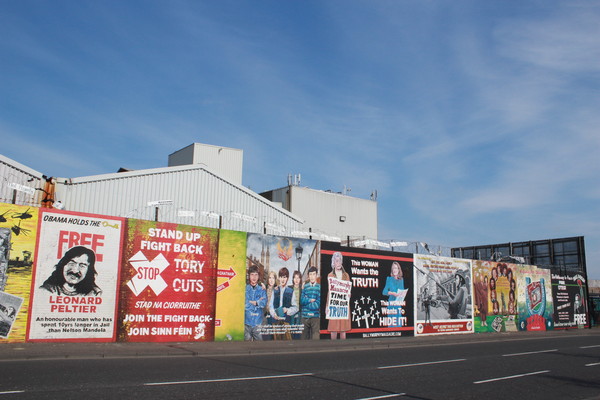
With the UK general election approaching in May, Belfast’s streets are adorned with campaign banners from nationalist parties such as the Social Democratic and Labour Party (SDLP) and Sinn Féin. Outside the city center, near the Peace Walls, no party slogans can be seen—political stances are probably discernible enough from sectarian divisions. As the car drives from Falls Road toward Cupar Way, political murals line the route. The five-kilometer-long Peace Wall separates Protestant and Catholic neighborhoods. This high wall is regarded by local residents as a vital facility for ensuring safety and is still being expanded today. At one point, the taxi driver handed me a spray can, gesturing for me to write something on the wall. I used to think the wish for “world peace” was too clichéd, but in Northern Ireland, it becomes the most heartfelt blessing.
The driver is a Protestant who does not want Northern Ireland to become independent—not for religious reasons, but ultimately because of money. “Right now, my family and I enjoy various benefits, such as the UK’s National Health Service and education system. There are too many unknowns if we become independent.”
I couldn’t help but ask, what was life like when communities were segregated? “I grew up attending Protestant schools, and all my friends were Protestants. In those days, religious communities were clearly divided. Religious tensions led to discrimination against Catholics when seeking jobs. Now things are better. My son has many Catholic friends, and they get along well.” Before he could finish his sentence, we had already driven into Shankill Road, a predominantly Protestant neighborhood, where dozens of murals came into view.
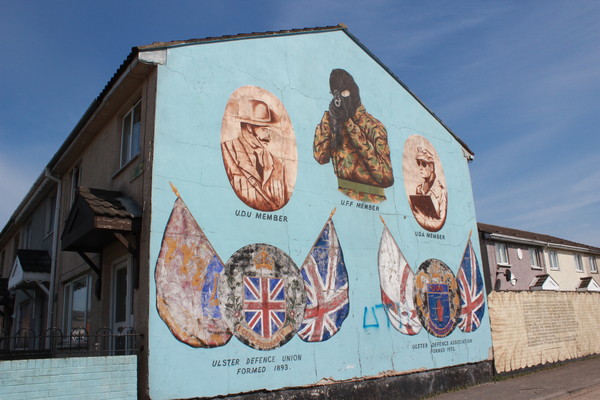
It is a quiet residential area where a group of children are playing by the roadside. Across the street is a mural of an Ulster Freedom Fighters (UFF) militant aiming a gun. The children are too young to understand the meaning behind the murals, but perhaps when they grow up, they will realize this land is steeped in suffering. A previous article described how this road played a significant role in the region’s turbulent history.
Author: Zhen Zi.A Hong Kong native, he left for the UK after turning twenty, lived in Northern Europe, and studied in Sweden. On a world map, these three places form a straight line like a triangle ruler. The author believes that even the best camera cannot accurately capture the people and events of society—only words can. While living in the UK, his surroundings consisted only of plants, trees, and a cemetery. With little else to do, he picked up a pen and began writing, recording life stroke by stroke.
Author's Facebook Page【Triangle Ruler】
Share
This article is published by HowToTrip. Sharing and reposting are welcome — please credit the source.
Article URL: https://www.howtotrip.net/views-11568
Related Articles
- Shaoxing's "Grandpa Gourd" hangs the gourds back up: "If there are too many people, we'll interact less — just take a quick look from afar"
- Chinese authorities announce "reciprocal adjustment" to Japan visa fees — single-entry visa jumps from 2,250 to 16,750 yen!
- The "health stones" carried by a traveler were found to have radiation levels exceeding safety limits by a thousand times, potentially endangering fellow passengers on the same flight. Customs issues warning!
- Shenzhen Airport Issues Late-Night Notice: Unidentified Aerial Object Detected, Causing Widespread Flight Delays!
- “They only said it cost money after I opened the box and washed it!” 200g of grapes sold for 60 yuan on a high-speed train—12306 responds!
- Can't buy an airline ticket? Denied exit? Blocked from boarding? A large number of Chinese tourists have mysteriously become "discredited individuals"
- Adverse weather and economic fluctuations impact Colombia's coffee market
- Beach bathing area responds to 2 yuan/30 seconds fee for freshwater foot rinsing: Clearly priced!
- Taking off with an improperly closed cabin door? Wing malfunction? Multiple flights made emergency returns mid-journey!
- Experience the gifts of nature! A countdown of the world’s ten most stunning coastlines