A forgotten maritime ruin for nearly 40 years — it was once the most densely populated place on Earth

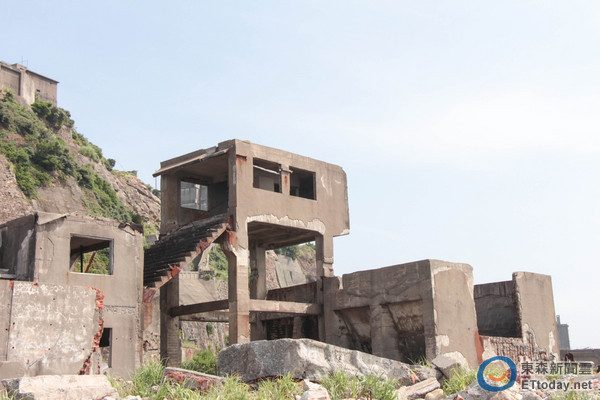
▲ Hashima Island is called Battleship Island because of its ship-like shape.
Reported and photographed by reporter Huang Shiyuan / Nagasaki
Because of coal mining, a small island off the coast of Nagasaki, Japan, was filled with reinforced concrete buildings, with a population that once reached 5,300, and a population density that was even nine times that of Tokyo at the time, the highest in the world. In addition to residential buildings, the island also had elementary and middle schools, a police station, a cinema, shops, barbershops, a shrine, and even a swimming pool. But as Japan's energy dependence shifted from coal to oil, coal production and the population declined, eventually leading to the mine’s closure. The island became uninhabited and slept under a veil of mystery for over 30 years. It has gradually drawn attention again since tourism was opened up.
The island is named "Hashima," also known as "Battleship Island," located 4.5 kilometers west of the Nagasaki Peninsula in Japan. It is about 480 meters long from north to south and about 160 meters wide from east to west, with a total coastline of approximately 1,200 meters and an area of about 6.3 hectares. Why is it called "Battleship Island"? Because the island was rich in coal. Initially, in the early Meiji period, small-scale mining was carried out by the Saga Clan, and later it was operated by Mitsubishi Joint Stock Company for large-scale extraction. As coal production increased, so did the population on the island. In addition to reclaiming land from the sea, cement was used to expand the land, and high-rise reinforced concrete apartment buildings were constructed to house miners. The first reinforced concrete residence in Japan was built on this island. Due to the vertical concrete seawalls and numerous concrete buildings, Hashima, when viewed from afar, resembles the battleship "Tosa," hence its nickname "Battleship Island."<<<>>>

▲ Many buildings on the island have collapsed.
▲ An old coal mine entrance.
After the coal mine closed in 1974, Battleship Island became uninhabited. It wasn’t until 2009, when it was listed on the Tentative List of World Heritage Sites and reopened for public visits, that it emerged from over 30 years of abandonment. Many structures had collapsed during that time, but roughly half of the buildings and facilities still remain, including a seven-story elementary and middle school, a hospital, and several miners’ residences. However, due to the long-term disuse and risk of collapse, even though it is open for tourism, access is restricted to specially built visitor pathways. All other areas remain off-limits.

▲ Only a red brick wall remains of the general affairs building.
Currently, there is only one tour route on Battleship Island, featuring three viewing plazas. At each plaza, a guide (speaking Japanese) provides commentary. The first plaza features remnants and buildings such as an elementary and middle school, a coal conveyor belt, and the residence of the highest-ranking official. The second plaza offers views of the general affairs building and the pier of Shaft No. 2. The third plaza showcases the reinforced concrete residences numbered 30 and 31, with No. 30 being the first such residence in Japan. Residence No. 31 has a communal bath in the basement, while the first floor includes a post office and barbershop. After leaving the island, the cruise boat continues to circle Battleship Island, allowing visitors to see different views of the island from the sea.

▲ Japan’s first reinforced concrete residential building (right).
Guides on Battleship Island say that before the abandonment, the buildings on the island were brightly lit, so that ships working at sea could see Battleship Island from afar when returning to Nagasaki Port. But after the coal mine closed in 1974 and the island was deserted, a lighthouse was erected on the island to prevent ships from colliding with it — it is now the newest structure on the island.
As Hashima had been abandoned for over 30 years, it developed an air of mystery and a somewhat eerie atmosphere, making it a setting or backdrop for many films and stories. For example, the Japanese TV drama “Idol Bakeneko Den” used Hashima as a filming location, and “Battle Royale II” was set on the island. In the James Bond film “Skyfall,” the villain Raoul Silva’s hideout was modeled after a deserted island, also inspired by Hashima. However, none of these productions filmed on the island itself—at most, “Skyfall” included a distant shot of Hashima.095-818-1105
http://www.gunkanjima-tour.jp/index.html
● Battleship Island Concierge
Tel.095-895-9300
http://www.gunkanjima-concierge.com/
Share
This article is published by HowToTrip. Sharing and reposting are welcome — please credit the source.
Article URL: https://www.howtotrip.net/views-11325
Unique hair dance and string music exchange of the Tao people – a moving grassland concert for travelers in Orchid Island
Next →The Palace Museum in Beijing has implemented a "real-name ticketing system," preventing Taiwanese visitors without their Mainland Travel Permit for Taiwan Residents (Taiwan Compatriot Permit) from purchasing tickets and entering.
Related Articles
- Shaoxing's "Grandpa Gourd" hangs the gourds back up: "If there are too many people, we'll interact less — just take a quick look from afar"
- Chinese authorities announce "reciprocal adjustment" to Japan visa fees — single-entry visa jumps from 2,250 to 16,750 yen!
- The "health stones" carried by a traveler were found to have radiation levels exceeding safety limits by a thousand times, potentially endangering fellow passengers on the same flight. Customs issues warning!
- Shenzhen Airport Issues Late-Night Notice: Unidentified Aerial Object Detected, Causing Widespread Flight Delays!
- “They only said it cost money after I opened the box and washed it!” 200g of grapes sold for 60 yuan on a high-speed train—12306 responds!
- Can't buy an airline ticket? Denied exit? Blocked from boarding? A large number of Chinese tourists have mysteriously become "discredited individuals"
- Adverse weather and economic fluctuations impact Colombia's coffee market
- Beach bathing area responds to 2 yuan/30 seconds fee for freshwater foot rinsing: Clearly priced!
- Taking off with an improperly closed cabin door? Wing malfunction? Multiple flights made emergency returns mid-journey!
- Experience the gifts of nature! A countdown of the world’s ten most stunning coastlines