5 keywords to experience Prague’s dual personality
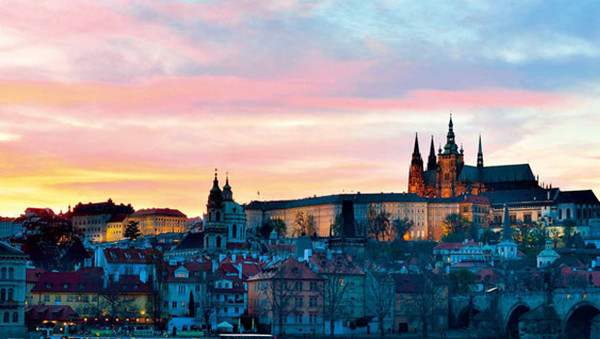
▲ Dual Personality Prague. (Photo / Provided by Business Weekly / Photographer Li Mingyi)
By Li Guangzhen
Prague, the first city in the world recognized by UNESCO as a World Heritage Site, is also the city with the highest density of artists globally. Before exploring Prague, there are five keywords you must know.
Keyword 1: Surreal
The City of a Hundred Spires, the Golden City, the Heart of Europe, Paris of the East, Miniature Vienna... these are all nicknames for Prague. However, German philosopher Nietzsche once said: “When I speak of music, I think of Vienna, but when it comes to ‘mystery,’ only Prague comes to mind.”
The “Bone Church” is another surreal wonder of Prague. During the medieval Black Death, piles of bones accumulated. What to do? Just use them to decorate the church—lavish chandeliers, altars, candlesticks... all made from human bones. After all, the church leads straight to heaven, so the dead should be with God.
Keyword 2: Dual Personality
Prague is the capital of the Czech Republic, but “Czech” is actually a later concept. Historically, this land was known as “Bohemia,” primarily inhabited by the Slavic peoples. It was originally part of the Holy Roman Empire, then came under Habsburg rule after the 16th century, later incorporated into the Austro-Hungarian Empire (1867–1918), and only became an independent nation after World War I.
In other words, for nearly five centuries, Czechs had “Germanic minds and Slavic bodies.” Their culture, thinking, and institutions aligned with the strict and rigid German and Austrian traditions, but the free-spirited nature in their blood was hard to erase.
Keyword 3: Absurd Alienation
Whether you like literature or not, you’ve probably heard of “Kafka.” His *The Metamorphosis* tells the story of a man who wakes up one morning to find himself transformed into a giant beetle. This bizarre tale became a milestone in modern literature, psychology, and even psychiatry.
Kafka disliked Prague, describing it as “evil narrow alleys filled with oppressive pale streets.” He felt completely alienated here, focusing solely on his inner world. Yet his former residences—such as the Golden Lane in Prague Castle and the House of the Golden Unicorn on the Old Town Square—are now sacred sites for literature lovers worldwide.
Keyword 4: Satirical Humor
Although Kafka is Prague’s pride, his neurotic, nitpicking personality is completely at odds with the carefree, humorous nature of Prague’s people. The self-image of Prague residents is that of the chubby, goofy Good Soldier Švejk.
The author of *The Good Soldier Švejk*, Hašek, was a contemporary of Kafka but a completely different type. Hašek was very “Slavic”—loved drinking, rebelled against authority, despised materialism, and enjoyed mingling with all kinds of people.
When World War I broke out in 1914, Czechia, as a vassal of the Austro-Hungarian Empire, was forced to join. But Hašek actually deserted during the war, surrendered to the enemy—the Russians—and later joined the Russian Revolution, becoming a communist commissar.
These experiences were written into *The Good Soldier Švejk* by Hašek, though he passed away before finishing it. But Švejk’s act of pretending to be foolish, outwardly obedient but secretly stirring up trouble, driving Austrian officers crazy and helpless, resonated deeply with Czechs and was met with loud applause.
Keyword 5: Paradise for Artists
With the influence of European aesthetics and the romantic freedom of Bohemia, the Czech Republic is recognized as the country with the highest density of artists in the world. They have a saying: “One in every five Czechs is a musician,” including Jewish composer Mahler, and Slavic-rooted composers Smetana, Dvořák, and Janáček, as well as conductors Kubelík and Ančerl.
Today’s Prague features exquisitely beautiful architecture, well-developed public facilities, friendly and cheerful people, and is full of theaters and restaurants. It’s hard to imagine that just 25 years ago, this city was still gray and dilapidated. Havel showed the world how much resonance an artist can create in a nation full of artistic spirit. What surprises will Prague’s new era bring? It’s definitely something to look forward to.
【 More Reports 】
※ For the full article, see *Business Weekly*.
※ This article is authorized by *Business Weekly*. Reproduction without permission is prohibited.
Share
This article is published by HowToTrip. Sharing and reposting are welcome — please credit the source.
Article URL: https://www.howtotrip.net/views-10820
Related Articles
- Shaoxing's "Grandpa Gourd" hangs the gourds back up: "If there are too many people, we'll interact less — just take a quick look from afar"
- Chinese authorities announce "reciprocal adjustment" to Japan visa fees — single-entry visa jumps from 2,250 to 16,750 yen!
- The "health stones" carried by a traveler were found to have radiation levels exceeding safety limits by a thousand times, potentially endangering fellow passengers on the same flight. Customs issues warning!
- Shenzhen Airport Issues Late-Night Notice: Unidentified Aerial Object Detected, Causing Widespread Flight Delays!
- “They only said it cost money after I opened the box and washed it!” 200g of grapes sold for 60 yuan on a high-speed train—12306 responds!
- Can't buy an airline ticket? Denied exit? Blocked from boarding? A large number of Chinese tourists have mysteriously become "discredited individuals"
- Adverse weather and economic fluctuations impact Colombia's coffee market
- Beach bathing area responds to 2 yuan/30 seconds fee for freshwater foot rinsing: Clearly priced!
- Taking off with an improperly closed cabin door? Wing malfunction? Multiple flights made emergency returns mid-journey!
- Experience the gifts of nature! A countdown of the world’s ten most stunning coastlines