How to Travel Around Central and Hokuriku Japan on a Budget? Here’s Your Ultimate Guide

Text and photos / Excerpted from "Nagoya: Highlights of Central and Hokuriku Japan," by Wang Yaoqin.
The Central and Hokuriku regions of Japan cover a wide area. To start, decide which cities and attractions you most want to visit. When planning your itinerary, gather information through local tourism board websites, read relevant travel guidebooks, ask friends or family who have been there, or learn from valuable online experiences. Even if you’re joining a tour group, it’s important to understand the destination’s highlights and basic info to fully enjoy your trip. If your vacation schedule requires traveling during peak tourist seasons, unless booked through a travel agency, you should reserve flights and accommodations 3–4 months in advance to get the best value for your budget.
Bonus Tips & Deals
1. Search for Discounted Offers
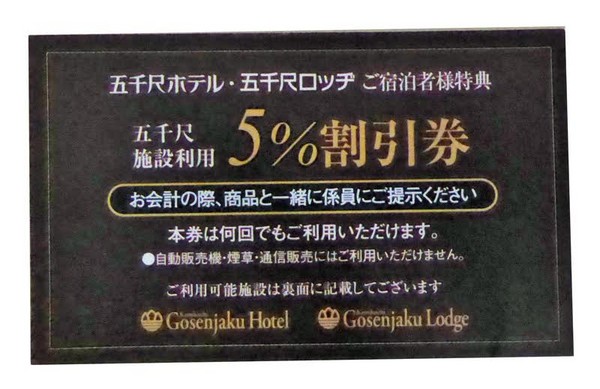
Using a smartphone and having a Facebook account, when planning a trip to Central and Hokuriku Japan, first check whether local tourism boards, popular restaurants, or shops on Facebook are offering any promotions? Some stores may offer discounts or freebies for liking their page or checking in. Be sure to read the terms and expiration dates before downloading or printing.
2. What Kinds of Discounts Are Available?
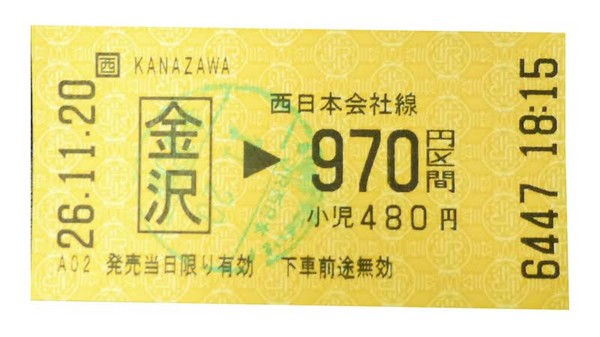
Each city’s shopping districts and shops offer different types of discounts or deals. In some areas, holding a one-day pass, sightseeing bus ticket, or package deal can also grant you special offers or gifts at certain stores. Other perks may include discounted admission to tourist attractions.
3. Where to Get Vouchers?
Hotels, train stations, and tourist centers often have coupons from restaurants or shops. Some shops’ Facebook pages also occasionally offer downloadable vouchers. Purchasing one-day passes can also give you access to special store deals or gifts.
Popular Japanese food websites provide restaurant coupons that you can search online:
GURUNAVI:http://www.gnavi.co.jp/tw/
Toyama Food Coupons:http://www.info-toyama.com/gurumeguri/(Japanese)
Budget Travel Tips
1. Where to Find Affordable Accommodation?
When traveling independently in Japan, accommodation costs make up the largest portion of your travel budget. If you don’t want to book through a travel agency, it’s best to reserve your hotel 3–4 months or even half a year in advance. First, outline your itinerary, then choose lodging that fits your budget and is conveniently located. In general, budget business hotels or guesthouses close to subway or bus stations are favorites among foreign backpackers—so book early to avoid sold-out situations.
Commonly used hotel chains by Taiwanese travelers include:
Toyoko Inn (Traditional Chinese):http://www.toyoko-inn.com/china/index.html
APA Hotels & Resorts (Traditional Chinese):http://www.apahotel.com.t.ju.hp.transer.com/language/hokuriku/
Super Hotel (Simplified Chinese):http://www.superhoteljapan.com/cn/s-hotels/takaoka/
Dormy Inn Akiyoshidai (Simplified Chinese):http://dormy-inn.partner.booking.com/
Booking websites include:
Agoda (Traditional Chinese):http://www.agoda.com/zhtw?cid=1416961&setcookienew=1
Booking.com (Traditional Chinese):http://www.booking.com/index.html?aid=313370
HotelClub (Traditional Chinese):http://www.hotelclub.com/
e路东瀛 Japanican (Traditional Chinese):http://www.japanican.com/Traditional-Chinese/index.aspx
Rakuten (Traditional Chinese):http://travel.rakuten.com.tw/
Jalan (Japanese):http://www.jalan.net/
114.com (Japanese):http://www.ikyu.com/
OZmall (Japanese):http://www.ozmall.co.jp/hotel
JNTO Japan Hotel & Ryokan Search (Traditional Chinese):http://www.jnto.go.jp/ja-search/chc/index.php
Japan Ryokan Association (Traditional Chinese):http://www.ryokan.or.jp/tw/
Global Hotel Price Comparison Website (Traditional Chinese):http://www.hotelscombined.com/
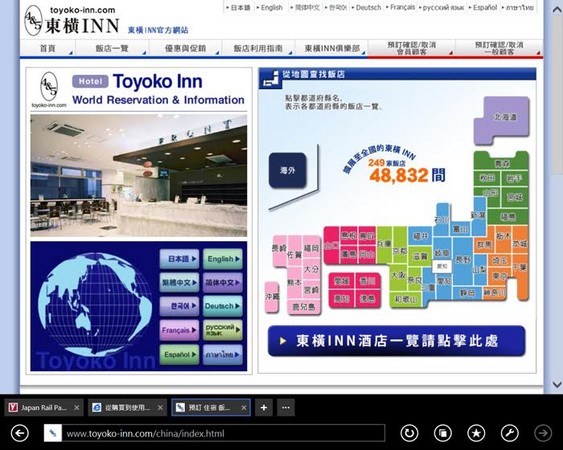
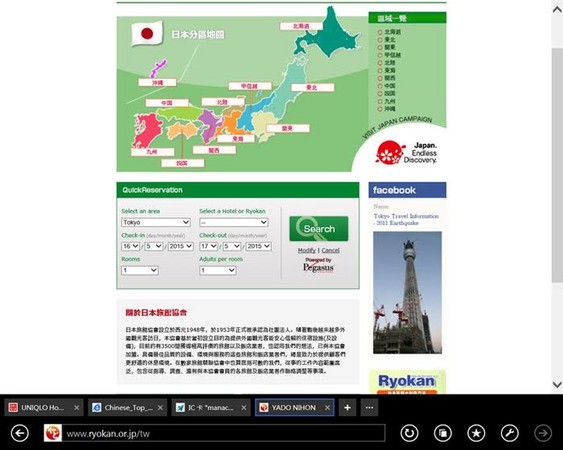
▲Pages of Toyoko Inn and the Japan Ryokan Association.
2. Information on Hotels of Various Grades
Choose from guesthouses, youth hostels, chain business hotels, star-rated hotels, or high-end hot spring ryokan based on your budget and preferences. In general, reservations are required, especially during cherry blossom season, autumn foliage, summer vacation, and the Spring Festival holiday period—you should book 3 to 4 months in advance. Some hotels may ask for your credit card details and process payment upon check-in, but if you change or cancel your plans without notifying the hotel, you may still be charged.
In the Chubu and Hokuriku regions, such as at hotels like Kamikōchi, Kaga Onsen ryokan, and Shirakawa-go gassho-style guesthouses, the standard is usually one night with two meals—dinner, breakfast, and accommodation. Room rates are calculated per person. Because meals are prepared in advance, walk-ins without reservations are not accepted.
Hotels and guesthouses in Japan at all levels provide basic toiletries such as toothbrushes. Tipping is not customary. Onsen (hot springs) facilities in hotels are gender-segregated, and bathers must enter completely nude—no clothing or towels allowed. It’s advisable to carry a card with your hotel’s address and phone number during your stay, just in case.

▲Accommodation in Kamikōchi.
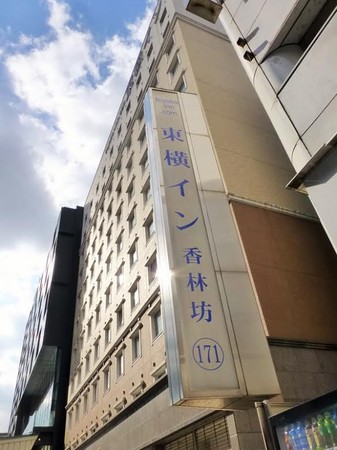
▲Toyoko Inn Kanazawa Korinbo.
3. Make Good Use of Discount Tickets
The JR Pass, designed for foreign tourists, is suitable for backpackers planning to visit at least 3–4 cities or traveling for an extended period. Examples include the Takayama-Hokuriku Area Tourist Pass issued by JR Central, the Hokuriku Area Pass issued by JR West, and the Kansai-Hokuriku Area Pass also issued by JR West. Additionally, IC cards and one-day passes issued in various regions offer convenience and discounts that can be put to good use.
4. JR National Railway Pass (JR PASS)
Takayama-Hokuriku Area Tourist Pass (TakayamaHokuriku Area Tourist Pass)
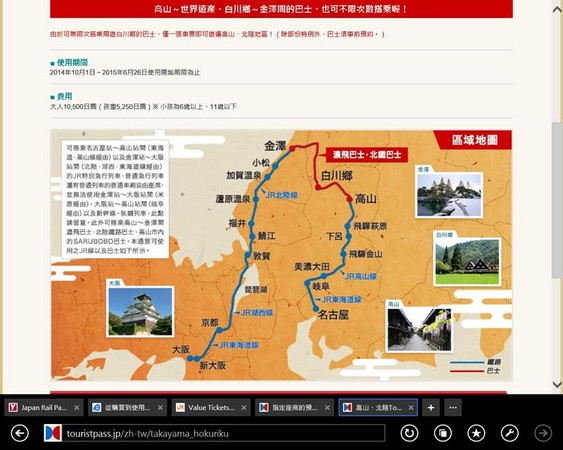
Sold by JR Central starting October 1, 2014. Valid for 5 consecutive days with unlimited rides. Covers JR limited express or local trains between Nagoya ∼ Gero Onsen ∼ Takayama, Kanazawa ∼ Kaga Onsen ∼ Awara Onsen ∼ Kyoto ∼ Osaka, with up to 4 uses of reserved seating.
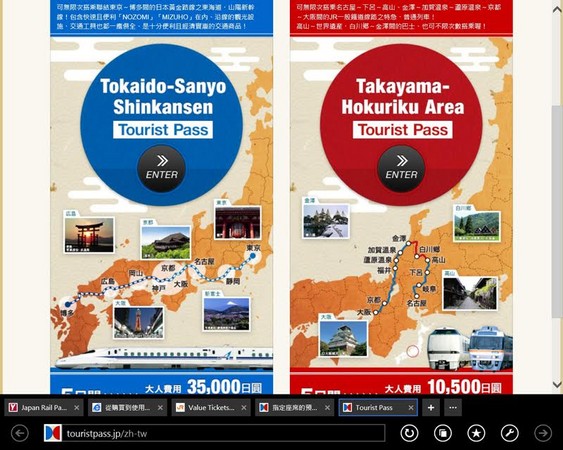
How to Purchase:
Not sold in Japan. Before departure, purchase an exchange order (MCO/Miscellaneous Charges Order) from a travel agency in Taiwan. Upon arrival in Japan, exchange the voucher along with your passport for the actual ticket.
Exchange Locations:
'vJR Central: Stations such as Tokyo, Shinagawa, Shin-Yokohama, Odawara, Mishima, Shizuoka, Hamamatsu, Nagoya, Kyoto, and Shin-Osaka (JR Central ticket counter on the 3rd floor).
'wJR Central Tours: Stations such as Tokyo, Shinagawa, and Shin-Yokohama.
'xJR West: Stations such as Kyoto, Shin-Osaka (JR West travel counter on the 3rd floor), Shin-Osaka (next to the east ticket gate on the 3rd floor), Osaka, and Kansai Airport. In the Kansai region, look for the green window; in the Kanto region, look for JR Central counters (not JR East).
Coverage Area:
'vUnlimited rides on JR limited express, rapid, and local trains between Nagoya ∼ Takayama and Kanazawa ∼ Osaka, with up to 4 uses of standard class reserved seating.
'wDoes not cover routes between Kanazawa ∼ Maibara ∼ Osaka, Takayama ~ Gifu ∼ Kanazawa, or Shinkansen and sleeper trains. Cannot be used to travel from Osaka to Nagoya, nor to Toyama, Tateyama (partially ???), or other restricted areas.
'xUnlimited rides on the Nohi Bus or Hokuriku Railway Bus between Takayama ∼ Kanazawa. Some bus services require seat reservation in advance.
'yUnlimited rides on the Sarubobo Bus in Takayama City.
How to Use:
'vFor personal use only. On the first day of use, get the ticket stamped for activation by station staff at the ticket gate.
'wCannot use automatic ticket gates; proceed through manned gates and show the ticket to station staff to confirm its validity period.
Carry your passport with you in case verification is required.
When taking the Nohi Bus or the Hokuriku Railway Bus, you must check in at the bus center counter in advance.
When taking the Monkey Baby Bus, you must present your ticket.
You cannot board the sections from Toyama to either {?Five Swords???Grouper or via online booking}.
You cannot take the bus from Osaka to Nagoya.
Note: Exchange orders that have not yet been converted into physical tickets can be refunded within one year from the date of issue by requesting a refund from the purchasing travel agency, though some may charge a processing fee.
For detailed regulations, please check online: JR Central:http://touristpass.jp/zh-tw/
Hokuriku Area Pass
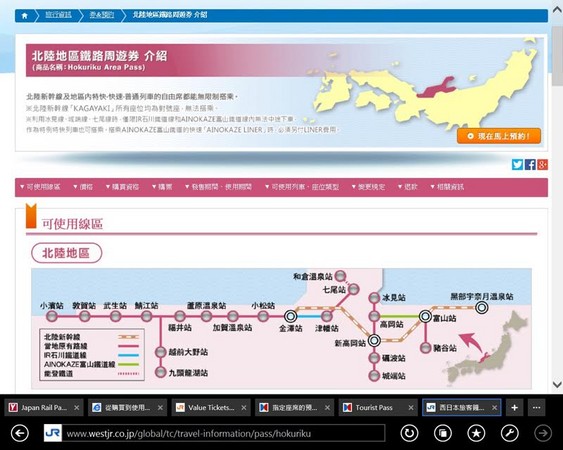
Issued by JR West Japan, this pass allows unlimited rides for four consecutive days from the activation date. Presenting the Pass grants you discounts on some other transportation services and attraction entry fees in the Hokuriku region.
How to purchase:
Purchase an exchange voucher (MCO/Miscellaneous Charges Order) from a travel agency in Taiwan before departure. Upon arriving in Japan, exchange it for a physical ticket using your passport and the voucher.
Alternatively, you can purchase and exchange the ticket directly in cities across the Hokuriku region in Japan such as Toyama, Takayama, Kanazawa, Matsumoto, Toyama Airport, Takaoka, and Komatsu. (There is no physical ticket counter at Komatsu Station—you can exchange the voucher there. Note: A service fee of 220 yen applies when purchasing in Japan as a foreigner.)
Coverage:
Unlimited rides in the free-seating cars of the Hokuriku Shinkansen between Kanazawa and Hakusan-Unazuki-Onsen, as well as on super express trains such as the “THUNDERBIRD” or limited express trains.
Unlimited rides on rapid and local trains operated by JR West Japan on conventional lines.
Not valid for the Hokuriku Shinkansen between Hakusan-Unazuki-Onsen and Tokyo.
Not valid for the IR Ishikawa Railway Line or the Ainokaze Toyama Railway Line.
Exception: If you ride within the IR Ishikawa Railway Line section between Kanazawa and Tsubata or the Ainokaze Toyama Railway Line section between Takaoka and Toyama without getting off midway, you may use the Rail Pass to board the Himi Line, the Seiryū Line, and the Nanao Line. On the Kanazawa–Tsubata section, the IR Ishikawa Railway operates super express trains—if you take those, you will need to pay the fare. Also, if you take the Ainokaze Toyama Railway’s rapid “Ainokaze LINER,” you will need to pay the LINER fare.
For detailed regulations, please check online: JR West Japan:http://www.westjr.co.jp/global/tc/travel-information/pass/hokuriku/
Kansai-Hokuriku Area Pass
Sold year-round by JR West Japan. When purchasing, you must specify a usage date. The pass is valid for seven consecutive days from the usage date. Presenting the Pass grants you discounts on some other transportation services and attraction entry fees in the Hokuriku region.
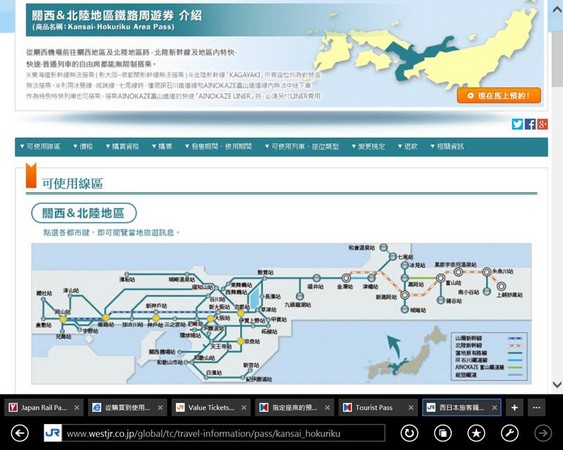
How to purchase:
Before departure, purchase an exchange voucher (MCO/Miscellaneous Charges Order) from a travel agency in Taiwan or pre-order on the JR West Japan website. Upon arriving in Japan, exchange the voucher and your passport for a physical ticket.
Alternatively, you can purchase and exchange the physical ticket directly at stations in Japan such as Kansai Airport, Osaka, Shin-Osaka, Kyoto, Kanazawa, Toyama, Komatsu, Tōbari (East), and Tōbari (West).
Coverage:
Unlimited rides in the free-seating cars of the Sanyo Shinkansen between Shin-Osaka and Okayama.
Unlimited rides in the free-seating cars of the Hokuriku Shinkansen between Kanazawa and Echigo-Yuzawa.
Unlimited rides in the free-seating cars of super express and limited express trains such as the HARUKA, THUNDERBIRD, KUROSHIO, KOUNOTORI, and SUPER HAKUTO (Kyoto–Kamigōri).
Unlimited rides on JR West Japan’s new rapid, rapid, and local trains on conventional lines.
Not valid for the Hokuriku Shinkansen between Echigo-Yuzawa and Tokyo.
Not valid for the Tokaido Shinkansen between Shin-Osaka and Tokyo.
|You cannot take the Sanyo Shinkansen between Shin-Onomichi ∼ Hakata.
}You cannot take the IR Ishikawa Railway Line or the AINOKAZE Toyama Railway Line.
Exception: You may use your rail pass on the IR Ishikawa Railway Line between Kanazawa ∼ Tsugawa and the AINOKAZE Toyama Railway Line between Takasaki ∼ Toyama without getting off at intermediate stations to access the Himi Line, Seinō Line, and Nanao Line. Note that the IR Ishikawa Railway operates super express trains on the Kanazawa ∼ Tsugawa section. If you take the AINOKAZE LINER rapid service on the AINOKAZE Toyama Railway Line, you will need to pay the LINER fare.
For detailed regulations, please check online: JR West:http://www.westjr.co.jp/global/tc/travel-information/pass/hokuriku/
5. Free Pass
Nagoya’s transportation system mainly consists of subways and buses. If you plan to take 3–4 train or bus rides in one day, purchasing a one-day pass is cost-effective.
'v Subway One-Day Pass: Can only be used on Nagoya Municipal Subways. Available year-round.
'w Bus One-Day Pass: Can only be used on Nagoya Municipal Buses. Available year-round.
'x Bus & Subway One-Day Pass: Can be used on both subways and Nagoya Municipal Buses, including Nagoya Sightseeing Buses.
'y Donichi Eco Ticket: Can be used on subways and municipal buses. Sold on the 8th of each month, every Saturday, Sunday, and holiday. The fare is cheaper than the subway one-day pass.
Share
This article is published by HowToTrip. Sharing and reposting are welcome — please credit the source.
Article URL: https://www.howtotrip.net/views-10627
Related Articles
- Shaoxing's "Grandpa Gourd" hangs the gourds back up: "If there are too many people, we'll interact less — just take a quick look from afar"
- Chinese authorities announce "reciprocal adjustment" to Japan visa fees — single-entry visa jumps from 2,250 to 16,750 yen!
- The "health stones" carried by a traveler were found to have radiation levels exceeding safety limits by a thousand times, potentially endangering fellow passengers on the same flight. Customs issues warning!
- Shenzhen Airport Issues Late-Night Notice: Unidentified Aerial Object Detected, Causing Widespread Flight Delays!
- “They only said it cost money after I opened the box and washed it!” 200g of grapes sold for 60 yuan on a high-speed train—12306 responds!
- Can't buy an airline ticket? Denied exit? Blocked from boarding? A large number of Chinese tourists have mysteriously become "discredited individuals"
- Adverse weather and economic fluctuations impact Colombia's coffee market
- Beach bathing area responds to 2 yuan/30 seconds fee for freshwater foot rinsing: Clearly priced!
- Taking off with an improperly closed cabin door? Wing malfunction? Multiple flights made emergency returns mid-journey!
- Experience the gifts of nature! A countdown of the world’s ten most stunning coastlines