Baiyun Rock in Mount Wuyi
Baiyun Rock in Mount Wuyi

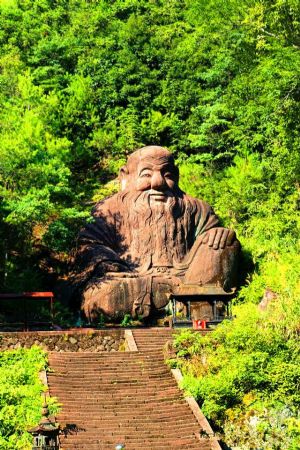
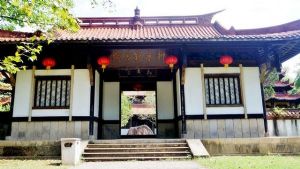
The temple is built against the cliff and beside the stream, resembling a hanging monastery. To reach the temple, one must cross Xingcun Bridge, follow the mountain path northeast for about half an hour to the foot of Baiyun Rock, and then climb the steps to get there. The temple was originally built during the Ming Dynasty but was destroyed by fire several times. It was rebuilt and completed in 1994. Following a narrow crevice along the waist of Baiyun Rock, the temple was constructed along the natural contour, with the mountain gate at the end, and in reverse order, the main hall and the kitchen.
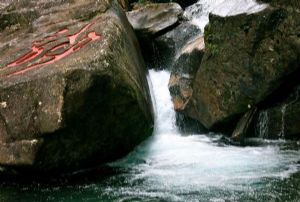
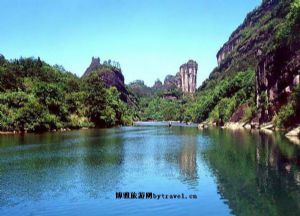
The main hall is built deep and high within the crevice, thus forming two levels with a delicate and compact layout. Leaning on the railing and looking south, you can see the Nine Bend River meandering like a ribbon, with Flame Mountain in the southwest clearly visible in the distance. Xu Xiake visited here in the 44th year of the Wanli reign of the Ming Dynasty (1616) and wrote: “Climbing to the top and looking south toward the upper reaches of the Nine Bend, I saw an islet standing alone in the middle, with the stream coming from the west, splitting around it, and then converging again at the bend. Beyond the islet, the mountains gradually open up as the Nine Bend comes to an end.” The panorama of mountains and rivers is truly breathtaking. Hence, the eminent Qing Dynasty monk Pengri inscribed the two characters “大观” (Grand View) on the rock face at Baiyun Rock. This cliff inscription can be found on the back wall behind the Buddha niche in the main hall of Baiyun Temple.
Baiyun Rock features overlapping cliffs that tower majestically above the clouds. At dawn, white clouds often drift halfway up the rock, gathering and dispersing unpredictably, hence the name Baiyun Rock. Several ruined walls remain on Baiyun Rock, which are the remnants of the former site of Baiyun Nunnery [photo]. Behind the nunnery is a cave called Baiyun Cave. Qiao Kun, a Taoist priest mentioned in the ancient Chinese novel Investiture of the Gods, which depicts King Wu of Zhou’s campaign against the Shang Dynasty, once cultivated himself here, calling himself a “hermit of Baiyun Cave in Mount Wuyi.” Later, for his contribution in helping Jiang Ziya break through the enemy formation, he was conferred the title of “God of Night Patrol.”
On the northern side of the rock is a spacious cave known as “Land of Ultimate Bliss.” The path leading into the cave is said to be the most perilous in all of Mount Wuyi. The entrance is flanked by sheer cliffs, with only a narrow horizontal ledge serving as the sole passage. One must crawl on hands and knees and move forward inch by inch to squeeze through the crevice and enter the cave. In the 44th year of the Wanli reign of the Ming Dynasty (1616), the famous Chinese traveler Xu Xiake first entered Fujian and visited Mount Wuyi. He partially experienced this dangerous journey and vividly described it in his Diary of Mount Wuyi: “I proceeded along the cliff ledge. Soon the ledge lowered, and the cliff became more precipitous, so I had to stoop low. The lower and narrower it got, the more I had to crawl on my knees and belly. When the ledge turned, there was only seven inches of vertical space and fifteen inches of width at the top, while the outer cliff dropped thousands of feet. I crawled forward, my chest and back rubbing against the cliff, and managed to get through the danger.”
The cave is indeed vast and layered, with signs of past attempts to carve a path through it but never completed.” Standing atop Baiyun Rock and looking south toward the upper reaches of the Nine Bend River, you’ll see open plains and fertile fields suddenly come into view, a scene quite unlike any other. The verse by Zhu Xi, the renowned Neo-Confucian scholar of the Southern Song Dynasty — “As the Nine Bend reaches its end, the view suddenly opens up; amidst the rain and dew, mulberry and hemp stretch over the plains” — describes the landscape of this area. Baiyun Rock marks the eastern gateway of the Yandang Mountain Scenic Area, covering a total area of about 46 square kilometers.






Share
This article is published by HowToTrip. Sharing and reposting are welcome — please credit the source.
Article URL: https://www.howtotrip.net/travel-19543
Related Articles
- Shaoxing's "Grandpa Gourd" hangs the gourds back up: "If there are too many people, we'll interact less — just take a quick look from afar"
- Chinese authorities announce "reciprocal adjustment" to Japan visa fees — single-entry visa jumps from 2,250 to 16,750 yen!
- The "health stones" carried by a traveler were found to have radiation levels exceeding safety limits by a thousand times, potentially endangering fellow passengers on the same flight. Customs issues warning!
- Shenzhen Airport Issues Late-Night Notice: Unidentified Aerial Object Detected, Causing Widespread Flight Delays!
- “They only said it cost money after I opened the box and washed it!” 200g of grapes sold for 60 yuan on a high-speed train—12306 responds!
- Can't buy an airline ticket? Denied exit? Blocked from boarding? A large number of Chinese tourists have mysteriously become "discredited individuals"
- Adverse weather and economic fluctuations impact Colombia's coffee market
- Beach bathing area responds to 2 yuan/30 seconds fee for freshwater foot rinsing: Clearly priced!
- Taking off with an improperly closed cabin door? Wing malfunction? Multiple flights made emergency returns mid-journey!
- Experience the gifts of nature! A countdown of the world’s ten most stunning coastlines