Huangyangjie
Huangyangjie

The terrain of Huangyangjie is majestic and precipitous. Looking out from afar, the undulating mountains are enveloped in mist, white as an endless sea, while Huangyangjie appears like an isolated island in the ocean. This is why people call Huangyangjie the “0 Sea” or “Wangyang Sea.” Due to natural conditions such as the terrain and valley circulation, the climate here is changeable—with strong winds, frequent fog, and peculiar clouds. The enchanting mist and rolling dense clouds resemble a surging sea when viewed from afar, presenting a spectacle of mountains surging forward and white clouds filling the valleys. It’s a marvelous sight that makes you feel as if you’re not on earth.
Watching the Sunrise at Huangyangjie: Huangyangjie is one of the best spots on Jinggang Mountain to watch the sunrise. The sunrise here is extraordinarily spectacular.
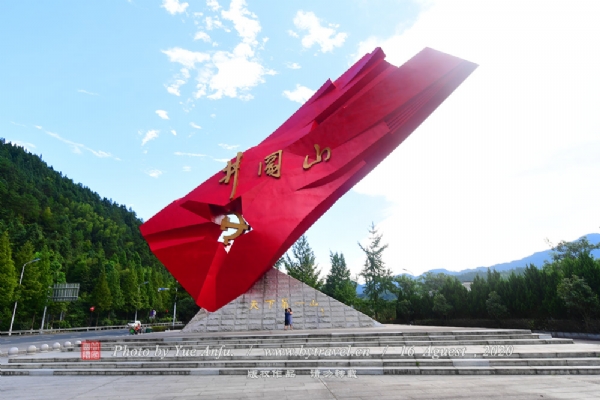
On August 30, 1928, the famous Battle of Huangyangjie took place here. To this day, the original sentry fortifications, the Red Army barracks, and the path that Mao Zedong, - and Red Army soldiers once took to carry grain from Ninggang, along with the lotus trees by the roadside, are still preserved. Huangyangjie stretches for miles with overlapping high mountains, presenting a majestic and precipitous view as far as the eye can see. In May 1965, Mao Zedong wrote in his poem “Shuidiao Getou – Returning to Jinggang Mountain”: “Once past Huangyangjie, no other perilous scene need be seen.” Here, you can also enjoy natural attractions such as sunrises, mountain ridges, sea of clouds, and azaleas.
Dajing: “Xingzhou Prefecture, Ciping County, the five big and small wells are the imperial palace.” This is a folk rhyme that was popular among the people of Jinggang Mountain in those days. The “big and small five wells” refer to five villages on Jinggang Mountain—Dajing, Xiaojing, Zhongjing, Shangjing, and Xiajing. The five villages are surrounded by layers of undulating mountains, resembling wells in shape, hence the name. Dajing is the largest of the five villages, located 7 kilometers from Ciping. Dajing was one of the important places where great figures of the time such as Mao Zedong, -, Chen Yi, and Peng Dehuai, along with the Red Army, carried out revolutionary activities.
Bamianshan: The Bamianshan Sentry Post is located 19 kilometers northwest of Ciping, at an altitude of 1,484 meters, and is one of the five major sentry posts of the Jinggang Mountain military base area. Standing at the sentry post and looking into the distance, the continuous undulating mountain peaks are all in view, hence the name “Bamianshan” (Eight-Faced Mountain).
Shangjing: Features the revolutionary cultural attraction “Shangjing Red Army Mint” and the natural attraction “Bamboo Garden.”
A mysterious natural phenomenon—the Buddha’s Light—has appeared here multiple times. At around 7:40 AM on April 10, 1983, meteorological workers near the Huangyangjie weather observation field spotted a colorful ring of light, red on the outside and purple on the inside, which pierced through the thick clouds and mist. People’s shadows were refracted within the ring, moving as they moved and jumping as they jumped. This phenomenon has been observed multiple times since then, sometimes lasting only an instant, other times continuing for tens of minutes. Scientists believe this occurs because to the southeast lies a deep valley with high humidity, forming dense clouds and mist. When touched by the low-angle sunlight of dawn or dusk, the light diffracts through countless tiny water droplets, creating a colorful ring. Observers facing the ring with their backs to the sun have their shadows projected onto the cloud curtain by the backlight, resulting in this marvel.
Address: Inside the Jinggang Mountain Scenic Area, Ji’an City, Jiangxi Province (north of Ciping)
Type: Mountain
Recommended Visiting Time: 4–5 hours
Phone: 0796-6550550 (Jinggang Mountain Scenic Area)
Opening Hours:
8:00–17:00 (slight adjustments may be made by season)
Ticket Information:
No separate ticket required. Included in the Jinggang Mountain Scenic Area ticket.


Share
This article is published by HowToTrip. Sharing and reposting are welcome — please credit the source.
Article URL: https://www.howtotrip.net/travel-19497
Related Articles
- Shaoxing's "Grandpa Gourd" hangs the gourds back up: "If there are too many people, we'll interact less — just take a quick look from afar"
- Chinese authorities announce "reciprocal adjustment" to Japan visa fees — single-entry visa jumps from 2,250 to 16,750 yen!
- The "health stones" carried by a traveler were found to have radiation levels exceeding safety limits by a thousand times, potentially endangering fellow passengers on the same flight. Customs issues warning!
- Shenzhen Airport Issues Late-Night Notice: Unidentified Aerial Object Detected, Causing Widespread Flight Delays!
- “They only said it cost money after I opened the box and washed it!” 200g of grapes sold for 60 yuan on a high-speed train—12306 responds!
- Can't buy an airline ticket? Denied exit? Blocked from boarding? A large number of Chinese tourists have mysteriously become "discredited individuals"
- Adverse weather and economic fluctuations impact Colombia's coffee market
- Beach bathing area responds to 2 yuan/30 seconds fee for freshwater foot rinsing: Clearly priced!
- Taking off with an improperly closed cabin door? Wing malfunction? Multiple flights made emergency returns mid-journey!
- Experience the gifts of nature! A countdown of the world’s ten most stunning coastlines