Yunwo
Yunwo

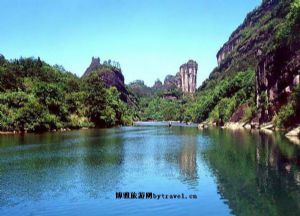
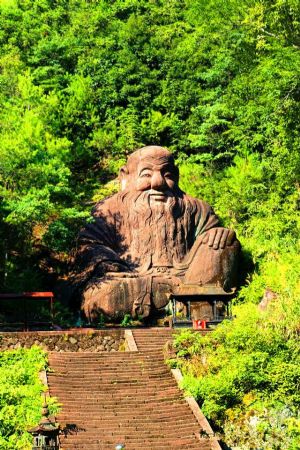
This can be considered one of the most beautiful spots in Wuyi Mountain. It is located on the north bank between the Fifth and Sixth Bends, nestled between Xianzhang Peak and Jiesun Peak, backed by mountains and fronted by water, with numerous striking peaks. The name comes from the frequent clouds and mist that drift here at dawn and dusk. The best time to view the clouds is during early mornings and evenings in late spring and early autumn.
Yunwo is divided into Upper Yunwo and Lower Yunwo. Backed by cliffs and facing the water, it is surrounded by Xiangyin Rock, Danlu Peak, WanDui Peak, Tianyou Peak, and Yinping Peak. Beneath the rugged rocks lie many caves. In winter and spring, wisps of mist often drift out from these caves, curling among the peaks and rocks. Other scenic spots include Tixiang Stone, Fuhu Rock, Juluo Cave, as well as historical ruins such as Shugei Retreat, Shuiyun Liao, and Youxi Thatched Cottage.
At the foot of the mountain lies the Ziyang Academy, where Zhu Xi once lectured. In the 11th year of the Wanli era of the Ming Dynasty (1583 AD), Chen Yesheng, Vice Minister of War, retired here and built the Youxi Thatched Cottage along with Binyun Hall and Qiyun Pavilion, though only cliff inscriptions remain today. Across the stream from Yunwo lies Xiangyin Rock, where visitors’ calls and laughter produce echoes. The rock features inscriptions by many notable figures. Below the rock stands a stone shaped like a cuttlefish by the stream; to its right, another stone juts across the stream, forming a perilous shoal known as “Old Crow Shoal.”
Yunwo is situated beneath the western cliffs of Jiesun Peak, encircled by Xiangyin Rock, Danlu Rock, Xianji Rock, Tianzhu Peak, Gengyi Platform, Tianyou Peak, and Cangping Peak. Here, massive rocks stand tall against the mountain and water, located in the heart of Wuyi Mountain Scenic Area, making it the premier attraction. Yunwo has over ten large and small caves. During the early mornings and evenings of winter and spring, faint clouds often emerge from the caves, drifting lightly among the peaks and stones—sometimes gathering into clusters, sometimes dispersing, shifting unpredictably, hence the name Yunwo (Cloud Nest).
Yunwo is divided into Upper Yunwo and Lower Yunwo. The area above Tixiang Rock is called Upper Yunwo; the area below is called Lower Yunwo. According to the Records of Wuyi Mountain, Yunwo has long been a retreat for ancient literati, officials, and hermits seeking peace. In the 11th year of the Wanli era (1583 AD), Vice Minister of War Chen Sheng built the Youxi Thatched Cottage between Upper and Lower Yunwo, which included Binyun Hall, Qiyun Pavilion, Chaoyun Tower, Shengyun Platform, Chiyun Pavilion, and Tingyun Pavilion—sixteen structures in total, all exquisitely ornate. Sadly, these buildings have long since collapsed, leaving only cliff inscriptions that hint at their former splendor.
To restore the historic charm of Yunwo, the premier scenic area of Wuyi Mountain, in recent years the Wuyi Mountain Management Committee has reconstructed more than ten antique-style pavilions and pavilions made of bamboo, wood, and cement on the original sites. These include Shuiyue Pavilion, Shizao Qinglian Pavilion, Baiyun Pavilion, Wangxian Pavilion, and Xianyi Pavilion. Some are built on cliffs towering thousands of feet high; some stand by the Nine Bend Stream; others are tucked within bamboo groves. The pavilions feature classic wooden chairs where visitors can rest.
Tiger Cave: One of the seventy-two famous caves of Wuyi Mountain. It is an entrance tunnel along the Cloud Path Stone leading into Yunwo. The cave is spacious enough to hold over a hundred people. Inside, there are stone tables and chairs that offer a cool retreat in summer and warmth in winter for visitors to rest. Luohan Rock: This is a rock formation that marks the entrance to Yunwo, named for its resemblance to a luohan (Buddhist arhat). A pavilion called Duoxiu Pavilion was originally built here by Hu Yin, a scholar of the Southern Song Dynasty. When Zhu Xi constructed the Wuyi Scholarly Retreat at the Fifth Bend, he renovated it and renamed it Tie Di Pavilion, inspired by Hu Yin’s verse: “Better yet, play your iron flute, let the immortals hear.” Beneath the rock lies a vast cave that connects from end to end—the Luohan Cave.
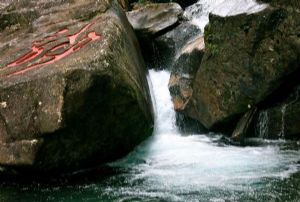
Qingyin Rock: One of the ninety-nine famous rocks of Wuyi Mountain. Located on the northern wall of Chadian, the steep cliff leans against the base of Tianyou Peak. The rock face bears the inscription “Qingyin” (Tranquil Seclusion). The character is a variant of 玄 (Xuan), missing the “mountain” radical and two “mouth” radicals, as the towering mountain and two springs at the foot serve as substitutes for those parts. The inscription is creatively designed, and the surrounding scenery is serene and secluded. A Song Dynasty official, Liu Kui, wrote a poem here: “A land far from the mortal world, stone gates shut by clouds. A recluse lives carefree, visited by white cranes coming and going.”
Shugei Retreat: Located at the heart of the Yunwo scenic area. In the 5th year of the Zhenghe era of the Northern Song Dynasty (1115 AD), imperial envoy Su Deyu was tasked with inviting the virtuous scholar Jiang Zhi (courtesy name Shugei) from Chongan to serve in the imperial court. Jiang declined three times. The envoy then ordered the local magistrate Chen Nan to build the Shugei Retreat for him at Yunwo. The plaque read “Shugei Retreat,” and Jiang was honored with the title Shaowei Master (Shaowei Star, also known as the Literary Star, symbolizes the emergence of great scholars). The site was thus established to commend his virtue, and the gate is also called the Shaowei Gate.
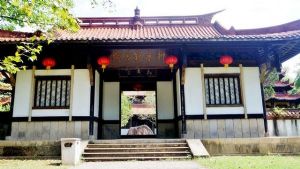
Nearby, there is also a significant rock inscription: “The dwelling place of Shugei, author of ‘Detailed Excerpts from Comprehensive Mirror to Aid in Government.’” Jiang Zhi’s nephew, Jiang Dexiu, adhered to his family’s scholarly tradition, studied diligently, and eventually rose to the rank of Court Gentleman for Consultation. The court built him a retreat named Huaiyang Academy, located at the base of Jiesun Peak. Both inside and outside the memorial archway were imperial lands. By the Ming Dynasty, due to declining prestige, the land was sold to Chen Sheng, a former official from Changle, who built his retreat here for 13 years. It was later acquired by Li Shixing, a retired official from the late Ming period. In the 12th year of the Yongzheng era of the Qing Dynasty (1734 AD), Jiang Rui, a descendant of Jiang Zhi, redeemed the ancestral property from the Li family, expanded the grounds to include Upper and Lower Yunwo, Jiesun Peak, Tianyou Peak, Tianhu Peak, Cangping Peak, and parts of the abandoned Yuan Dynasty Imperial Tea Garden. He also built the Fengxian Ancestral Shrine on the site of the Huaiyang Academy to enshrine Jiang Zhi and Jiang Dexiu. The site still preserves the Shaowei Gate and the monument of the Jiang Family Ancestral Shrine. The gate plaque, couplets, and other features remain intact.






Share
This article is published by HowToTrip. Sharing and reposting are welcome — please credit the source.
Article URL: https://www.howtotrip.net/travel-19031
Related Articles
- Shaoxing's "Grandpa Gourd" hangs the gourds back up: "If there are too many people, we'll interact less — just take a quick look from afar"
- Chinese authorities announce "reciprocal adjustment" to Japan visa fees — single-entry visa jumps from 2,250 to 16,750 yen!
- The "health stones" carried by a traveler were found to have radiation levels exceeding safety limits by a thousand times, potentially endangering fellow passengers on the same flight. Customs issues warning!
- Shenzhen Airport Issues Late-Night Notice: Unidentified Aerial Object Detected, Causing Widespread Flight Delays!
- “They only said it cost money after I opened the box and washed it!” 200g of grapes sold for 60 yuan on a high-speed train—12306 responds!
- Can't buy an airline ticket? Denied exit? Blocked from boarding? A large number of Chinese tourists have mysteriously become "discredited individuals"
- Adverse weather and economic fluctuations impact Colombia's coffee market
- Beach bathing area responds to 2 yuan/30 seconds fee for freshwater foot rinsing: Clearly priced!
- Taking off with an improperly closed cabin door? Wing malfunction? Multiple flights made emergency returns mid-journey!
- Experience the gifts of nature! A countdown of the world’s ten most stunning coastlines