Longchuan Grand Canyon
Longchuan Grand Canyon

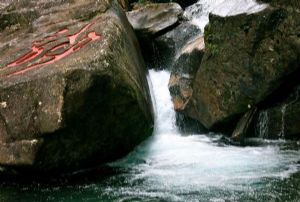
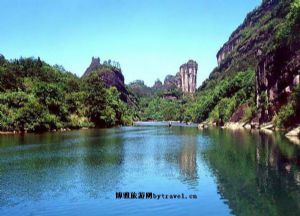
The red rock formations of Longchuan are consistent with Wuyishan’s overall Danxia landform. Due to the complexity of the terrain and years of erosion and carving by flowing water, there are two waterfalls with a hundred-meter drop within nearly one kilometer, along with over ten smaller waterfalls, caves, hidden pools, and rock cavities. The red rocks of Longchuan Grand Canyon were formed due to the influence of the Yanshan Movement (135 million years ago) in the late Mesozoic era, when Wuyishan rose from the seabed to become land. Subsequently, after the Himalayan orogeny 25 million years ago, hills and high mountains emerged here. The red sandstone from the late Cretaceous period forms the main body of the canyon’s fiery red cliffs, belonging to the pre-Sinian and Sinian metamorphic rock series.
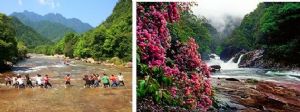
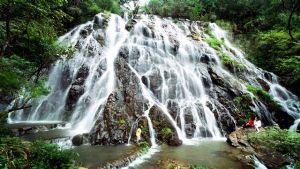
The Thousand-Layer Waterfall derives its name from its many folds, often described as "layered Danxia terraces." The Dragon’s Nine Turns, as the name suggests, refers to the stream’s winding path through the Danxia cliffs, resembling a dragon twisting through eighteen bends. This gentle stream flows along the fiery red cliffs, as if a snake were slithering through, though geologically, it represents fracture marks from the orogeny period.
The Guanyin Waterfall, the second-largest in Longchuan, has a drop of 58 meters. Looking up at it from the Immortal-Mortal Bridge, you’ll see two large and small peculiar rocks in the middle. The larger one on the west side depicts Guanyin Bodhisattva meditating with her back to the wall, while the smaller one beside her is her attendant “Dragon Girl.” The kind-hearted Boy Sage is off delivering children to families who “do good deeds,” as tasked by Guanyin. Among Wuyishan’s ten oddities: trees grow outside rocks; live snakes are sold soaking in liquor; the reserve has bizarre mountain corners; rocks even fall in love; a utopia still exists today; leaves are roasted and served as dishes; Tongmu black tea—unique; cliffside strongholds stand firm; every household sells tea; bamboo rafting is loved by all.
The Red Cliff Waterfall has a drop of 98 meters and a width of 38 meters. The waterfall cascades from a nearly hundred-meter-high cliff. “Savor the red cliffs, glance back, and linger at the flying waterfall, unwilling to leave.” The Siyuan Waterfall is the highest point in Longchuan Grand Canyon, named for its meaning of “remembering the source of the waterfall.”
The local name for Longchuan Grand Canyon is Dawanggong, and the current hiking trail is called Changlingkeng. Before the road was built, this was the essential passageway for villagers from all directions, who made a living through hunting, fishing, and logging. The top of the Siyuan Waterfall was once a bustling residential area called Hezhi, which even had a market. People often floated their timber downriver to sell in places like Fuzhou, as the wood was of such high quality that it fetched excellent prices, earning the saying “an inch of wood is worth an inch of gold.”
Legend has it that in the past, the ancestors of the dragons, fleeing a celestial disaster, escaped from the sea and wandered with their entire clan until they arrived in Wuyishan. They ultimately chose this very secluded grand canyon to settle temporarily. With the dragons’ protection, the area enjoyed year-round favorable weather, and the trees grew exceptionally lush and vibrant. Birds, beasts, insects, and fish flocked here to inhabit the place. Villagers from nearby regions, drawn by dreams, relocated to the banks of Changlingkeng, gradually forming a lively settlement with a market. The clan leader guarding Changlingkeng, surnamed Zhang, had eight sons and one daughter. All eight sons were brave and strong—skilled in hunting in the mountains and fishing in the waters—leading to a very happy and joyful family life. Their eighty-year-old grandmother, with snow-white hair but a youthful face, could still sing beautiful mountain songs like a young girl. The dragon family deeply fell in love with this place, often transforming into young men and women to work and live joyfully alongside the villagers.
It was under these circumstances that the young dragon met Princess Changling of the Zhang family and developed sincere love. However, disaster struck—when the old dragon king reported the human world’s disasters to the Jade Emperor, his bold honesty angered the Jade Emperor. Coupled with the slander of treacherous ministers, the old dragon king was severely punished and ordered to return to the sea within a deadline. Enraged, the old dragon king fumed but could do nothing, as heavenly decrees could not be defied. He had no choice but to lead his dragon clan, reluctantly, back to the sea. Yet, the young dragon swore never to return, preferring to be petrified just to stay with Princess Changling. In the end, he was turned into stone and remains in the Hidden Dragon Pool of Longchuan.






Share
This article is published by HowToTrip. Sharing and reposting are welcome — please credit the source.
Article URL: https://www.howtotrip.net/travel-18623
Related Articles
- Shaoxing's "Grandpa Gourd" hangs the gourds back up: "If there are too many people, we'll interact less — just take a quick look from afar"
- Chinese authorities announce "reciprocal adjustment" to Japan visa fees — single-entry visa jumps from 2,250 to 16,750 yen!
- The "health stones" carried by a traveler were found to have radiation levels exceeding safety limits by a thousand times, potentially endangering fellow passengers on the same flight. Customs issues warning!
- Shenzhen Airport Issues Late-Night Notice: Unidentified Aerial Object Detected, Causing Widespread Flight Delays!
- “They only said it cost money after I opened the box and washed it!” 200g of grapes sold for 60 yuan on a high-speed train—12306 responds!
- Can't buy an airline ticket? Denied exit? Blocked from boarding? A large number of Chinese tourists have mysteriously become "discredited individuals"
- Adverse weather and economic fluctuations impact Colombia's coffee market
- Beach bathing area responds to 2 yuan/30 seconds fee for freshwater foot rinsing: Clearly priced!
- Taking off with an improperly closed cabin door? Wing malfunction? Multiple flights made emergency returns mid-journey!
- Experience the gifts of nature! A countdown of the world’s ten most stunning coastlines