Hometown of Zhu Xi
Hometown of Zhu Xi

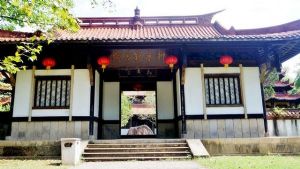
Wufu Town is located in the southeastern part of Wuyishan City. It is not only known as the “Hometown of White Lotus,” but also referred to as the “Origin of Zoulu Culture.” It is the birthplace of the Neo-Confucian master Zhu Xi and the birthplace of Zhu Xi’s philosophy. Zhu Xi studied under teachers here for over 40 years, leaving behind historical relics such as Xingxian Academy, Zhuzi Lane, and Ziyang Building. Zhu Xi once lectured and taught students at Xingxian Academy. The name “Xingxian” is said in folklore to imply “cultivating the virtuous and nurturing the talented,” carrying the meaning of carrying on the past and opening up the future. Today, in the academy, you can admire plaques written in the style of Zhu Xi’s calligraphy, such as “Carrying On the Past and Opening the Future,” along with various couplets.
Zhuzi Lane is the boundary between Zhonghefang and Rulinfang in Wufu. The lane is entirely paved with cobblestones, winding with many turns, and lined with ancient high walls on both sides. Walking through it, you can almost hear the echoes of Zhu Xi’s footsteps as he pursued his studies. Zhu Xi lived in Wufu Town for nearly 50 years, and he passed through this small lane every time he went out.
Next to Zhuzi Lane is the Lian Family Chastity Archway, which was first built in the 16th year of the Guangxu reign of the Qing Dynasty (1890). The archway’s plaque is inscribed with “Imperial Edict” and “Erected in Honor of Madam Lian, Mother of Liu, Wife of the Imperial Examination Candidate Guan, by Historian Shi Yuan.” The brick reliefs on the facade depict figures, stories, auspicious birds, and mythical beasts, featuring elegant design and exquisite craftsmanship. The interior has sturdy beams and columns, with exquisitely carved window lintels and beam supports. The entire structure of the gate and building is well-preserved, representing a typical Qing Dynasty architectural style with some Ming influences.
Ziyang Building is located at the foot of Pingshan Mountain and by the Tanxi River, surrounded by towering ancient trees and bamboo forests. In front of the house is the Half-Mu Square Pond, and behind it is a lush bamboo grove. Legend has it that Zhu Xi’s poem *Reflections on Reading* was inspired by his hard studying by the pond, when he was moved to spontaneously write: “A half-mu square pond opens like a mirror; the light of sky and clouds linger together. Why is it so clear? Because it has a constant inflow of fresh water.” The Ziyang Building features a solemn and elegant architectural style, with one ridgepole and two courtyards. The front courtyard served as Zhu Xi’s study and bedroom. To honor his father, Zhu Xi named the bedroom “Weizhai” (after his father’s alias) and the study “Huaitang.” The central hall hangs a plaque inscribed “Ziyang Study Hall,” signifying his remembrance of his ancestral home, Huizhou’s Wuyuan (now in Jiangxi), known as Ziyang.
The architectural style of Ziyang Building is solemn and elegant, with plain blue bricks and tiles, consisting of one ridgepole and two courtyards. The front courtyard served as Zhu Xi’s study and bedroom. To uphold his father’s wishes, Zhu Xi named the bedroom “Weizhai,” using his father’s alias, and the study “Huaitang.” The central hall is hung with a plaque inscribed “Ziyang Study Room,” also symbolizing remembrance of his homeland, using the name of the Ziyang Mountain in his ancestral home of Wuyuan, Huizhou (now in Jiangxi). This plaque was personally written by Zhu Xi’s teacher, Liu Zihui. Zhu Xi himself wrote *Record of the Named Hall and Room* to express that he “dare not forget his late father’s aspirations.”
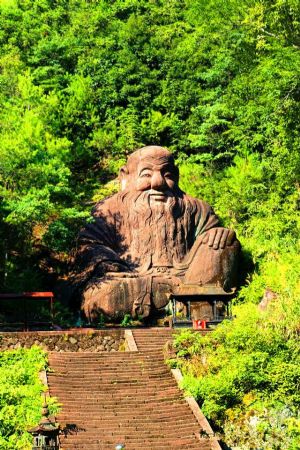
Zhu Xi, who reinterpreted and redefined Confucius’ thoughts, becoming the founder of the Neo-Confucian school that reached its ultimate stage with Ming Dynasty characteristics, was a master who transformed the entire Chinese nation’s Confucian concepts. He is also a pivotal figure in Chinese history. Zhu Xi returned to his mother’s hometown, Wufu Town, after his father’s death, caring for his mother for 40 years, thus having ample time to contemplate Confucius’ ideas, making Wufu Town the birthplace of Neo-Confucianism.
Zhu Xi (1130~1200) Zhu Xi, courtesy name Yuanhui, later changed to Zhonghui, also known as Huian, with the alias Ziyang, was from Wuyuan, Jiangxi, but born in Youxi, Fujian. His father, Zhu Song, served as the magistrate of Youxi County during the fifth year of the Xuanhe reign of the Song Dynasty (1123), and after his term, resided in the guesthouse of Zheng Andao in Shuinan County. On September 15 of the fourth year of the Jianyan reign (1130), Zhu Xi was born. Zhu Xi was intelligent and studious from an early age. At the age of 7, he moved with his parents to Jianzhou (now Jian’ou, Fujian). At the age of 14, following his father’s dying wish, he went to live with his friends Hu Xian and Liu Mianzhi in Chongan County. Hu and Liu treated Zhu Xi like their own nephew, arranged his life, and taught him enthusiastically. Liu Mianzhi even married his daughter to Zhu Xi. In the 18th year of the Shaoxing reign (1148), Zhu Xi passed the imperial examination...... More+







Share
This article is published by HowToTrip. Sharing and reposting are welcome — please credit the source.
Article URL: https://www.howtotrip.net/travel-18596
Related Articles
- Shaoxing's "Grandpa Gourd" hangs the gourds back up: "If there are too many people, we'll interact less — just take a quick look from afar"
- Chinese authorities announce "reciprocal adjustment" to Japan visa fees — single-entry visa jumps from 2,250 to 16,750 yen!
- The "health stones" carried by a traveler were found to have radiation levels exceeding safety limits by a thousand times, potentially endangering fellow passengers on the same flight. Customs issues warning!
- Shenzhen Airport Issues Late-Night Notice: Unidentified Aerial Object Detected, Causing Widespread Flight Delays!
- “They only said it cost money after I opened the box and washed it!” 200g of grapes sold for 60 yuan on a high-speed train—12306 responds!
- Can't buy an airline ticket? Denied exit? Blocked from boarding? A large number of Chinese tourists have mysteriously become "discredited individuals"
- Adverse weather and economic fluctuations impact Colombia's coffee market
- Beach bathing area responds to 2 yuan/30 seconds fee for freshwater foot rinsing: Clearly priced!
- Taking off with an improperly closed cabin door? Wing malfunction? Multiple flights made emergency returns mid-journey!
- Experience the gifts of nature! A countdown of the world’s ten most stunning coastlines