Xiangshan Nunnery in Jinggangshan
Xiangshan Nunnery in Jinggangshan
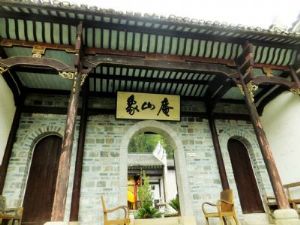
Xiangshan Nunnery is located in Jinggangshan City, Ji'an, Jiangxi Province, and is named after the nearby Xiangshan (Elephant Mountain). Originally built in the 12th year of the Kangxi reign during the Qing Dynasty (1713), it faces southwest and is situated to the northeast. Initially, it housed three main halls: the “Great Buddha Hall,” the “Bodhidharma Ancestral Hall,” and the “Thousand Meals Hall.” Legend has it that the nunnery once had 99 large pillars, and at its peak, 99 nuns practiced here.
During the revolutionary struggle in Jinggangshan, this site was an important hub for the Red Army. It hosted the Rear Base of the Fourth Red Army, the Artillery Company of the Fourth Red Army, and the printing press of the Special Committee of the Hunan-Jiangxi Border Area. Joint meetings of party organizations from Yongxin, Ninggang, and Lianhua counties, as well as the first party and league training class in the Hunan-Jiangxi border area, were also held here. Notably, the wedding of Comrade Mao Zedong and He Zizhen took place in this modest nunnery.
In early November 1927, to quickly restore the party organizations in border counties that had been severely damaged by the enemy following the failure of the Great Revolution—and to facilitate the establishment of the Jinggangshan Revolutionary Base Area—Comrade Mao Zedong presided over a joint meeting of former party organization leaders from Ninggang, Yongxin, and Lianhua counties here. Attendees included comrades such as Long Chaoqing (Ninggang), Wang Huai, Liu Zhen, Liu Zuoshu, He Minxue, Zhu Changxie, He Zizhen (Yongxin), and Zhu Yiyue (Lianhua). After thoroughly inquiring about the conditions of the county party organizations, Mao pointed out that there were too few worker and peasant party members and too many intellectuals, resulting in unstable party organizations and wavering commitment to the revolution. He urged the counties to rebuild their party organizations as soon as possible and actively carry out struggles. After the meeting, party members who had been hiding in the hills around Maoping returned to their respective counties, successively re-establishing and developing party organizations. They actively engaged in their work, formed local armed forces, mobilized the masses to overthrow local tyrants, distribute wealth, launch rural guerrilla uprisings, and lead their counties’ people in the great struggle to establish the Jinggangshan Revolutionary Base Area. By February 1928, the base area had taken control of three county towns—Ninggang, Chaling, and Suichuan—establishing red political power in all three and laying the foundation for the worker-peasant armed separatist movement in the Hunan-Jiangxi border region. This shows that the Xiangshan Nunnery Meeting was a crucial step in Mao Zedong’s efforts to establish the Jinggangshan Base Area.
At the same time, Xiangshan Nunnery also served as the rear base for the Worker-Peasant Revolutionary Army. Established in early October 1927 under the leadership of Comrade Yu Benmin, the rear base was mainly responsible for establishing and managing rear facilities such as field hospitals, clothing factories, and weapons repair workshops. Thanks to the hard work of the comrades at the rear base and the support of the people in the base area, the rear operations were carried out exceptionally well, making a significant contribution to the establishment and development of the Jinggangshan Revolutionary Base Area.
Address: Maoping Village, Jinggangshan City
Type: Historical Architecture
Opening Hours:
08:00–17:00
Ticket Information:
No separate ticket required. Included in the general Jinggangshan Scenic Area admission.
Share
This article is published by HowToTrip. Sharing and reposting are welcome — please credit the source.
Article URL: https://www.howtotrip.net/travel-18575
Related Articles
- Shaoxing's "Grandpa Gourd" hangs the gourds back up: "If there are too many people, we'll interact less — just take a quick look from afar"
- Chinese authorities announce "reciprocal adjustment" to Japan visa fees — single-entry visa jumps from 2,250 to 16,750 yen!
- The "health stones" carried by a traveler were found to have radiation levels exceeding safety limits by a thousand times, potentially endangering fellow passengers on the same flight. Customs issues warning!
- Shenzhen Airport Issues Late-Night Notice: Unidentified Aerial Object Detected, Causing Widespread Flight Delays!
- “They only said it cost money after I opened the box and washed it!” 200g of grapes sold for 60 yuan on a high-speed train—12306 responds!
- Can't buy an airline ticket? Denied exit? Blocked from boarding? A large number of Chinese tourists have mysteriously become "discredited individuals"
- Adverse weather and economic fluctuations impact Colombia's coffee market
- Beach bathing area responds to 2 yuan/30 seconds fee for freshwater foot rinsing: Clearly priced!
- Taking off with an improperly closed cabin door? Wing malfunction? Multiple flights made emergency returns mid-journey!
- Experience the gifts of nature! A countdown of the world’s ten most stunning coastlines