Tongtianzhai
Tongtianzhai

Tongtianzhai isn’t very large, and its attractions are relatively concentrated. Within a 2-square-kilometer core area, you’ll find the Dashe Lotus Sightseeing Garden, the ancient dwelling Nanwu, the Tongtianzhai Eco Park, Tongtianyan, Yuyu Temple, Jingtuyan, the Sword-Testing Stone, the Stone Bamboo Shooting into the Sky, and the Bell and Drum Rocks, among others. The entire tour takes about two to three hours, and there are well-developed walking paths and signage. Highlights on the mountain include the "Gate of Life," a Danxia landform phenomenon featuring a yin-yang formation, the naturally formed Thousand Buddha Danxia, and the rare rock surface cracking formations. There’s also a glass observation deck where you can stand on transparent glass to enjoy the view and take photos, experiencing a thrilling sensation of being suspended in midair.
If you visit Tongtianzhai in July or August, the lotuses at the foot of the mountain will be in full bloom. Using the lotus pond as a foreground, you can capture the panoramic view of Tongtianzhai’s Danxia mountains, offering the most stunning scenery.
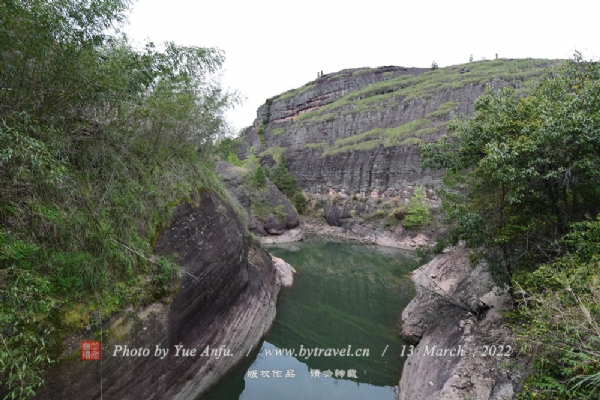
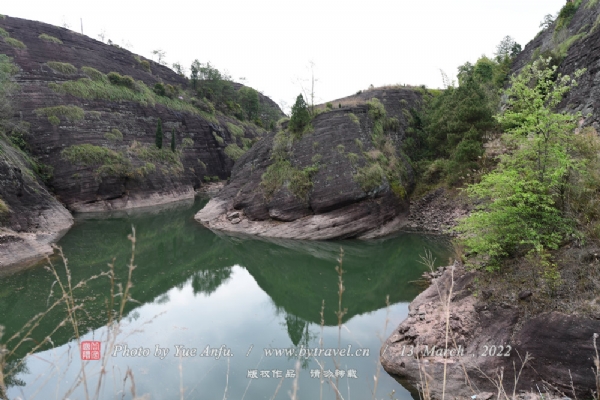
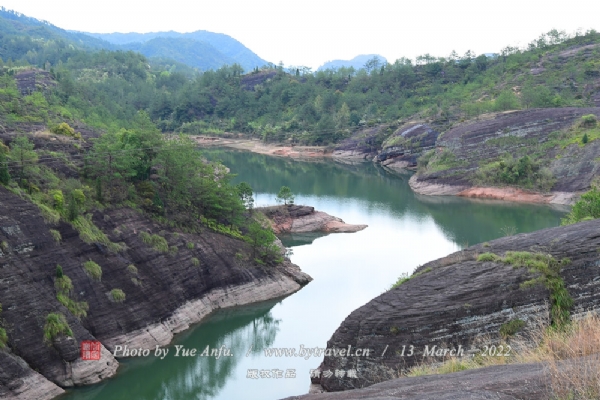
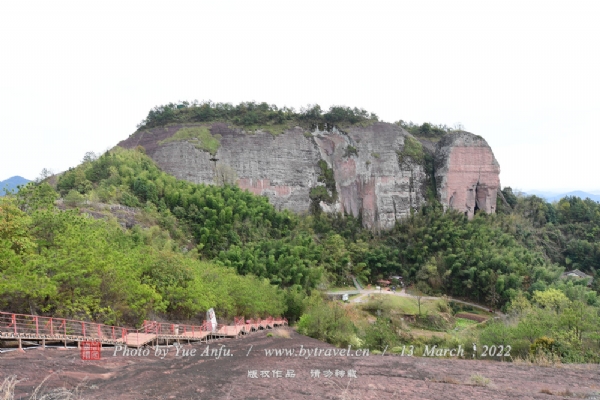
Tongtianzhai is a long-renowned Danxia landform scenic area, located in Dashe Village, 7 kilometers from Shicheng County Town. It earned its name because the main rock on the mount resembles two fingers pinching together on the outside and two palms half-closing on the inside, as if reaching toward the sky. The mount is covered with forest-like peculiar rocks, appearing as if Danxia formations stretch across the sky; the cracked stone slabs are poetically called "Immortals Plowing the Fields"; clear springs flow through the mount all year round, surrounded by lush bamboo and forests; and the area below is encircled by emerald waters, with rolling green mountains all around. The unique landscape and beautiful scenery create a breathtaking earthly paradise.
Before the road was built, access to Tongtianzhai was via an ancient Hakka post road known as the "Fujian-Guangdong Corridor." Walking along the smooth pebble-paved path, you can almost feel the hardships endured by the Hakka ancestors in constructing this vital route to Fujian and Guangdong. At the foot of Tongtianzhai lies a shimmering river, atop which stands a stone arch bridge built during the Song Dynasty by Hakka forebears—later referred to as "General Bridge." Legend has it that during the late Yuan and early Ming dynasties, Chen Youliang retreated to Tongtianzhai with his troops and heavily guarded this bridge. When Zhu Yuanzhang led his army in pursuit and fought over control of the bridge, the two sides engaged in fierce battle amid flashing blades, billowing smoke, and rivers of blood. In the end, several generals from both armies perished on the bridge. Afterward, the bridge was repaired and named General Bridge.
Just beyond General Bridge lies a traditional Hakka ancient village nestled against the mountains. Built during the Qing Dynasty’s Qianlong era and named Nanluwu, it was constructed by the Huang family and is a typical example of Hakka "courtyard-style" residential architecture. It consists of five interconnected courtyards, totaling ninety-nine and a half rooms. Stepping inside feels like entering a maze—you could walk through all ninety-nine rooms without seeing sunlight, showcasing the exceptional architectural skills of the Hakka ancestors. Descendants of the Huang family still live there today.
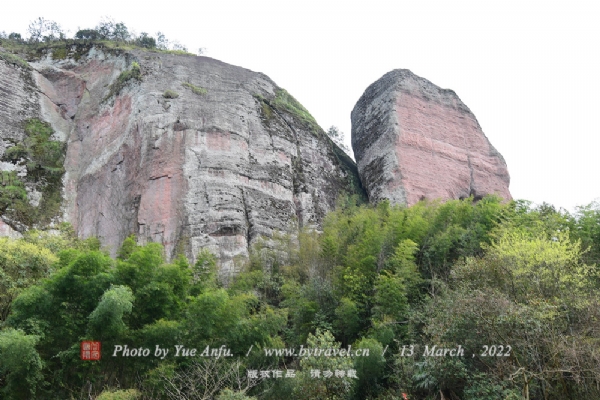
From the entrance of the Huang family village, you can see two towering stone pillars rising dramatically from Tongtianzhai, dozens of meters high—one tall and one short—called "Stone Bamboo Shooting into the Sky." Legend says that in ancient times, a male and female immortal traveled the world in search of a place for spiritual cultivation. One day, they unexpectedly met here and both fell in love with this auspicious land, neither willing to yield. When the standoff continued, the local earth god mediated, suggesting they each demonstrate their divine powers—the one with superior skill would claim the land. They agreed to compete by building celestial ladders to the heavens, with the first to reach the top declared the winner. Transforming instantly into two stone pillars, they shot wildly toward the sky. Focused solely on winning, their fierce upward thrust caused earthquakes, flying sand, and rolling stones, endangering all nearby life. The Heavenly Emperor, enraged, ordered the Thunder God to strike the rampaging pillars. With thunder and lightning, the Thunder God split the two pillars, leaving behind one tall and one short stone bamboo.
The path to climb Tongtianzhai runs along the base of a nearly 100-meter-high cliff. Looking up at the towering cliffs, you’ll be mesmerized by their myriad forms. Some rocks resemble majestic lions, others like eagles soaring or hawks overlooking chicks, some like Guanyin or monks in meditation—showcasing the finest collection of unusual rocks in the world. Not far up the path, a mountain gate built during the Song Dynasty stands solemnly in the valley, its powerful yet elegant inscribed characters “Shimen” (Stone Gate) sparking the imagination. Looking down from the gate, you’ll truly sense the imposing might of “one man guarding the pass, ten thousand unable to break through”—no wonder this has been a strategic military location throughout history.
Near the mountain’s summit stands the Yuyu Temple, built during the Ming Dynasty’s Wanli era. It is one of the province’s fourteen key open temples. Pilgrims flock here to worship, while visitors can also enjoy a cup of the famed Tongtian Tea. This tea has remained popular for centuries and was once a tribute to the imperial court, celebrated far and wide. Brewed with spring water from the mount, the tea is emerald green with a fragrant aroma.
Key attractions on the mount include the “Two Stone Bamboos Shooting into the Sky,” Tongtianyan, Jingtuyan, the Sword-Testing Stone, the Massacre Pit, the Shipside Cliff, Immortals Plowing the Fields, Wasps Hanging on Cliffs, Seven Immortals Viewing the Sea, the Bell, and the Drum—each more beautiful and more spectacular than the last, drawing endless streams of visitors.
Tongtianzhai was also an ancient battleground. Since the Song Dynasty, it has been a crucial strategic stronghold and a contested military site. Remnants of battle, such as broken walls and ruins, can be found everywhere. Today, you can still see traces of war at sites like Monkey City, the Massacre Pit, the Zhubu Fort, and the Changgeng Gate.
The scenic area contains numerous ancient stone carvings and steles. Throughout the dynasties, literati and poets visited to admire the scenery, sip tea, compose poetry, and write couplets, leaving behind many timeless masterpieces.
Address: Qianjiang Village, Qinqjiang Town, Shicheng County, Ganzhou City
Type: Mountain
Rating: AAAA
Recommended visiting time: 2–3 hours
Phone: 0797-5733177
Official website: http://www.scttz.com/
Opening hours:
8:00–17:00 in spring and winter (October–next May), 6:30–19:00 in summer (June–September).
Share
This article is published by HowToTrip. Sharing and reposting are welcome — please credit the source.
Article URL: https://www.howtotrip.net/travel-13542
Related Articles
- Shaoxing's "Grandpa Gourd" hangs the gourds back up: "If there are too many people, we'll interact less — just take a quick look from afar"
- Chinese authorities announce "reciprocal adjustment" to Japan visa fees — single-entry visa jumps from 2,250 to 16,750 yen!
- The "health stones" carried by a traveler were found to have radiation levels exceeding safety limits by a thousand times, potentially endangering fellow passengers on the same flight. Customs issues warning!
- Shenzhen Airport Issues Late-Night Notice: Unidentified Aerial Object Detected, Causing Widespread Flight Delays!
- “They only said it cost money after I opened the box and washed it!” 200g of grapes sold for 60 yuan on a high-speed train—12306 responds!
- Can't buy an airline ticket? Denied exit? Blocked from boarding? A large number of Chinese tourists have mysteriously become "discredited individuals"
- Adverse weather and economic fluctuations impact Colombia's coffee market
- Beach bathing area responds to 2 yuan/30 seconds fee for freshwater foot rinsing: Clearly priced!
- Taking off with an improperly closed cabin door? Wing malfunction? Multiple flights made emergency returns mid-journey!
- Experience the gifts of nature! A countdown of the world’s ten most stunning coastlines