Guanshe Village
Guanshe Village
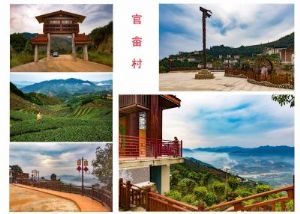
The Origins of Guanshe Village
Guanshe Village originated over 300 years ago during the Shunzhi era of the Qing Dynasty. A group of She people traveled upriver from Taikou, Hua’an, and settled around the ancient dock of Xinxu. Later, they spotted a spiral-shaped piece of land halfway up the mountain, where a Han Chinese family was already living. The head of that household had just passed the imperial examinations and was about to move to the prefectural capital of Zhangzhou to take up an official post. He handed over his home to the She people.
“First came the Han official, then the She people settled”—and thus the name “Guanshe” (官畲, meaning “Official She”) has been passed down to this day.
Unique Culture: The Festive “Fire-Inviting Festival”
Every year on the 12th day of the first lunar month, Guanshe Village holds its annual “Fire-Inviting Festival.”
On that day, a procession of She villagers, after inviting sacred fire from the mountaintop, forms a long dragon-like line. Accompanied by drums and music, they parade through the village, going through rituals such as “Treading the Altar,” “Stepping on Fire,” and “Grabbing the Fire.” The highlight of the event comes at the Phoenix Platform, where the “Stepping on Fire” ceremony pushes the festivities to a climax. She men carry statues of deities on their shoulders and barefoot dash across a pile of fiery charcoal reaching above their calves, sending sparks flying and drawing cheers from the crowd.
Finally, villagers of all ages grab shovels and spades prepared earlier to compete for a shovel-full of live coals to take home and place in their stoves. This act symbolizes bringing home the seeds of hope, good fortune, and prosperity, and expresses wishes for a thriving new year.
Sea of Clouds Tea Plantations
Just a few years ago, Guanshe She Village was the poorest ethnic minority village in Hua’an. But thanks to tea cultivation, in recent years the village—home to more than 400 residents—has become one of the county’s top-earning “prosperous villages” in terms of per capita income.
“Fragrant Tea, Prosperous Farmers, Beautiful She Village.” During the tea production season, the refreshing aroma of tea fills the entire She settlement. From National Day until Cold Dew, as the weather cools, Guanshe’s autumn tea fragrance wafts far and wide. Daily, tea merchants from Xiamen, Quanzhou, Guangdong, Hubei, Beijing, and other parts of the country flock to the village to snap up fresh tea. With prices often ranging from 300 to 500 yuan per jin (500g) of rough tea, premium tea fetching 800 or even 1,000 yuan per jin leads to scrambling and “rationing.” Some place advance deposits, others wait early in line, all afraid someone else might buy their chosen batch. The booming tea trade and rising prices year after year leave the village’s tea farmers beaming with joy.
Ethnic Charm: The Ancestral Shrine of the Village Founders
Guanshe Village still preserves a shrine dedicated to its founding ancestors. Originally, the residential buildings were centered around the ancestral house, with homes constructed on either side. In front of the ancestral house was a pond featuring symbols of the “Four Treasures of the Study” (writing brush, ink stick, paper, and inkstone). In the upper left corner of the pond stood a stone chair, which, if restored, would make a great spot for visitors. The area also retains folk songs and ancestral portraits. Before liberation, the entire village had only about 50 houses, more than 20 of which were thatched cottages. To guard against bandit raids, the whole village was enclosed by fences, sometimes even double-layered ones, and the entrance gates were designed to shut automatically—so much so that one had to be careful not to get their heels caught. On either side of the ancestral house stood two- to three-story towers. When bandits attacked, residents would lock their doors and retreat into these towers for defense and resistance. The towers were outfitted with gunports on all sides, allowing defenders to shoot at invaders with muzzle-loading guns. The bamboo fencing was a distinctive feature of Guanshe Village’s defenses against bandit raids.
Source: Fujian Provincial Tourism Development Commission
Share
This article is published by HowToTrip. Sharing and reposting are welcome — please credit the source.
Article URL: https://www.howtotrip.net/travel-11086
Related Articles
- Shaoxing's "Grandpa Gourd" hangs the gourds back up: "If there are too many people, we'll interact less — just take a quick look from afar"
- Chinese authorities announce "reciprocal adjustment" to Japan visa fees — single-entry visa jumps from 2,250 to 16,750 yen!
- The "health stones" carried by a traveler were found to have radiation levels exceeding safety limits by a thousand times, potentially endangering fellow passengers on the same flight. Customs issues warning!
- Shenzhen Airport Issues Late-Night Notice: Unidentified Aerial Object Detected, Causing Widespread Flight Delays!
- “They only said it cost money after I opened the box and washed it!” 200g of grapes sold for 60 yuan on a high-speed train—12306 responds!
- Can't buy an airline ticket? Denied exit? Blocked from boarding? A large number of Chinese tourists have mysteriously become "discredited individuals"
- Adverse weather and economic fluctuations impact Colombia's coffee market
- Beach bathing area responds to 2 yuan/30 seconds fee for freshwater foot rinsing: Clearly priced!
- Taking off with an improperly closed cabin door? Wing malfunction? Multiple flights made emergency returns mid-journey!
- Experience the gifts of nature! A countdown of the world’s ten most stunning coastlines