Rui Zhu Rock
Rui Zhu Rock
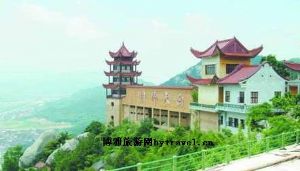
Rui Zhu Rock was established by the monk Chuxi during the Five Dynasties period. It got its name because when Chuxi cut through bamboo to channel spring water, withered bamboo unexpectedly sprouted shoots.
Originally, there was a temple built on the rock, along with stone caves, stone inscriptions, clear springs, and two iron trees planted during the Tang and Song dynasties. There is also a stone meditation bed on the mountain, said to be the spot where Chuxi entered deep meditation. Throughout history, figures such as Lin? and Chen Tianding from the Ming Dynasty studied here. Lin? built “Jieshi YunNest,” an octagonal pavilion; Chen Tianding carved a path through the mountain with a secluded entrance. On the overhanging cliffs are engraved the four large characters “Hai Ri Jiang Chun” (Sunrise over Sea, Spring on River). Later, Chen Tianding served as a Langzhong in the Ministry of Personnel and composed a couplet inscribed on the stone pillars of the main hall on the rock: “When the wind calms, the tide is just full; when the mountain is empty, the moon is directly overhead.” The Grand Secretary Lin? also inscribed a couplet on the stone pillars: “All rooted in wisdom flourish lushly; the highest good speaks silently yet spreads boundlessly.” Dai?, a Jinshi scholar of the Qing Dynasty’s Kangxi era (year of Ji Chou) and magistrate of Shouchangyuan County, wrote in his regulated poem “Visiting Rui Zhu Rock”: “Pine trees cluster in chaos, making the way seem lost; a hollow rock forms a natural gate.” In modern times, the art master Li Shutong (also known as Master Hongyi) stayed here when Xiamen fell to Japanese forces during the War of Resistance. In recent years, the site has been renovated and expanded, appearing even more magnificent and grand.
Share
This article is published by HowToTrip. Sharing and reposting are welcome — please credit the source.
Article URL: https://www.howtotrip.net/travel-10849
Related Articles
- Shaoxing's "Grandpa Gourd" hangs the gourds back up: "If there are too many people, we'll interact less — just take a quick look from afar"
- Chinese authorities announce "reciprocal adjustment" to Japan visa fees — single-entry visa jumps from 2,250 to 16,750 yen!
- The "health stones" carried by a traveler were found to have radiation levels exceeding safety limits by a thousand times, potentially endangering fellow passengers on the same flight. Customs issues warning!
- Shenzhen Airport Issues Late-Night Notice: Unidentified Aerial Object Detected, Causing Widespread Flight Delays!
- “They only said it cost money after I opened the box and washed it!” 200g of grapes sold for 60 yuan on a high-speed train—12306 responds!
- Can't buy an airline ticket? Denied exit? Blocked from boarding? A large number of Chinese tourists have mysteriously become "discredited individuals"
- Adverse weather and economic fluctuations impact Colombia's coffee market
- Beach bathing area responds to 2 yuan/30 seconds fee for freshwater foot rinsing: Clearly priced!
- Taking off with an improperly closed cabin door? Wing malfunction? Multiple flights made emergency returns mid-journey!
- Experience the gifts of nature! A countdown of the world’s ten most stunning coastlines