Zhangzhou South Fort
Zhangzhou South Fort
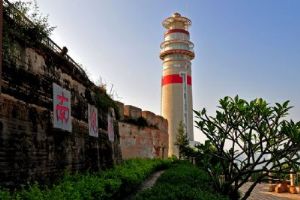
Yuzaiwei South Fort was built in the spring of 1840 during the Qing Dynasty’s Daoguang reign by Deng Tingzhen, the Viceroy of Min-Zhe, in coordination with national hero Lin Zexu’s anti-opium campaign in Guangdong, as part of preparations to resist foreign aggression. By 1891 during the Guangxu reign, the fort was expanded and equipped with Krupp cannons manufactured in Germany, including one main gun and three secondary guns, making them “sister cannons” to those at Xiamen’s Hulishan Fort. The fort complex included a castle, barracks, trenches, an ammunition depot, and a training ground. The fort walls were constructed from rammed earth in an elliptical shape, with a perimeter of about 240 meters, a height of 6 meters, and a thickness of 1.5 meters. The walls featured crenellations, embrasures, and gun ports. Despite over a century of weathering, the walls remain solid and intact. The three secondary guns have long been dismantled, and the main gun was also removed in 1953 during the construction of the Xiamen Gaoqi–Jimei Seawall.
In June 1840, when the Opium War broke out, Charles Elliot, commander-in-chief of the British invasion forces, led over 40 warships to attack Guangdong. After encountering strong resistance from Chinese troops and civilians with no opportunity for an easy victory, he redirected his fleet to harass Xiamen. On July 2 and August 22, British ships intruded into Qingyu Mouth and the inner harbor of Xiamen, respectively, and were met with brave counterattacks from the local military and civilians. On the afternoon of August 24, when British ships chased a Chinese merchant vessel with three sampans, the soldiers at Yuzaiwei South Fort witnessed the scene and were filled with righteous indignation. They aimed their cannons at the British ships and launched fierce bombardments, demonstrating the might of the Chinese people, forcing the British ships to retreat. After the Marco Polo Bridge Incident in July 1937, Japanese invaders attempted to occupy Xiamen Island, a key strategic point on China’s southeastern coast. On August 24, they evacuated the last group of Japanese residents from Xiamen and subsequently declared a naval blockade of southern Chinese waters, including Xiamen. Around 4 a.m. on September 3, Japanese forces brazenly dispatched several warships, including the “Hatsuyuki” and “Wakatake,” to provoke near the lighthouse of Dadan Island. The patriotic officers and soldiers of Yuzaiwei South Fort, who had long prepared themselves for resisting Japan and defending the nation, under the command of gun captain He Rongguan, fired furious shells at the Japanese ships, firing the first shots of the Xiamen region’s Anti-Japanese War. The Baise Fort on Xiamen Island responded with cannon fire. Though the Japanese ships, equipped with superior weaponry, returned fire, the battlefield became shrouded in smoke and flying shrapnel. The brave defenders grew more resolute as the battle continued for over half an hour. Smoke began to rise from the midsection of the Japanese ship “Wakatake,” which gradually started to sink. Two accompanying Japanese ships hurriedly approached and escorted it as it retreated toward Taiwan.
Time flies, and the smoke of the Opium War and the Anti-Japanese War has long dissipated. But South Fort, this ancient structure that played a role in over a century of anti-imperialist struggles, still stands firmly on the southeastern maritime frontier of the motherland, serving as a place for people to visit and reflect.
Source: Fujian Provincial Tourism Development Commission
Share
This article is published by HowToTrip. Sharing and reposting are welcome — please credit the source.
Article URL: https://www.howtotrip.net/travel-10832
Related Articles
- Shaoxing's "Grandpa Gourd" hangs the gourds back up: "If there are too many people, we'll interact less — just take a quick look from afar"
- Chinese authorities announce "reciprocal adjustment" to Japan visa fees — single-entry visa jumps from 2,250 to 16,750 yen!
- The "health stones" carried by a traveler were found to have radiation levels exceeding safety limits by a thousand times, potentially endangering fellow passengers on the same flight. Customs issues warning!
- Shenzhen Airport Issues Late-Night Notice: Unidentified Aerial Object Detected, Causing Widespread Flight Delays!
- “They only said it cost money after I opened the box and washed it!” 200g of grapes sold for 60 yuan on a high-speed train—12306 responds!
- Can't buy an airline ticket? Denied exit? Blocked from boarding? A large number of Chinese tourists have mysteriously become "discredited individuals"
- Adverse weather and economic fluctuations impact Colombia's coffee market
- Beach bathing area responds to 2 yuan/30 seconds fee for freshwater foot rinsing: Clearly priced!
- Taking off with an improperly closed cabin door? Wing malfunction? Multiple flights made emergency returns mid-journey!
- Experience the gifts of nature! A countdown of the world’s ten most stunning coastlines