Micronesia
An island nation in the western Pacific Ocean composed of the four states of Yap, Chuuk, Pohnpei, and Kosrae, renowned for its stone money culture and Chuuk Lagoon wreck diving.
Micronesia (Federated States of Micronesia)
| Capital | Palikir |
|---|---|
| Continent | Oceania |
| Languages | English |
| Currency | US Dollar (USD $) |
| Time Zone | UTC+10 to UTC+11 (Yap, Chuuk) |
| Dialling Code | +691 |
| Area / Population | 702 square kilometers / Approximately 100,000 |
| Visa | Most foreign visitors traveling to the Federated States of Micronesia for tourism can apply for a 30-day visa on arrival by presenting a return ticket, accommodation proof, and proof of funds. Visas are required in advance for business, work, or long-term stays. Please check the latest announcements from the FSM immigration authorities before traveling. |
| Best Season | The dry season runs from December to April, featuring calm seas ideal for diving and island-hopping. The rainy season lasts from May to November, with especially heavy rainfall on Pohnpei—bring rain gear. |
| Main Cities | Palikir, Kolonia, Weno, Tol, Kolonia Harbor, Lehu, Tofol, Utwe |
Micronesia in Detail
Overview of the Federated States of Micronesia
The Federated States of Micronesia (FSM), officially the Federated States of Micronesia, is located in the Caroline Islands of the western Pacific Ocean. Spanning approximately 2,700 kilometers east to west across the ocean, it consists of 607 islands with a total land area of just 702 square kilometers and a population of around 100,000. The country is divided into four states: Yap (west), Chuuk, Pohnpei, and Kosrae (east). The constitutional capital, Palikir, is located in the northwest of Pohnpei Island, while the capital and largest town of Pohnpei State is Kolonia. English is the official language, and each state also has its own indigenous languages, such as Chuukese, Pohnpeian, Yapese, and Kosraean.
The FSM is a federal presidential republic. It gained independence on November 3, 1986, and signed the Compact of Free Association (COFA) with the United States. Under this agreement, the U.S. is responsible for defense, FSM citizens can freely live and work in the U.S., and the U.S. provides financial assistance. The revised 2023–2024 treaty continues this arrangement. The U.S. dollar is the official currency, and the country does not issue its own currency.
Geography and Climate
The four states vary greatly in geography: Yap State consists mainly of Yap Island and surrounding atolls, with flat terrain and a reputation for traditional villages and stone money culture; Chuuk State features a massive lagoon of about 2,100 square kilometers surrounded by atolls, making it a world-class wreck diving destination; Pohnpei State’s main island, Pohnpei, is the largest, highest (around 791 meters), and wettest volcanic island in the FSM, with mangroves along the coast and dense rainforests; Kosrae State is a standalone volcanic island known for its pristine rivers, mangroves, and the ancient ruins of Lelu.
The climate is tropical maritime, with high temperatures year-round and average monthly temperatures of about 26–28°C. The period from December to April is relatively dry, while May to November is the rainy season. Pohnpei receives over 3,000 millimeters of rainfall annually, making it one of the wettest places on Earth. The states are located on the edge of the typhoon belt, and both Yap and Chuuk have been hit directly by powerful typhoons in the past. Infrastructure recovery is limited, so monitor weather warnings during the rainy season.
Historical Background
The ancestors of Micronesians migrated from Southeast Asia and New Guinea in waves between 2,000 and 4,000 years ago. Ancient societies were hierarchical, characterized by chiefdoms, clan-based land systems, and sophisticated open-ocean canoe navigation. Nan Madol, off the coast of Pohnpei Island, was built around 1200–1600 AD and consists of nearly 100 artificial islets and massive basalt "stone wall" structures. Known as the "Venice of the Pacific," it was inscribed on the UNESCO World Heritage List in 2016 (also listed as endangered). The Yapese are famous for mining and possessing large limestone discs called Rai stones, whose value lies not in their size but in their history of ownership and transfer—a unique case in the history of human currency.
Spanish navigators arrived in the Caroline Islands in the 16th century. Spain sold the islands to Germany in 1899. After World War I, Japan took over as the mandated power, and Chuuk Lagoon became Japan’s most important naval base in the Pacific. During World War II, in 1944, the U.S. launched Operation Hailstone, heavily bombing Chuuk and sinking numerous ships, creating the famous "Ghost Fleet." After the war, the region became a United Nations Trust Territory administered by the U.S. The FSM gained independence in 1986 and became a UN member.
Economy and Currency
The FSM has a small and undiversified economy, with main income sources including U.S. COFA aid, tuna fishing license fees, and remittances (many citizens work in Guam, Hawaii, and the U.S. mainland). Tourism remains a niche industry. The official currency is the U.S. dollar (USD), and there is no national currency. All banks, shops, airline tickets, and ferry fares are priced in dollars. Inter-island travel between the four states relies mainly on weekly "Island Hopper" flights and small domestic routes, making travel costs relatively high and limiting tourist numbers.
In recent years, the FSM has been developing eco and cultural tourism, including the preservation of Nan Madol, Chuuk Lagoon wreck diving management, Yap’s stone money culture and village tours, and Kosrae’s mangrove kayaking routes. However, overall reception capacity is limited, and accommodations and boat schedules during peak seasons often require bookings several months in advance. At the same time, traditional cultures are increasingly fragile under modernization pressures, and there is a widespread sense of urgency for cultural and ecological preservation.
Culture and Society
The four states of the FSM share common cultural roots but also have distinct characteristics. Society is based on extended families and clans, with land and titles passed down through family lineages. Feasts and communal labor are central to community life, and the ethic of "give before you take" permeates interpersonal relationships. Yap still preserves stone money banks—outdoor displays of massive stone discs—where some discs are never moved but are still "transferred" among villagers. The Pohnpeian sakau (kava) ceremony, Kosraean weaving and canoe craftsmanship, and Chuukese maritime and carpentry traditions are all living examples of Micronesian culture.
Christianity (Protestantism and Catholicism) is the dominant religion, and Sundays are important family days. Dress preferences lean toward loose, muted colors, and visitors should follow local etiquette when entering villages and cemeteries. English is widely spoken, and communication with tourists is generally not an issue.
Tourism Overview
The FSM is a paradise for niche travelers. Chuuk Lagoon is a world-renowned top-tier wreck diving destination, with dozens of WWII-era ships resting at depths of 15–40 meters in crystal-clear waters—some wrecks, like the Fujikawa Maru, have become coral gardens. Pohnpei offers the cultural and natural highlights of Nan Madol and the Kepirohi Waterfall, as well as the Sokehs Ridge hike. Yap’s Mangyol Bay, village stone money banks, and offshore sailing cruises are ideal for deep cultural exploration. Kosrae’s mangroves, Lelu ruins, and the "Sleeping Lady" mountain are peaceful island hiking destinations. Travelers typically base themselves in Pohnpei or Chuuk and visit one or two other states, with stays of 3–5 days per state being the most common rhythm.
Local Currency: US Dollar (USD)
Currency Overview
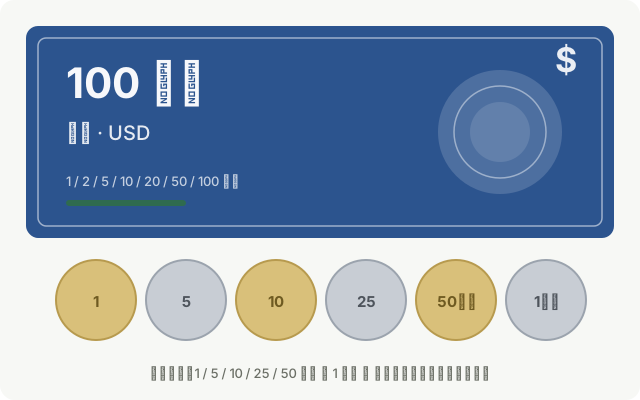
The Federated States of Micronesia does not issue its own currency. The U.S. dollar (currency code: USD, symbol: $) is the sole legal tender. This reflects the country’s relationship under the Compact of Free Association with the U.S.: the federal government relies on U.S. aid, its financial system is closely integrated with that of the U.S., and U.S. postal and banking services are available across the four states. Travelers only need to use U.S. dollars throughout the country, with no currency exchange hassles and straightforward budgeting.
Denominations
The denominations in circulation are identical to those in the U.S.: banknotes in $1, $2, $5, $10, $20, $50, and $100, and coins in 1¢, 5¢, 10¢, 25¢, 50¢, and $1. Due to the small economic scale of the four states, $100 bills are rarely accepted in rural shops or by taxi drivers, so smaller denominations like $5, $10, and $20 are more practical. In markets on Chuuk, Yap, and other areas, change is often given in $1 coins and smaller bills.
Cash and Payment Habits
Financial services in the FSM are concentrated in the capitals of the four states. Banks such as the Bank of the FSM and Bank of Guam in Kolonia (Pohnpei), Weno (Chuuk), Yap, and Kosrae have ATMs that accept foreign cards. However, machines are scarce, internet connections are unstable, and withdrawing cash across states is inconvenient. Some hotels and dive shops accept credit cards, but fees of 3–5% are often added. Taxis, markets, guesthouses, and small shops typically only accept cash.
It is recommended to carry $80–$150 in cash per day, with a higher proportion of small bills and coins. Upon arrival at your first destination (usually Pohnpei or Chuuk), withdraw enough cash for the entire trip, as there are almost no cash withdrawal or card payment options on outer islands or in remote villages.
Tips for Travelers
- Only U.S. dollars are used nationwide. It’s safer to exchange for U.S. dollars before departure.
- ATMs are only available in the four state capitals. Withdraw enough cash upon arrival as cross-state withdrawals are difficult.
- Credit cards are only accepted by a few hotels and dive shops, often with additional fees. Cash is king.
- Tipping for diving, guided tours, and guides is appreciated at $5–$20. Carry small change.
Flag Meaning
Flag Design
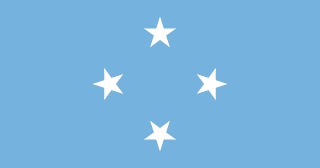
The flag of the Federated States of Micronesia is a light blue rectangle with a 19:10 aspect ratio. On the right side of the flag, four white five-pointed stars are arranged in a diamond (or lozenge) shape. The light blue color is similar to the "UN blue" used on the United Nations flag. The four stars represent the four states of the FSM in their geographic order from west to east across the Caroline Islands—Yap (left/west), Pohnpei and Kosrae (right/east)—creating an asymmetrical yet directional composition that is quite unique among world flags.
Meaning
The light blue symbolizes the Pacific Ocean, as well as hope and peace. The four white stars represent the four states of Yap, Chuuk, Pohnpei, and Kosrae, and their diamond arrangement reflects their distribution along the island chain. White symbolizes purity and honesty, while the stars signify guidance, representing the unity and shared journey of the FSM states across the vast ocean. The flag also carries the historical memory of the Caroline Islands’ transition from a trust territory to an independent nation.
History and Legal Status
From 1947, the Pacific Islands Trust Territory—including the Caroline Islands—used a "six-star flag" with six white stars on a light blue background representing the six districts of the trust territory (including Palau, the Marshall Islands, and the Northern Mariana Islands). In 1978, when the four states of the FSM (excluding Palau) formed a federation, a new four-star flag was officially adopted on November 30 of the same year. This flag has been in continuous use since independence, with its design strictly regulated by flag law.
Today, the four-star flag is flown at the Congress building in Palikir, the state governments of the four states, airports, and ships. Independence Day (Freedom Day) on November 3 is the most prominent occasion for displaying the flag and serves as the most visible symbol of national identity in the FSM.
Micronesia Travel Guide
All Guides »Federated States of Micronesia Travel Quick Guide: Visa on Arrival, Island Flights & Budget
The success of your trip to the four-state island nation hinges on flight dates ...
Classic 8-Day Micronesia Itinerary: Pohnpei & Chuuk Dual-State Deep Dive 8 days
Swim with jellyfish in Jellyfish Lake, witness shark storms at Blue Corner, and ...
4-Day Micronesia Short Trip: Nan Madol and Waterfalls of Pohnpei 4 Days
Even a Single State Is Worth It: Focus on World Heritage Site Nan Madol, Kepiroh...
Top Attractions in Micronesia: Nan Madol, Chuuk's Ghost Fleet, and Yap's Stone Money Banks
Explore the 12 best sights across Micronesia’s four states, featuring the UNESCO...
Micronesian Cuisine Guide: Breadfruit, Sakau Ceremonies, and Surprising Japanese Food in Chuuk
Micronesian tables are grounded in coconut, breadfruit, and seafood. In Pohnpei,...
Micronesia Travel Guide: Island Hopper Flight Schedules, Intra-State Car Rentals, and Ferry Arrangements
The backbone of transportation in the Federated States of Micronesia (FSM) is th...
Practical Tips for Micronesia: Flight Schedules, Cash Reserves, and Village Etiquette – Nine Key Points
Nine practical tips from travels across Micronesia’s four states: focusing on fl...