The Tianchi Lake on Changbai Mountain boasts a unique landscape—winter is the best time for hiking and sightseeing, paired with ginger tea.

Photos & text / or TravelChina
British novelist James Hilton’s *Lost Horizon* depicts a utopia nestled among the majestic mountains of the East, where peace and tranquility abound, and people’s hearts are filled with serenity. Stepping into the sacred and mysterious winter wonderland of Changbai Mountain feels like entering a “Shangri-La of ice and snow.”
Changbai Mountain has a temperate continental mountain climate, characterized by long, harsh winters, short and cool summers with unpredictable weather, windy springs, and foggy autumns.
The best time to admire Changbai Mountain’s ever-changing, four-seasons-in-one-mountain scenery is July, August, and September. However, winter is the prime season for skiing, as the mountain remains open (unless heavy snowfall occurs).
In winter, Changbai Mountain is blanketed by flying snow, draping the valleys and peculiar rocks in a soft coat of silver-white. The year-round unfrozen hot spring water evaporates, condenses upon meeting the cold air, and coats the riverside plants with delicate ice crystals.
Visitors endure the bitter cold, waiting for the mist to clear to catch a glimpse of the frozen Tianchi. In that moment, their hearts are filled with simple anticipation, as pure as the white snow atop the mountain.
Thirty degrees below zero—truly unforgettable
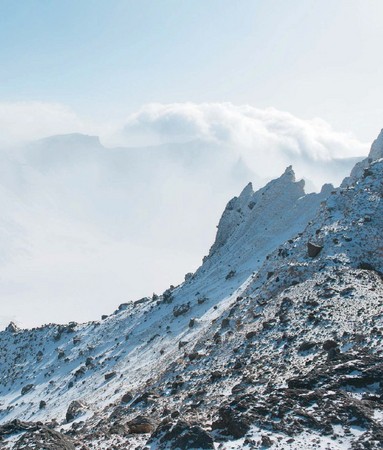
▲ Tianchi shrouded in mist also has a unique charm.
When visiting Changbai Mountain, the highlight is naturally hiking up to see Tianchi. Beyond that, the forest and canyon landscapes within the volcanic terrain are also quite extraordinary and worth savoring in detail.
The hiking routes on the Chinese side of Changbai Mountain are divided into three trails: the northern slope, western slope, and southern slope (the eastern slope is in North Korea). Each route features vastly different terrains, and the viewing angles of Tianchi vary accordingly, offering rich scenic diversity.
Among them, the northern slope was developed earliest, has the most attractions, and is the most accessible by transportation, making it the top choice for winter hikes. Enter the scenic area through the northern slope’s main gate, then take the park’s eco-friendly shuttle directly to other sites.
Sitting in the vehicle, wipe the condensation from the window with your glove and gaze at the surrounding pine and fir forests, standing neatly and resolutely on the slopes like sentinels. They brave the piercing cold winds, like guardians shielding Changbai Mountain through the winter. Though winter makes the distinct vertical forest zones less obvious compared to summer and autumn, careful observation reveals the difference between the dark coniferous forests and the leafless Dahurian birch woods.
Arriving at the Julong Hot Spring area, step off the shuttle and walk along the boardwalk to view the Changbai Waterfall. The scenic walkways are well-built, ensuring safe hiking even right after heavy snowfall.
However, the -30°C temperature on the mountain is truly bone-chilling. Even with two pairs of socks and boots, your toes will go numb after just fifteen minutes of walking—not to mention your nose and cheeks, which quickly turn bright red.
Fortunately, the Erdao Bai River, which flows past the hot spring area, has relatively warm water. When the cold becomes unbearable, huddling near the steaming riverbank provides instant relief.
Although the winter temperatures on Changbai Mountain are indeed harsh for those accustomed to subtropical climates, there’s no need to worry too much. The scenic area has many wooden rest huts, often selling ginger soup and hot tea at their small shops. Next to the hot spring area, there’s also a hot spring vent with water temperatures exceeding 80°C, where eggs are boiled. Enjoying a hot spring egg with a cup of ginger tea in the freezing cold is simply blissful.
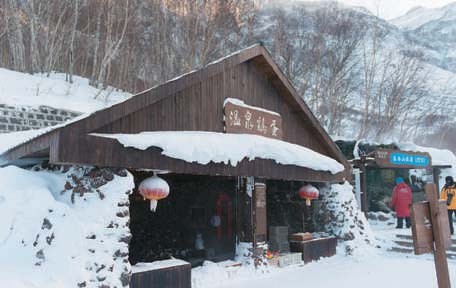
▲ The hot spring egg stall near Julong Hot Springs—when you can’t take the cold anymore, come here for a cup of ginger tea!
The frozen ice waterfall exudes awe-inspiring grandeur
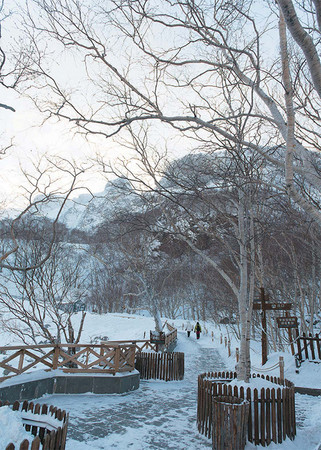
▲ The scenic boardwalks are well-planned, but the snow depth beyond them is unpredictable. Do not wander off to avoid danger.
Gather your strength and continue toward the Changbai Waterfall. This section involves climbing steeper stairs, and the low temperatures drain energy even faster. We hike while panting, frequently stopping to catch our breath.
Looking around, everything is a pristine white. As clouds and light shift, the shadows of distant mountains and trees quietly move, captivating us until returning hikers cheer us on. Soon after, we finally reach the viewpoint for the Changbai Waterfall.
The Changbai Waterfall is 1,250 meters from Tianchi. Its water source is Tianchi, flowing out from the “Sky-Mending Stone” at the gap to form a narrow stream called “Chengcha River,” which stretches about one kilometer. The terrain then suddenly steepens, and the river surges down a 68-meter cliff, forming the Changbai Waterfall.
Due to the significant drop, the fierce white cascade creates a pool over 20 meters deep beneath the cliff. The water continues downstream, forming the Erdao Bai River—the source of the Songhua River. Through a camera telephoto lens, it’s astonishing to see some of the water flow frozen into icefalls in the frigid temperatures.

Share
This article is published by HowToTrip. Sharing and reposting are welcome — please credit the source.
Article URL: https://www.howtotrip.net/views-9188
Related Articles
- Shaoxing's "Grandpa Gourd" hangs the gourds back up: "If there are too many people, we'll interact less — just take a quick look from afar"
- Chinese authorities announce "reciprocal adjustment" to Japan visa fees — single-entry visa jumps from 2,250 to 16,750 yen!
- The "health stones" carried by a traveler were found to have radiation levels exceeding safety limits by a thousand times, potentially endangering fellow passengers on the same flight. Customs issues warning!
- Shenzhen Airport Issues Late-Night Notice: Unidentified Aerial Object Detected, Causing Widespread Flight Delays!
- “They only said it cost money after I opened the box and washed it!” 200g of grapes sold for 60 yuan on a high-speed train—12306 responds!
- Can't buy an airline ticket? Denied exit? Blocked from boarding? A large number of Chinese tourists have mysteriously become "discredited individuals"
- Adverse weather and economic fluctuations impact Colombia's coffee market
- Beach bathing area responds to 2 yuan/30 seconds fee for freshwater foot rinsing: Clearly priced!
- Taking off with an improperly closed cabin door? Wing malfunction? Multiple flights made emergency returns mid-journey!
- Experience the gifts of nature! A countdown of the world’s ten most stunning coastlines