The fully bloomed cherry blossoms are so romantic—Nagoya Castle, one of Japan’s Top 100 Castles.
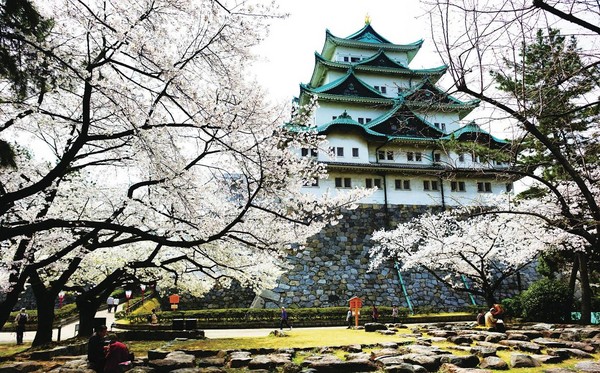
▲ The fully bloomed cherry blossoms adorn the entire Nagoya Castle in breathtaking shades of pink.
Text and photos by Kavanagh, excerpted from *Kavanagh X Japan’s 100 Castles: Complete Conquest*, published by Takarajimasha.
Originally, Nagoya Castle was a fortress called "Yanagi-no-maru" built by Imagawa Ujichika, the lord of Suruga Province. In 1532, it was captured by Oda Nobuhide, the father of Oda Nobunaga, who renamed it "Nagoya Castle." Nobuhide later handed the castle over to Nobunaga, where he spent his formative years. In 1555, after defeating Oda Nobutomo, Nobunaga relocated his main castle to Kiyosu Castle (formerly Kiyosu). Soon after, Nagoya Castle was abandoned, falling into decades of neglect.
After the Battle of Sekigahara, the Owari region’s Kiyosu Domain came under the control of Tokugawa Ieyasu’s fourth son, Matsudaira Tadayoshi. Upon Tadayoshi’s death in 1607, Tokugawa Yoshinao took over. Finding Kiyosu Castle situated in a low-lying area prone to flooding and unsuitable as an administrative center, Ieyasu—always doting on his son—initiated a nationwide construction effort ("Tenka Fushin") to build a new castle: Nagoya Castle. Legend has it that Ieyasu proclaimed, “Everybody, come quickly and help build my son a castle!” (The other feudal lords probably thought, “Here we go again…”).
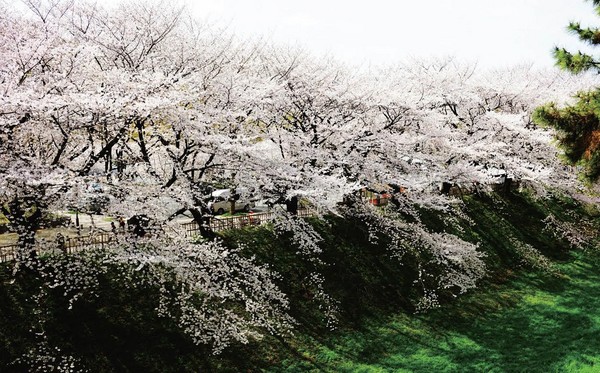
▲ Cherry blossoms surrounding Nagoya Castle.
The masterminds behind Nagoya Castle’s design were top-tier architects of their time. For example, the keep was designed by Nakai Masakiyo, who also worked on the keeps of Edo Castle, Nijō Castle, and Sunpu Castle, while the stone foundation was overseen by the legendary warlord architect Kato Kiyomasa. This dream team would be akin today to the likes of Tadao Ando and Toyo Ito, along with Kazuyo Sejima and Ryue Nishizawa. (A lot of big names, huh?)
Kiyomasa was an expert in building stone walls, and his own castle, Kumamoto Castle, is one of Japan’s most renowned. To prevent his proprietary stoneworking techniques from leaking out, he had the construction site enclosed with curtains to maintain secrecy. The resulting stone foundation of Nagoya Castle’s keep features graceful curves similar to those at Kumamoto Castle. Despite enduring multiple earthquakes and bombings during World War II, it has remained standing—a testament to Kiyomasa’s exceptional craftsmanship.
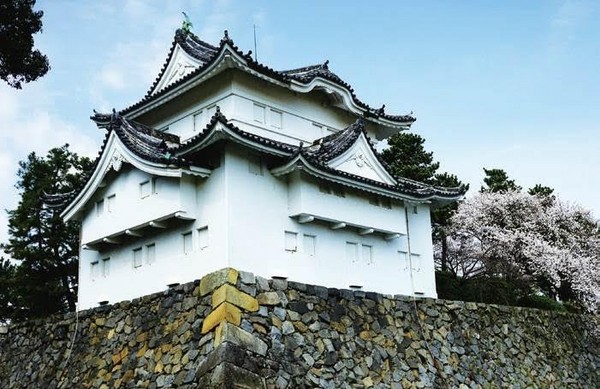
▲ Southeast corner turret of Nagoya Castle.
Completed in 1612, Nagoya Castle became the residence of the Owari Tokugawa family—one of the Tokugawa shogunate’s three prestigious branches, known as the Gosanke—until the Meiji Restoration and the abolition of the feudal domains. Unlike many historic castles, Nagoya Castle was not demolished after the Meiji era but, like Himeji Castle, was designated a Japanese National Treasure and carefully preserved. Tragically, this grand castle (Nagoya Castle was massive—the keep alone was four times the size of Himeji Castle’s!) could not escape destruction. On May 14, 1945, it was bombed by U.S. forces during an air raid. The keep, the Honmaru Palace, and Nagoya Castle’s iconic golden shachihoko (mythical creature) were all completely burned, reducing the proud 330-year-old structure to ashes… It’s heartbreaking every time I think about such a beautiful, magnificent, and well-preserved castle being destroyed. (Covers heart)
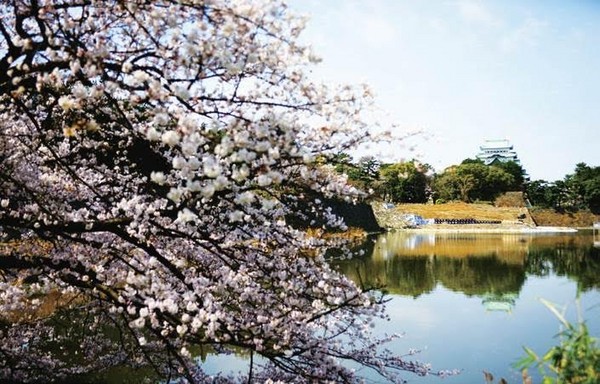
▲ Nagoya Castle in spring cherry blossom season.
Reconstruction of the keep began in 1957. Initially, there were plans to rebuild it using traditional wood, but concerns about the post-bombing stone foundation’s ability to support the weight led to a decision to reinforce the foundation first before reconstructing the keep with reinforced concrete. Excitingly, restoration work on the Honmaru Palace commenced in 2009. The wooden, traditionally built Honmaru Palace reopened its entrance hall and Omote Shoin (main reception hall) in 2013, with plans to open the “Shimo Gosho” (Lower Palace) in 2016. The full project is set to be completed in 2018, when we will once again be able to witness the grandeur and opulence of this symbol of shogunal authority.
I’ve visited Nagoya Castle three times, but the most memorable was in the spring of 2014, during cherry blossom season. The fully bloomed cherry blossoms made the entire castle incredibly picturesque—classic beauty of a famous castle adorned with cherry blossoms. Though the original castle was destroyed, six existing structures remain, including three surviving turrets. The most famous is the northwest corner turret, nicknamed the “Kiyosu Turret.” This three-story, three-tiered structure is larger than the surviving keeps of Kochi Castle and Maruoka Castle. It’s said that some original materials from Kiyosu Castle were discovered inside the turret, making its nickname entirely fitting.
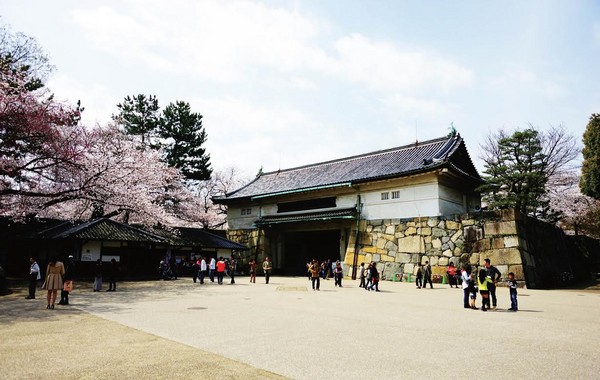
▲ Main gate of Nagoya Castle.
The current Nagoya Castle keep is a reinforced concrete reconstruction. While its exterior is impressive, the interior feels overly modern, lacking the historical charm of the original. However, the ongoing traditional reconstruction of the Honmaru Palace is highly anticipated. I sincerely hope that one day the keep, too, will be fully restored using traditional wooden construction methods.
Information
Main Gate Ticket Gate, East Gate Ticket Gate
Location: Aichi Prefecture
Castle Type: Flatland Castle
Construction Year: 1609
Builder: Owari Tokugawa Clan
Current Status: Important Cultural Property, Japanese National Treasure
Access: Get off at Shiyakusho Station on the Meijo Line, a 5-minute walk
Hours: 09:00 – 16:30 (Closed December 29 – January 1)
Admission: Adults 500Q????夥鸭br />
Suggested Visiting Time: 3–4 hours
Recommended Season: Cherry Blossom Season
Kavanagh @ Kyoto, Freely Staying.
Kavanagh X Japan Travel Obsession
Share
This article is published by HowToTrip. Sharing and reposting are welcome — please credit the source.
Article URL: https://www.howtotrip.net/views-8291
Related Articles
- Shaoxing's "Grandpa Gourd" hangs the gourds back up: "If there are too many people, we'll interact less — just take a quick look from afar"
- Chinese authorities announce "reciprocal adjustment" to Japan visa fees — single-entry visa jumps from 2,250 to 16,750 yen!
- 旅客携带的“保健石”核辐射超标千倍,同机人员或遭殃!海关提醒!
- 深圳机场深夜通报!出现不明升空物,航班大面积延误!
- “拆盒洗了才说要钱!”高铁200克葡萄卖60元,12306回应!
- 买不了机票?出境被拒?登机被拦?一大波中国游客莫名成了“失信人”
- 不利天气和经济波动影响哥伦比亚咖啡市场
- 海边浴场回应冲脚淡水收费2元/30秒:明码标价!
- 舱门没关好就起飞?机翼出现问题?多个航班途中紧急折返!
- 感受大自然的馈赠!盘点世界十大唯美海岸线