The Dark Lord Among Japan’s Top 100 Castles — “The Demon’s Castle,” the Prototype of the Momotarō Legend
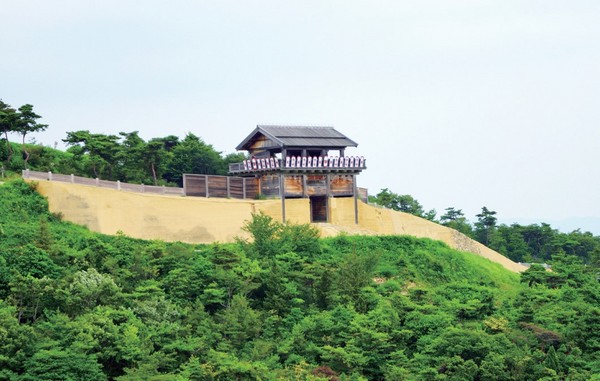
▲ The restored “West Gate.”
Photo and text by Kavanah, excerpted from *Kavanah’s Complete Conquest of Japan’s 100 Famous Castles*, published by Takarabunko
Legend has it that during the reign of Japan’s 10th Emperor, Emperor Sujin, an evil demon named “Onra” occupied the mountainous area now known as “Onigajo Mountain” and established “The Demon’s Castle” (鬼ノ城) as his stronghold, oppressing the local people at will.
The oppressed locals, suffering immensely, sought help from the nearby Yamato Court (the precursor to today’s Japanese imperial family). Responding to their plea, the Yamato Court dispatched Prince Kibitsuhiko-no-mikoto, accompanied by three retainers: Inukai no Mikoto, Wakamori no Mikoto, and Tamaro no Mikoto, to subdue Onra. After years of fierce battle, Prince Kibitsuhiko finally defeated Onra, buried his head beneath the hearth of what is now Kibitsu Shrine in Okayama Prefecture, and successfully drove away the demon.

▲ Along the way up to the castle, a “Demon’s Cauldron” is displayed by the path.
Seeing this, doesn’t it feel familiar? That’s right — the story of Prince Kibitsuhiko defeating Onra is the prototype of the “Momotarō” legend!
But in truth, the so-called “Onra Legend” is a myth fabricated by the Yamato Court to beautify its history of invasion.
According to research, “Onra” may have been a prince or chieftain from Korea skilled in ironworking. The Yamato Court originated in the Nara Basin and gradually expanded its territory, eventually unifying the entire Japanese archipelago. During this expansion, to better govern the newly conquered peoples, they often portrayed themselves as the righteous side fighting against evil — hence the birth of the “Onra Legend.” To this day, there are still many mysteries surrounding who built the Demon’s Castle and for what purpose. The ruins were discovered in 1971 and the earthen ramparts, stone walls, and other structures were restored in 2001. It was selected as one of Japan’s Top 100 Castles in 2006.
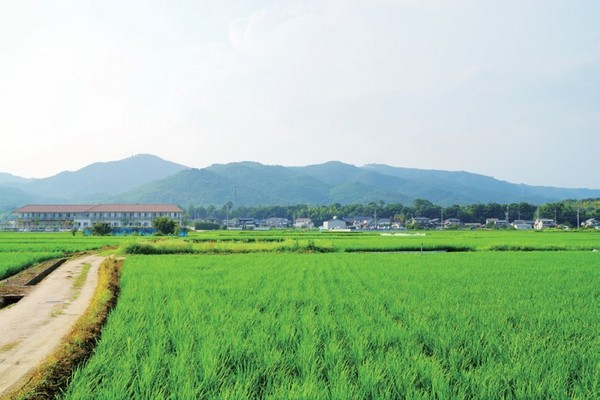
▲ View of the Demon’s Castle from outside Furuichi Station — the word “despair” immediately came to mind.
The Demon’s Castle is arguably the ultimate challenge among Japan’s Top 100 Castles, with a one-way hiking distance of about six kilometers. In my opinion, it’s tied with O-no Castle as the most grueling ancient castle to conquer. Here are two tips for tackling it:
One. Don’t bring any unnecessary luggage
The nearest JR station to the Demon’s Castle, Furuichi Station, is an unmanned small station with no lockers for baggage. Back then, I naively dragged my suitcase all the way to the Demon’s Castle. When I got off at Furuichi, I was completely stunned — there were no lockers to be found. I even ran to nearby Okayama University hoping to find a locker, but still no luck... In the end, I had to hide my suitcase in the broom closet of the bicycle parking lot next to Furuichi Station (and to prevent anyone from discovering it, I covered the suitcase with mops and brooms). To be honest, that was pretty risky (don’t try this at home, kids), so learn from my mistake: never drag a suitcase here.
Two. Treat it like a mountain hike
The walk from Furuichi Station to the Demon’s Castle is six kilometers and takes about one and a half to two hours. There are mostly rice fields and mountain paths along the way, with no shops to buy anything, so make sure to bring snacks, enough water, and a fully charged phone for navigation to avoid getting lost. To be honest, I’d actually recommend getting off at “Soja Station” and taking a taxi to the Demon’s Castle — because you can’t hail a taxi outside Furuichi Station.
Information
Demon’s Castle (Onigojo)
Castle Type: Kuruwa-style Mountain Fortress
Construction Period: Second half of the 7th century
Builder: Unknown
Current Status: National Historic Site
Access: Get off at JR Furuichi Station, then hike about 6 km (recommended to take a taxi from Soja Station)
Hours: Open for free exploration
Admission: Free
Recommended Visiting Time: 3–4 hours
Kavanah @ Kyoto — Living Freely.
Kavanah X Japan Travel Madness
Share
This article is published by HowToTrip. Sharing and reposting are welcome — please credit the source.
Article URL: https://www.howtotrip.net/views-8043
Related Articles
- Shaoxing's "Grandpa Gourd" hangs the gourds back up: "If there are too many people, we'll interact less — just take a quick look from afar"
- Chinese authorities announce "reciprocal adjustment" to Japan visa fees — single-entry visa jumps from 2,250 to 16,750 yen!
- 旅客携带的“保健石”核辐射超标千倍,同机人员或遭殃!海关提醒!
- 深圳机场深夜通报!出现不明升空物,航班大面积延误!
- “拆盒洗了才说要钱!”高铁200克葡萄卖60元,12306回应!
- 买不了机票?出境被拒?登机被拦?一大波中国游客莫名成了“失信人”
- 不利天气和经济波动影响哥伦比亚咖啡市场
- 海边浴场回应冲脚淡水收费2元/30秒:明码标价!
- 舱门没关好就起飞?机翼出现问题?多个航班途中紧急折返!
- 感受大自然的馈赠!盘点世界十大唯美海岸线