Gourmet Wang Ruiyao: Black-and-White Sliced Dishes Make Full Use of Ingredients, Not Random Chopping
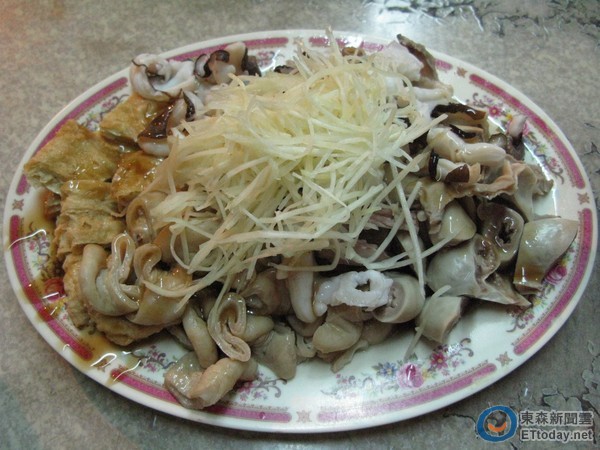
▲ A black-and-white sliced dish side plate.
Photos and text byWang Ruiyao’s Super Gourmet
If you, like me, are a huge fan of Taiwanese street food, didn’t you get just as furious as I did when you read Wikipedia’s description of black-and-white sliced dishes? I hope relevant authorities such as the Tourism Bureau won’t take this lightly and will quickly... (repeated segment, same as 1)
The Taiwan Gourmet Food Exhibition, which resumed last year, held a design competition for tableware used in Taiwanese street food, attracting enthusiastic participation from students of various universities and colleges. This year, “Big Dishes for Small Bites” expanded its scope, focusing on tableware for dishes like black-and-white sliced dishes, oyster omelets, pig intestines with vermicelli, bubble tea, gua bao, four-herb soup, grass jelly, stinky tofu, chicken rice, and stir-fried rice noodles. The goal was to create themed, creative, and practical plates tailored specifically for Taiwanese street food. A total of 387 entries competed for the top prize of NT$180,000.
A few days ago, while serving as a judge, I found that many entries focused only on surface-level design without in-depth research. Some even tried to be clever with puns or arbitrarily altered or reinterpreted Taiwanese street food. What’s more, over two groups actually considered the placement of mobile phones or the order of taking photos before eating—truly laughable and baffling.
In the black-and-white sliced dishes category, more than one contestant wrote: “The name ‘black-and-white sliced dishes’ comes from the Hokkien pronunciation, meaning vegetables are chopped casually—it’s a side dish that doesn’t emphasize knife skills or ingredient quality.” I found this strange, so I went directly to Wikipedia and sure enough, found the source of the misinformation.
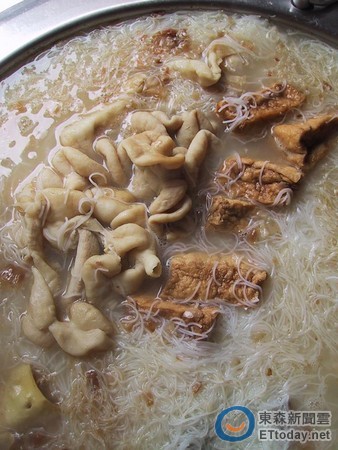
▲ The best buddies of black-and-white sliced dishes are either sliced noodle soup or rice noodle soup.
Black-and-white sliced dishes are chopped to order by the customer, not the chef. The best buddies of black-and-white sliced dishes are either sliced noodle soup or rice noodle soup—their deliciousness relies entirely on a good broth, and that broth mainly comes from boiling a whole pig’s head. After simmering the pig’s head to make the broth, the head meat is then sliced to become black-and-white sliced dishes.Including bone meat, jowl, “sky ladder” (pork soft palate), pork skin, as well as offal like large intestine, heart casing, tongue, heart, lung, and liver—all come together to create the ultimate flavor of black-and-white sliced dishes.
Black-and-white sliced dishes are a smart way of making full use of ingredients. Perhaps many shops nowadays find boiling a whole pig’s head and deboning the meat too troublesome, butdelicious black-and-white sliced dishes are definitely tied to the freshness and sweetness of pigs slaughtered that very day. Each part has its own cooking time requirements and unique methods for keeping warm and restoring texture. Of course, there’s no reckless, crude chopping—some slices are thin, some are thick, and the textures vary.
It’s been over ten years now. Back then, during a street food competition held in the food section of the China Times, I once went undercover to try rice noodle soup. Near the Investigation Bureau, I found a spot recommended by gourmet Zhu Zhenfan. There were two or three bloody, huge pig heads lying on the ground—I thought it was a crime scene and was really startled. It was right next to the outer edge of Dongmen Market, not inside the market, from an unnamed tent run by neither the Luo nor the Huang family. It was said to be a favorite of the late Chef Fu Pei-mei. Under a simple awning, the rice noodle soup shop served a whole pot of rice noodle soup with big chunks of black-and-white sliced dishes floating in it, including the rare “sky ladder” (pig’s upper palate). That told me the chef started by boiling the pig’s head to make the broth. The stand opened around noon and closed once the food sold out. That afternoon when I passed by, there were only two bowls left at the bottom of the pot. I hadn’t eaten yet, but didn’t sit down to have them—and I’ve regretted it ever since, still thinking about those two bowls of rice noodle soup.
Creating customized in-store or takeaway tableware for Taiwanese street food is a great idea, but without understanding the background of the food and the convenience for users, even the best designs remain theoretical. I used to love a designer shop called Qingting, admired their unique taste in selecting goods from around the world, and bought five expensive plain round plates designed by a Dutch designer. But the edges were too thin, and after a few uses in the dishwasher, they developed chipped edges. The bottoms weren’t glazed, so once they touched oil, they became impossible to clean—needed at least two rounds of detergent to get them clean. The designer’s signature, a sunken engraving, seemed cool at first, but after using it, I found it trapped dirt. Now, only one of the five plates remains, hidden at the bottom of the pile—I don’t even dare to take it out easily, afraid I might accidentally chip it again. Designer plates have now become just a memory.
Everyone criticizes Taiwanese street food for mostly using melamine ware, but doesn’t realize—is there really no other option besides melamine? In the past, everyone had Dajhong porcelain at home, with different types of bowls like large serving bowls, small soup bowls, dry noodle bowls, and soup noodle bowls, all with varying curvatures, depths, and widths. Nowadays, nobody cares about what kind of bowl goes with what kind of food. A few years ago, to help my brother Chef Bao write a cookbook, I went to a tableware store specifically to look for Dajhong porcelain. I even managed to find a few dry noodle bowls, but couldn’t find any “waist plates” anymore (many people don’t know what a waist plate is—it’s an oval fish plate).
Many people buy bowls and plates based on patterns, not function. The eating habits of Japanese, Koreans, and Europeans are completely different from ours. Many people buy cheap Korean bowls only to find that once they’re filled with rice and soup, they’re too hot to hold—the bowls have no feet and can’t be balanced properly. That’s because Koreans don’t lift their bowls to eat; they place the bowl on the table and scoop rice with a metal spoon. So their rice bowls are shaped like straight little flowerpots, some even square, which makes scooping rice with your hands quite awkward. But no one seems willing to put in extra effort to design better tableware for Taiwanese dining—do people just think “it’s good enough as it is”?
You hold your bowl when you eat, so chicken rice should be designed for easy spooning. Oyster omelets and four-herb soup are both soupy, but the former is rich while the latter is light—each has its own character. Oyster omelets, stinky tofu, and black-and-white sliced dishes all come with sauces—some poured on, some used for dipping—so the depth of the plates naturally varies. Bubble tea is meant to be sipped from the cup, while if you drink grass jelly straight from the cup, you might scald your mouth, and the many toppings could easily choke you. As for gua bao, it should be designed like a standing ice cream cone-shaped sushi, with a little stand to make it both attractive and easy to hold. Design isn’t about wild imagination—it needs to start from practicality, supported by origin and creativity, so the design can be truly implemented and meaningful.
Share
This article is published by HowToTrip. Sharing and reposting are welcome — please credit the source.
Article URL: https://www.howtotrip.net/views-6624
Related Articles
- Shaoxing's "Grandpa Gourd" hangs the gourds back up: "If there are too many people, we'll interact less — just take a quick look from afar"
- Chinese authorities announce "reciprocal adjustment" to Japan visa fees — single-entry visa jumps from 2,250 to 16,750 yen!
- 旅客携带的“保健石”核辐射超标千倍,同机人员或遭殃!海关提醒!
- 深圳机场深夜通报!出现不明升空物,航班大面积延误!
- “拆盒洗了才说要钱!”高铁200克葡萄卖60元,12306回应!
- 买不了机票?出境被拒?登机被拦?一大波中国游客莫名成了“失信人”
- 不利天气和经济波动影响哥伦比亚咖啡市场
- 海边浴场回应冲脚淡水收费2元/30秒:明码标价!
- 舱门没关好就起飞?机翼出现问题?多个航班途中紧急折返!
- 感受大自然的馈赠!盘点世界十大唯美海岸线