Now that Kumamoto has been rebuilt after the earthquake, is it okay to visit?

Text and photos by Joel Fukuzawa
When we say the phrase“Love Kumamoto”, we’ve received lots of concern from friends about various issues. Here’s a summary of the main questions:
1. Will our visit to Kumamoto affect the reconstruction efforts?
2. Is it dangerous to go to Kumamoto or Aso?
3. Now that Kumamoto Castle has collapsed and Aso Shrine has been destroyed, what else is there to do?

Let’s answer the first question:
1. Will our visit to Kumamoto affect the reconstruction efforts?
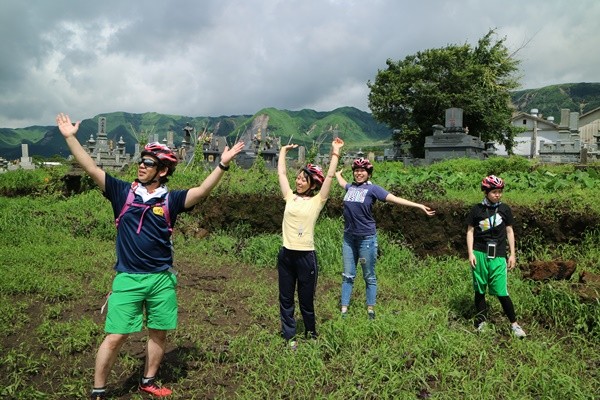
Today I joined a “Bike Fault Line Tour,” organized by an outdoor adventure company based in Aso in collaboration with a local NGO. The two-and-a-half-hour tour costs around 4,000 yen and is led by professionals who take you around the most severely affected volcanic fault zone. You can see how the fault line split the once-flat fields in two. Along the way, we saw workers repairing a house roof, and rather than feeling disturbed by cyclists, they actually said, “Keep it up, keep up with the group!” Some parts of the road over the fault line were deformed, but the traffic controllers we met kindly greeted us. Whether it affects reconstruction really depends on your attitude toward the people working hard to rebuild.
Now for the second question:
2. Is it dangerous to go to Kumamoto or Aso?
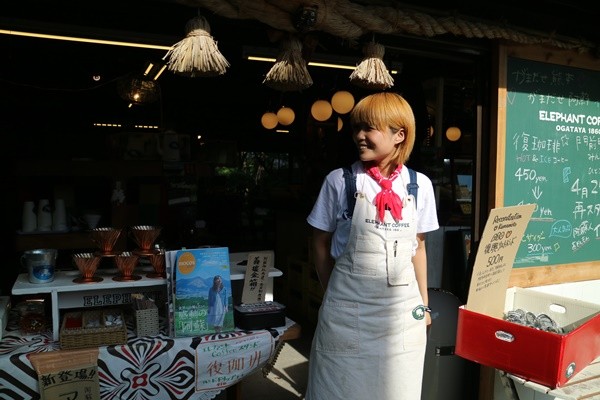
Aside from the main road connecting Kumamoto, Aso, and Oita—the Aso Bridge—which was destroyed by a landslide and requires a mountain detour (adding about 45 minutes to an hour), the roads leading to and from Aso are generally in good condition. However, due to the mountain roads, group travel isn’t highly recommended, as a large bus could easily block the route. As for trains, the line between Kumamoto and Aso is currently not running, but the railway from Aso to Oita will reopen this Saturday. Within Aso City itself, things are actually quite pleasant.
Now, the third question:
3. Now that Kumamoto Castle has collapsed and Aso Shrine has been destroyed, what else is there to do?
The best things to do in Aso or Kumamoto definitely aren’t seeing Kumamoto Castle or Aso Shrine—though you should still go check them out. But the most important thing is that there are vast, expansive grasslands as far as the eye can see. There’s a secret to why trees don’t grow on these grasslands. It’s because since the 18th century, there’s been a tradition of “yakihata” (field burning) here, which allows the land to rest and recover effectively. Every autumn, starting from Mount Aso, fires are set to burn the grasslands. This helps eliminate tree saplings and leaves behind nutrient-rich ash for the next year’s growth. These grasslands not only support livestock farming but also offer great opportunities for outdoor activities such as hot air balloon rides, paragliding, grass sledding, and cycling tours. In addition, the costs here are relatively lower compared to other destinations, and the shopping streets are especially charming—for example, “Monzen-nakacho” near Aso Shrine has a delightful Showa-era vibe.

If you still have questions about visiting Kumamoto after all this, feel free to let us know—we’re happy to answer them one by one.
Share
This article is published by HowToTrip. Sharing and reposting are welcome — please credit the source.
Article URL: https://www.howtotrip.net/views-6295
Related Articles
- Shaoxing's "Grandpa Gourd" hangs the gourds back up: "If there are too many people, we'll interact less — just take a quick look from afar"
- Chinese authorities announce "reciprocal adjustment" to Japan visa fees — single-entry visa jumps from 2,250 to 16,750 yen!
- The "health stones" carried by a traveler were found to have radiation levels exceeding safety limits by a thousand times, potentially endangering fellow passengers on the same flight. Customs issues warning!
- Shenzhen Airport Issues Late-Night Notice: Unidentified Aerial Object Detected, Causing Widespread Flight Delays!
- “They only said it cost money after I opened the box and washed it!” 200g of grapes sold for 60 yuan on a high-speed train—12306 responds!
- Can't buy an airline ticket? Denied exit? Blocked from boarding? A large number of Chinese tourists have mysteriously become "discredited individuals"
- Adverse weather and economic fluctuations impact Colombia's coffee market
- Beach bathing area responds to 2 yuan/30 seconds fee for freshwater foot rinsing: Clearly priced!
- Taking off with an improperly closed cabin door? Wing malfunction? Multiple flights made emergency returns mid-journey!
- Experience the gifts of nature! A countdown of the world’s ten most stunning coastlines