
China’s Mirror of the Sky is in Lugu Lake, Yunnan, and its charm will make you want to stay forever.

To get to Lugu Lake, you can first fly from Hong Kong to Kunming, then take a train or bus to Lijiang. Book your bus ticket for the next day at any guesthouse in Lijiang the day before. At 6:45 a.m. on Lijiang Ancient Town Square, as the morning light begins to appear, breakfast vendors, chatty tourists, and bus drivers puffing on half-smoked cigarettes gather everywhere, all ready to head to nearby tourist spots. The cost of visiting the mysterious Kingdom of Women is seven hours on winding mountain roads—but the road conditions are decent, the scenery along the way is pleasant, and you might want to take motion sickness pills just in case. Many have given up on Lugu Lake because of the exhausting journey, but Lugu Lake won’t miss them—they’ve missed out on a paradise unlike any other in the world.

Lugu Lake is the birthplace of the Mosuo people’s Kingdom of Women, the world’s last matrilineal society. Upon entering the Lugu Lake scenic area, you can see Mount Gemu Goddess from afar, standing at an elevation of 3,993 meters. She is the revered guardian deity of the Naxi and Mosuo peoples, governing population growth, crops, livestock, and most importantly, the health and fertility of Mosuo women. The shape of Mount Gemu resembles a resting lion, and in Tibetan, its name literally means “Lion Mountain.”

In this matrilineal Kingdom of Women, kinship is based on the mother’s line—all family members are descendants of one or a few founding matriarchs, and property is inherited through the female line: passed down from mothers to children and from maternal uncles to nephews and nieces. Within the household, men are not fathers but uncles and brothers. Each family has a matriarch, usually an older or capable woman known as the “Old Grandmother.” In this culture where women are honored but men are not belittled, uncles oversee rituals, while mothers manage the finances. In the Kingdom of Women, the Old Grandmother holds supreme authority. Respect and courtesy toward women must be shown in every setting. Without a gentleman’s demeanor, it would be hard to survive here—or rather, the men who live in Lugu Lake all possess the proper sense of chivalry.


Here, the water is so clean, the people so genuine. Spending half a day circling the lake reveals its ever-changing forms—like a dancer twirling and striking different poses to captivate the audience. It was early autumn, and the fall colors had begun to tint some leaves yellow and red. I hadn’t expected to witness such stunning beauty in the red foliage—it turned out to be even more gorgeous than I’d imagined. Venturing beyond your comfort zone and into the unknown often brings delightful surprises, and that’s the power of travel—it inspires us not to stand still and fills us with hope for the future.


Buses from Lijiang to Lugu Lake terminate at the largest town, Lige. Unless it’s peak season, you don’t need to book accommodation in advance—there are plenty of guesthouses along the lake. Boating on the lake is an essential activity in Lugu Lake, and you can inquire about tour details at any guesthouse in Lige. I simply walked to Lige’s dock, compared prices from different boat operators, and then made my decision. Pricing is usually based on the number of people. It’s recommended to take a boat ride during sunrise or sunset to enjoy the lake in a different light.

To see Lugu Lake from another angle, consider renting an electric scooter the next day to circle the lake. Starting from Lige, go clockwise along the lakeshore. There’s no smell of gasoline on the road, just the drifting aroma of cooking smoke. Traditional Mosuo wooden houses line the route, their interiors and exteriors stacked with golden-yellow corn, signaling what seems to be a bountiful harvest year. Circling the lake will inevitably take you across the border between Yunnan and Sichuan. Once you step into Sichuan, don’t forget to visit a post office, pick up a postcard, and stamp it with the special commemorative postmark prepared for visitors—proof that you’ve set foot in both Yunnan and Sichuan in one trip.

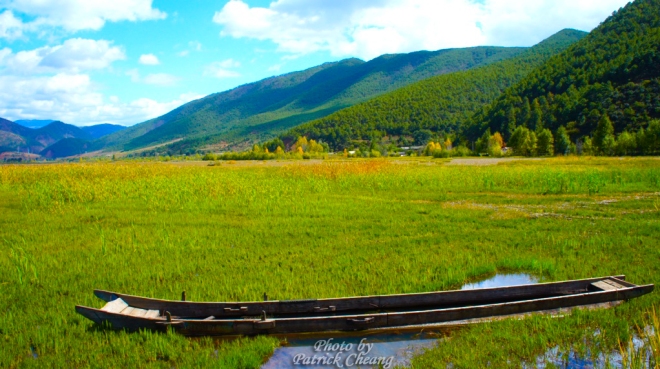
As you circle the lake, you’ll notice villages along the way undergoing rapid construction, preparing for the day when this serene Kingdom of Women becomes a major tourist destination. Eventually, you’ll reach a vast shallow area of Lugu Lake, where green and yellow reeds sway in the wind over the water, resembling a vast grassland. The Mosuo people simply call it the “Grass Sea,” and it’s one of the must-visit spots at Lugu Lake.
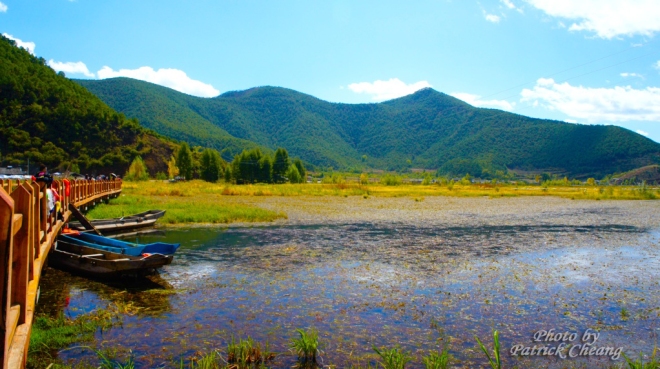
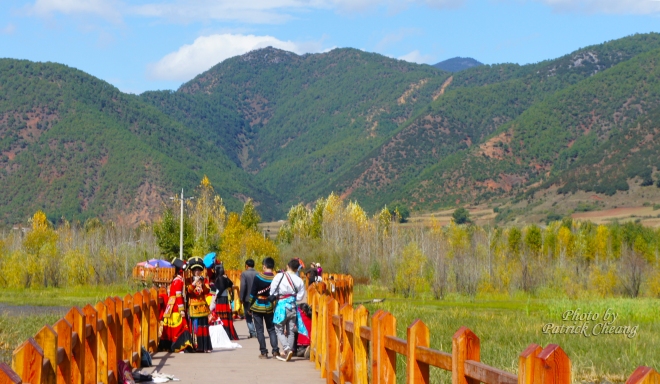
On the Grass Sea lies the Zouhun Bridge, the only bridge in all of Lugu Lake. The new bridge was built for tourism, but the old one once floated on the water’s surface. It was the bridge that connected countless Mosuo lovers across the lake for generations, supporting the Mosuo people’s continuation of their lineage. Even today, it silently watches over every Mosuo man who walks back and forth across the new Zouhun Bridge to meet his lover.

Lugu Lake is a place where you’ll want to stay forever, and one of the most wonderful and romantic spots in Yunnan. If you’re tired of the hustle and bustle of Lijiang Ancient Town or have stayed too long in Dali Ancient Town, why not fall in love with Lugu Lake? You’re sure to be enchanted by her charm.