Europe often gives the impression of being home to nations with long histories and well-established political systems. Yet, in the southern part of Europe, specifically in the Balkan Peninsula, there exists a place that gained independence just nine short years ago and is still striving for universal recognition — Kosovo.
At the end of the First Balkan War, the Ottoman Empire ceded Kosovo to Serbian rule, and it later became part of the Kingdom of Yugoslavia. However, during World War II, Kosovo was incorporated into Albania by the Axis powers.
After prolonged ethnic struggle, the Kosovo War ended with a mass exodus of Serbs from the region, placing it under United Nations administration. Unfortunately, Serbia insisted on maintaining its territorial integrity, and even after Kosovo declared independence from Serbian rule in 2008, Serbia firmly refused to relinquish its claim over Kosovo.
To this day, only 110 countries have recognized Kosovo, with many others either not taking a stance or opposing its independence, including the People’s Republic of China. As a result, on the official website of Hong Kong’s Immigration Department, there is no information indicating that Hong Kong passports enjoy visa-free entry to Kosovo. Conversely, Kosovo’s own website states that Hong Kong passports are visa-exempt.
Before visiting this country, I didn’t know much about its history. Driven by curiosity, I asked a local about it.
“Of course we want independence. Kosovo is mainly populated by Albanians — why should we be ruled by Serbs?”
“To be honest, we really hate Serbia because they once made us lose our homes!”
He seemed a bit agitated, so I decided to ask something else...
“Yeah, we’ve only had our own passports for a few years, but we’d never go to Serbia!! And they wouldn’t dare come to Kosovo either, hahaha!”
“But we often travel to Albania since we’re all part of the same people.”
While chatting, I suddenly remembered something a Polish friend who studied in Serbia once told me:
“If you enter Kosovo from Serbia and then return to Serbia from Kosovo, it’s not a problem. Since Serbia still considers Kosovo part of its territory, you can enter Serbia with an exit stamp from Serbia. But if you enter Kosovo from another country and then try to enter Serbia from Kosovo, you won’t be allowed in because they’ll ask why you don’t have an exit stamp from Serbia.”
“Also, there’s one area inside Kosovo where both Serbs and Kosovars (i.e., Albanians) live. It’s quite unique because these two groups are sworn enemies. There’s a bridge there — one side is for Serbs, the other for Albanians. If anyone crosses to the other side, they might get shot at. That’s why there are now foreign troops stationed on the bridge to maintain peace and prevent conflict.”
“Oh, and don’t let the cleanliness here fool you (I was in the town of Prizren at the time). In fact, northern Kosovo, near Serbia, still has many abandoned, garbage-filled areas. Due to war issues and a lack of funds, Kosovo hasn’t been able to rebuild those parts yet.”
After visiting Kosovo, I felt overwhelmed — not by the blazing sun, but by the history and conflicts that were hard to digest.
Some of the above information may not be entirely accurate, as I’m no historian and only heard it from others. But at least, I understand a country I previously knew nothing about much better now.
Travel isn’t just about food, fun, and sights. Sometimes, trying to understand a country’s past can make the whole journey even more memorable and meaningful.
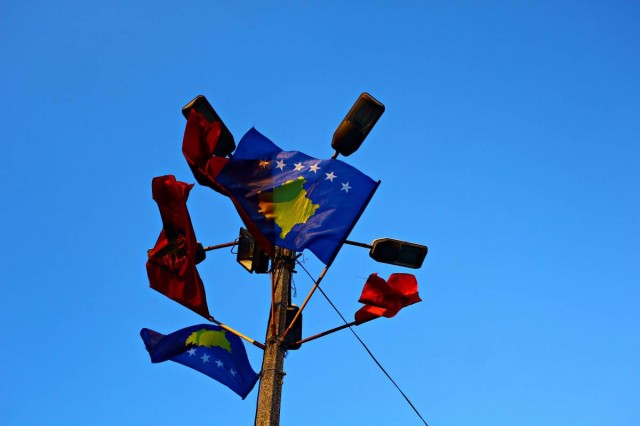
(Photo taken in Kosovo – Prizren: The Kosovo flag and the Albanian flag together)
Facebook Page: https://www.facebook.com/backpackersopoor
Blog: http://backpackersopoor.blogspot.hk/