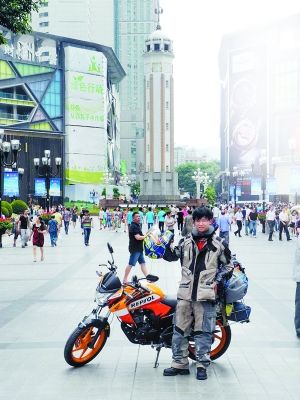
The place where the dream began—Jiefangbei
Nie Haotie, born in 1986, is from Jiangjin, Chongqing, and graduated from Southwest University of Political Science and Law in 2010
This post-80s man didn’t want to have regrets when he truly grows old
He set off last August and returned home at the end of January this year, spending the longest time—26 days—in Iran
Nepal, India, Pakistan, Iran, Armenia, Georgia, Turkey, UK, Jordan, Egypt
The entire journey was completed on a motorcycle
Chongqing → Jiangjin → Luzhou → Chengdu → Ya’an → Erlangshan → Jinsha River → Lhasa → Zhangmu Port → Kathmandu (Nepal) → Lumbini (Nepal) → India
They’re all post-80s, an age when you might be busy with work, career, and family. But when you read this report in the Chongqing Morning Post, you might find yourself envying the experience of the protagonist, Nie Haotie.
Last year, this 1986-born young man from Jiangjin quit his enviable job as a white-collar worker in a foreign company and set off on a motorbike journey abroad. He traveled across mountains and ridges, relying on his fluent English to venture through 10 countries alone.
During the 165-day journey, Nie Haotie was treated as an honored guest everywhere he went in Pakistan; in Iran, he encountered love but was mistaken for a terrorist from Afghanistan and locked up in a dark room; in Nepal, he worked as a conference interpreter for eight days and got free food and accommodation for the same period...
Speaking about his trip yesterday, Nie Haotie said calmly that riding a motorcycle around was just something he wanted to do as a not-yet-old-young man who didn’t want to have any regrets in the future. “At the very least, I’ve done things related to youth and passion.”
On the Sichuan-Tibet Highway
The motorcycle had altitude sickness and flipped over
Nie Haotie, from Jiangjin, Chongqing, was still a student at the School of Foreign Languages of Southwest University of Political Science and Law before July 2010, proficient in both foreign languages and law. His favorite place is the UK, and he speaks English particularly well. After graduating in the summer of 2010, he worked at a British architectural firm in Jiefangbei.
He set off last August, during the hottest time in Chongqing. The starting point was Jiefangbei. Riding his motorcycle, he passed through Jiangjin → Luzhou → Chengdu → Ya’an, then crossed Erlangshan, and reached Lhasa via the old Sichuan-Tibet Highway 318. His planned route was to exit Tibet via the Zhangmu Port.
Though he was in high spirits, the machine was prone to problems. Although his motorcycle had been modified, perhaps due to air pressure issues, it struggled to run and often failed to start once he entered the plateau. On the Sichuan-Tibet Highway, his motorcycle flipped over and pinned his calf. Fortunately, the injury wasn’t serious.
In Nepal
Working as a conference interpreter and staying in a villa for free
His first stop after leaving China was Nepal. He rode his motorcycle to the capital, Kathmandu. Actually, the weather in Nepal was already a bit cold by then. According to Nie Haotie’s plan, he didn’t intend to stay there too long, as it wasn’t his final destination. But some information he heard at the youth hostel made him want to stay a few more days.
A backpacker, learning that he spoke English fluently, told him that a multinational company was holding a meeting there and needed an English interpreter. The job was free, but not entirely voluntary—he’d get to enjoy free meals and accommodation for eight days in a large villa. This offer made Nie Haotie hesitate.
Normally, he stayed in youth hostels with ordinary conditions, costing about 30 to 80 RMB per night. Youth hostels, to put it simply, are like dormitories.
“But this big villa was like a five-star resort now—king-sized beds, nice environment—you could really enjoy it for several days. I was traveling on a budget, and getting free meals and accommodation for eight days without spending a cent—why not?” Nie Haotie stayed there. He interpreted in the morning and rode his motorcycle out for a stroll in the afternoon. Having started, he decided to go further: after finishing the interpreting, he simply stayed in the youth hostel for a few more days and even went to Lumbini—a small place on the border between Nepal and India. Once out of Nepal, he entered India, but he didn’t stay there long. The main issue was that his motorcycle could only go as far as India because it wouldn’t be able to cross the border. “Also, it’s very troublesome for Chinese people to transit through India, as it’s only allowed on Saturdays and Sundays,” Nie Haotie said. He ended up selling his motorcycle in India. The rest of his journey, though without a motorcycle, brought him both thrilling and dangerous experiences.
In Pakistan
He was treated like an honored guest and didn’t have to pay for meals
“When I arrived in Pakistan, I didn’t know anyone, but I felt like an honored guest.”
Nie Haotie said that Pakistanis’ hospitality toward the Chinese is heartfelt. When eating at restaurants, not only was he not charged, but the restaurant owner would also inform other owners that a Chinese friend had come, and then another restaurant owner would serve him steaming hot meals with great hospitality. Similarly, while waiting in line for trains or visa processing, many Pakistanis would voluntarily let him go ahead upon seeing that he was Chinese. “Looking back, there wasn’t a trace of complaint or displeasure—everyone seemed genuinely happy. And it became a kind of habit, just like how we give up our seats on buses to pregnant women and the elderly back home.”
In a place called Quetta on the Pakistani border, just dozens of kilometers away from the Taliban’s stronghold in Khyber, a Pakistani soldier acted as Nie Haotie’s “bodyguard” for his safety. “We traveled 12 kilometers without stopping and arrived in Iran.”
In Iran
He fell in love along the way, but he rejected her
Travel is always full of uncertainties. Nie Haotie encountered some danger in Iran—the place he most wanted to visit. It happened in Urmia, where getting a visa was the fastest, taking just two hours.
At the time, Nie Haotie was on a bus with a Beijing friend he had met in Iran when suddenly the bus stopped. Several burly men who looked like soldiers got on, said nothing, and dragged the two of them off the bus.
They were eventually taken to a place that looked like a police station. Even when they showed their passports, the officers ignored them. In the end, the officers tore open their bags. Nie Haotie said his biggest fear was being thrown into prison. Fortunately, they were released after about 20 minutes.
As the two walked out of the police station, two women from the bus came out to apologize to them. “It turned out someone had mistaken me for an Afghan and suspected we were terrorists who might blow up the bus. So they called the police.”
Also in Iran, Nie Haotie met a Korean girl in Mashhad. She was also a tourist, two or three years younger than him. Nie Haotie said the girl had feelings for him—mainly because she had borrowed $100 from him in an emergency and paid him back, then ended up confessing her feelings. But he turned her down.
In Jordan
Unwillingly overcharged, didn’t want to stay long
After spending 26 days in Iran, Nie Haotie traveled to Armenia, Georgia, Turkey, and the UK. “By the time I got to the UK, I had already started planning my return trip.”
To save money, Nie Haotie’s return trip first took him to Jordan. He stayed there for nine days. “It was really unpleasant—almost everything there had two prices: one for locals and one for tourists, even in supermarkets with clearly marked prices.”
Nie Haotie gave an example: “Once, in front of two friends from Shanghai, a supermarket employee tore off the price tag and said that price wasn’t for you. The price for you foreigners is different.” Nie Haotie said that as soon as he got his visa, he didn’t want to stay a moment longer. “I just took a boat to Egypt.”
When he returned to China from Egypt, it was late January 2013. Many people in Chongqing were already busy preparing for the New Year, and it had been exactly 165 days since he set off.
News Face-to-Face>
I don’t want to reach old age
with regrets
For most people, traveling is a form of enjoyment outside of work and life. But quitting your job to travel is an attitude that requires courage. Nie Haotie, a post-80s young man, quit his white-collar job at a foreign company and traveled solo through 10 countries. Did he ever struggle with doubts? Did he face opposition from those around him and his family? Yesterday, Chongqing Morning Post conducted an exclusive interview with this post-80s youngster.
Chenbao: Your family must be well-off.
Nie Haotie: Just average. My parents are both in geology, working-class. I started earning money when I was in college. I studied Legal English at SWUPL—both English and law. Books in this field were hard to find, so I started contacting friends in the UK to do business in this area while in college, earning tens of thousands of yuan. Later, I took out a mortgage on an apartment, sold it after graduation, and had savings of over 100,000 yuan. This trip cost just over 40,000 yuan, plus gear and such, totaling less than 80,000. I used less than half of that.
Chenbao: Did your parents agree to you quitting your job to travel?
Nie Haotie: To say my parents didn’t object would be a lie. Their generation is more conservative and traditional.
Actually, quitting my job to travel—for my parents, I just informed them, never thought about discussing it. Really, your twenties and thirties are ages when you still have dreams. I didn’t want to reach old age with regrets. Of course, I also gave my parents a rather respectable reason: we’re not just traveling to broaden our horizons, the more important thing is to shoot a documentary. They eventually agreed.
And finding a job isn’t too hard either. After all, my English level speaks for itself.
Chenbao: What if you run out of money?
Nie Haotie: I planned to travel on a budget. I never thought about how much I’d spend. The key is, it was all planned—if along the way, the money runs low and only the flight fare is left, I’ll just go home.
Chenbao: How did you handle visas for so many countries?
Nie Haotie: The biggest challenge was the visas. Different countries have different requirements for visa documentation. Before departure, I applied for visas to the UK, India, and Pakistan in China. Other visas were obtained en route—for example, for Nepal, I applied at Zhongmu Town on the China-Nepal border at the southern foot of the Himalayas, which is also Tibet’s only Class I national land port for trade. Jordan was visa-on-arrival, Georgia was a transit visa. For Turkey, we applied in Urmia, Iran, because getting a Turkish visa there only takes two hours. In other places, like Georgia, which is closer to Turkey, it would take three days.