Exclusive / Sun Yat-sen and Mao Zedong Are Here? Hundred-Dollar
Reported by Li Anjun / Taitung. Photography
“Here they come, here they come—Sun Yat-sen and Mao Zedong are racing to see who can swim faster!” It’s utterly impossible to get these two historical figures to “swim” together, but at Donghe’s Taitung’s famous attraction “Water Flowing Upstream,” it’s been done. Some people fold NT$100 bills and Renminbi into paper money boats and let the two figures “flow” one after the other in the well-known irrigation channel. Everyone rushes to help scoop up the money, and the hardworking cleaning staff laugh excitedly: “Maybe there’ll be less litter now!”
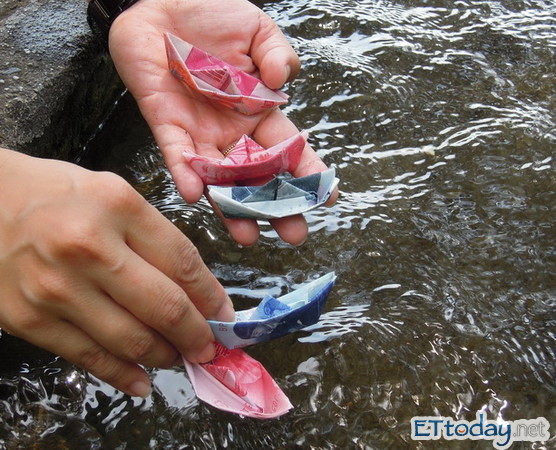
▲ Race begins ! Is Sun Yat-sen or Mao Zedong “swimming” faster? Stay tuned to find out.
“Money, money, money comes, come and scoop it up!” Taitung’s “Water Flowing Upstream” is a famous attraction. In addition to Taiwanese visitors, mainland Chinese tourists also make it a must-see. Many use leaves, paper, or cigarettes to test whether the water really flows upwards, resulting in a lot of litter being left behind. Many have asked the relevant management authorities to try to solve this problem, but so far no good solution has been found. Cleaning staff and police can only rely on persuasion, which has limited effect.
A local resident, Wang Fengming, proposed a method and invited ETtoday News Cloud reporters to test it together. The idea is to first fold the banknotes into the “boat shape” that children often made when playing, then place them in the water to float along the current. He joked that a sign should be erected nearby: “Water flows upstream, people climb higher, and money rolls in!” Wang Fengming said that Chinese people really believe in this.
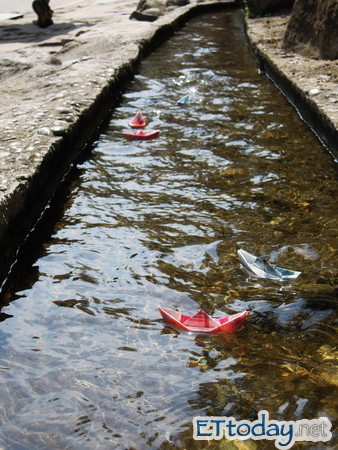
▲ Wow, money, money, money comes !If tourists all learn to fold “paper money boats” and set them floating, they will definitely retrieve them, and it won’t lead to a huge amount of litter.
He first borrowed NT$100 bills featuring the images of Father of the Nation Sun Yat-sen and Mao Zedong, folded them into boat shapes, and put them into the very fast-flowing channel. Sure enough, many people shouted: “Money, it’s money!” Then they helped scoop it up from higher ground. Tourists found it very interesting and immediately asked Wang Fengming how to fold the banknotes into boat shapes, trying it themselves as well. “See, human nature—even people help scoop it up. This way, there will definitely be less litter.”
“Many scenic spots have ‘wishing wells’ where coins pile up. ‘Water Flowing Upstream’ can’t do that, but at least we can tell tourists to let the money flow with the water—the money will then roll in. If you use paper or trash to test whether the water flows upwards, your life will become a total mess... But if you use banknotes to test it, tourists will pick them up, and there won’t be a huge buildup of litter.” Wang Fengming’s creative idea is indeed quite good, hitting the right psychological note.
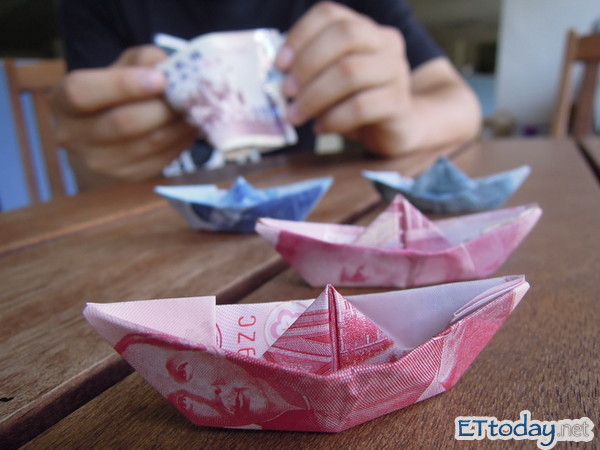
▲ Sun Yat-sen and Mao Zedong are about to “set off” to “swim” together !
“Water Flowing Upstream” is an old attraction, but since mainland Chinese tourism opened up, tour groups have made it a must-visit, further boosting its fame. To address the issue of excessive visitors, the relevant authorities even set up traffic lights and a parking lot at KM 152 on Provincial Highway 11, allowing everyone and small cars to safely turn right about 50 meters down the road to view the “Water Flowing Upstream” wonder. All the facilities were installed to accommodate the large number of visitors.
“Water Flowing Upstream” was originally an agricultural irrigation channel, winding along the ditch and seemingly flowing “upwards.” The water appears to flow upwards because the surrounding scenery has a steeper incline than the road surface, creating an optical illusion of water flowing from low to high. Because it’s so unique and free to enter, both locals and mainland tourists come to see it. To verify the rumor, tourists often pick up nearby leaves, flowers, or items like paper, handkerchiefs, or even cigarettes to test the water. Cleaning staff often end up scooping up a huge bag of trash daily, especially during peak tourist seasons when it’s even worse.
Taitung County Government and the East Coast National Scenic Area Administration might want to think about this. Otherwise, the year-end holidays and winter break will soon arrive, and police and cleaning staff will once again be busy dealing with such trivial matters. Dear readers, do you have a better, more effective solution? Or do you think Wang Fengming’s idea is really good, and perhaps some more creative persuasion methods could be added? Everyone, put on your thinking caps and help make Taiwan’s “wonders” even better !
Share
This article is published by HowToTrip. Sharing and reposting are welcome — please credit the source.
Article URL: https://www.howtotrip.net/views-29521
Related Articles
- Shaoxing's "Grandpa Gourd" hangs the gourds back up: "If there are too many people, we'll interact less — just take a quick look from afar"
- Chinese authorities announce "reciprocal adjustment" to Japan visa fees — single-entry visa jumps from 2,250 to 16,750 yen!
- The "health stones" carried by a traveler were found to have radiation levels exceeding safety limits by a thousand times, potentially endangering fellow passengers on the same flight. Customs issues warning!
- Shenzhen Airport Issues Late-Night Notice: Unidentified Aerial Object Detected, Causing Widespread Flight Delays!
- “They only said it cost money after I opened the box and washed it!” 200g of grapes sold for 60 yuan on a high-speed train—12306 responds!
- Can't buy an airline ticket? Denied exit? Blocked from boarding? A large number of Chinese tourists have mysteriously become "discredited individuals"
- Adverse weather and economic fluctuations impact Colombia's coffee market
- Beach bathing area responds to 2 yuan/30 seconds fee for freshwater foot rinsing: Clearly priced!
- Taking off with an improperly closed cabin door? Wing malfunction? Multiple flights made emergency returns mid-journey!
- Experience the gifts of nature! A countdown of the world’s ten most stunning coastlines