Exclusive / Chiang Kai-shek and Soong Mei-ling "liberated" with a "pink toilet" — bidet-equipped for posterior pampering
Reported by Reporter Li Anjun / Taoyuan
The military strongman Chiang Kai-shek and the timeless beauty Soong Mei-ling had unusually distinctive taste in toilets — theirs was an exceptionally rare pink color. Next to the toilet was also an American-style bidet device. Both suffered from "constipation issues." During his lifetime, Chiang was assisted by his aide Qian Rubiao in using glycerin suppositories to relieve constipation, while Soong Mei-ling had a dedicated person administer enemas. This mysterious pink-toned bathroom is located within the Cihu Mausoleum, and very few people have seen it.
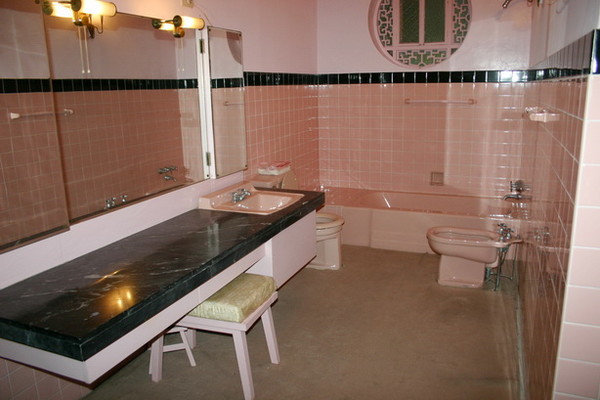
▲ The "pink-toned bathroom" of Chiang Kai-shek and Soong Mei-ling is very mysterious — few have seen it, and it’s rarely been shown to the public. (Photo / Provided by Huang Jianyi)
Taiwan has around 30 Chiang Kai-shek residences, most of which have now been converted into memorial halls, cultural centers, or tourist hotels. While many of these residences have similar bathroom styles, their toilets are usually the standard white or ivory like those used by ordinary people. However, the toilet in the “Cihu Guesthouse” (now the Cihu Mausoleum) uniquely features a pink design.
In front of the toilet there is also an American-style pink bidet device. After relieving themselves, Chiang or Madame Chiang would take a few steps, squat down, and flush. Compared to today's Japanese washlets, it wasn’t particularly convenient, but around 1962, it was considered highly advanced equipment. In addition to the pink toilet, the bathtub, wall tiles, sink, window grilles, and chairs were all in the soft pastel shades favored by many girls.
Huang Jianyi, a historian from Daxi in Taoyuan, said that the only residence Chiang Kai-shek personally supervised during construction was the Cihu Guesthouse — which might be why he chose colors and styles that suited his own family’s taste. But the choice of pink was surprising; the most likely reason is that Madame Soong Mei-ling liked it.
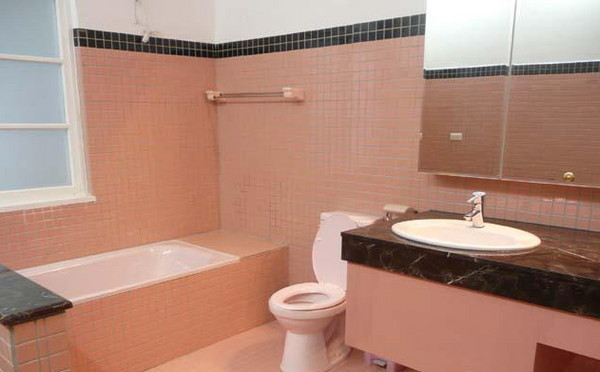
▲ A "replica" of the Chiangs’ pink-hued bathroom is displayed in the second exhibition hall at Hou Cihu, but compared to the luxurious original, it really doesn't compare — the windows alone are a major letdown.
Currently, the Cihu Mausoleum is open to the public for paying respects and ceremonies, but other indoor areas are closed off. To the left of the coffin are Chiang and Soong’s bedroom and bathroom, while to the right is the medal display room, which remains off-limits. Unless special individuals or circumstances arise, only the director or mausoleum officials may guide visitors inside. Huang Jianyi happened to witness the adorable "pink bathroom" during a tour for VIPs. He was also amazed by Chiang Kai-shek’s personally used "dragon throne" and collection of medals.
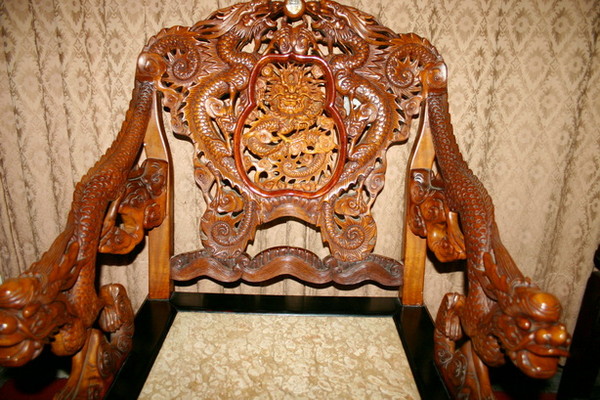
▲ The handcrafted dragon throne used by Chiang Kai-shek, with exquisitely fine carvings. (Photo / Provided by Huang Jianyi)
It’s worth mentioning that since the pink-hued bathroom isn’t open to the public, the relevant authorities replicated a similar "room setup" in the Hou Cihu exhibition hall. Mainland media once visited Taiwan to see it and reported extensively on it. Another Daxi resident who has seen the replica firsthand, Chen Guoquan, joked: “There’s a world of difference between having actually used it and just seeing a copy. The replica isn’t much fun — it’s fake, after all.”
In fact, the “constipation” issues of Chiang and Soong have long ceased to be a secret. According to the oral history records titled “Interview Records of Chiang Kai-shek’s Aides” compiled by the Institute of Modern History at Academia Sinica, aide Ying Shunren recalled that on December 4, 1971, aide Qian Rubiao used a glycerin suppository to help President Chiang with constipation. Unfortunately, he applied too much force and accidentally tore Chiang Kai-shek’s anus, causing a high fever. Bedridden, Chiang ordered severe punishment for Qian Rubiao. Fearful that news of the revered president’s injured anus might leak, Guard Commander Kong Lingcheng placed Qian Rubiao under house arrest in the restrictedChiang Kai-shek's anus, Qian Rubiao also served four years in an inexplicable black jail.
Additionally, Wang Feng, the author of the book *Beauty and Sorrow—Soong Mei-ling*, wrote: “Since 1963, Soong Mei-ling has suffered from habitual constipation… Before the enema, it is necessary to prepare 500CC of warm water and place it in a small bag of the enema apparatus. This small water bag is connected to a thin water hose, which has a rectal tube attached at the end. The user inserts the rectal tube into the appropriate position inside the anus, after which a staff member operates the apparatus to slowly squeeze the warm water from the bag, allowing the warm water to be injected into the anus… Under normal circumstances, once about 200CC of warm water is injected, the rectal area of the user will begin to accelerate peristalsis due to the stimulation of the warm water. During this peristaltic process, the accumulated feces in the rectum will gradually be expelled as they are agitated by the flow of warm water. Every night before going to bed was Soong Mei-ling’s time for an enema, a habit she maintained consistently for decades.”
Share
This article is published by HowToTrip. Sharing and reposting are welcome — please credit the source.
Article URL: https://www.howtotrip.net/views-29431
Related Articles
- Shaoxing's "Grandpa Gourd" hangs the gourds back up: "If there are too many people, we'll interact less — just take a quick look from afar"
- Chinese authorities announce "reciprocal adjustment" to Japan visa fees — single-entry visa jumps from 2,250 to 16,750 yen!
- The "health stones" carried by a traveler were found to have radiation levels exceeding safety limits by a thousand times, potentially endangering fellow passengers on the same flight. Customs issues warning!
- Shenzhen Airport Issues Late-Night Notice: Unidentified Aerial Object Detected, Causing Widespread Flight Delays!
- “They only said it cost money after I opened the box and washed it!” 200g of grapes sold for 60 yuan on a high-speed train—12306 responds!
- Can't buy an airline ticket? Denied exit? Blocked from boarding? A large number of Chinese tourists have mysteriously become "discredited individuals"
- Adverse weather and economic fluctuations impact Colombia's coffee market
- Beach bathing area responds to 2 yuan/30 seconds fee for freshwater foot rinsing: Clearly priced!
- Taking off with an improperly closed cabin door? Wing malfunction? Multiple flights made emergency returns mid-journey!
- Experience the gifts of nature! A countdown of the world’s ten most stunning coastlines