Stay Overnight at a Shrine / The Golden Mountain Shrine Greeted by Wild Monkeys
Text and photos by uQ Nakashiro Hiroshi / Excerpted from Owl Publishing’s *Come Stay Overnight at a Shrine*
The “Koganeyama Shrine on Kanayama Island” is a shrine located on a floating island in the Pacific Ocean.
Getting to the island is by no means convenient. But making a pilgrimage by boat, then staying overnight in the realm of the gods, is an experience filled with unparalleled charm. Take the JR Senseki Line from Sendai, gently rocking along the way while admiring the scenic spots of Matsushima through the train window, and get off at “Ishinomaki Station.”
 From there, take a bus along the coast of the Ojika Peninsula, and in about an hour and a half, you’ll arrive at “Ayukawa Port.” Ayukawa Port was once a thriving whaling harbor, not only featuring displays of whaling ships but also with “whale cuisine” signs everywhere you look. From here, take the scheduled ferry with fixed routes and timetables—about twenty minutes to reach “Kanayama Port” (take the JR Ishinomaki Line to “Onagawa Station,” a five-minute walk to “Onagawa Port,” from where ferries also operate).
“Kanayama Island” is a small island about one kilometer off the southeastern coast of the Ojika Peninsula. The entire circumference of the island is about 26 kilometers, with an area of approximately 1,000 hectares. Since the whole island is considered the sacred domain of the “Koganeyama Shrine,” it has been a protected area where hunting and logging have been prohibited since ancient times. As a result, wild animals such as deer and monkeys inhabit the island, preserving its rich natural environment.
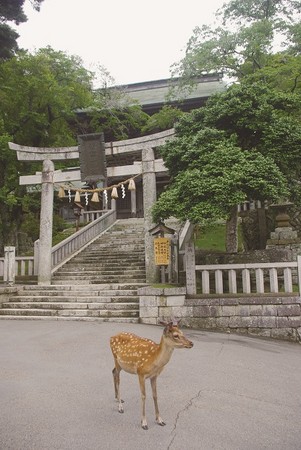
Wild deer welcome you to this island abundant in natural resources
The ferry docks at a pier on the western side of the island, and it takes about twenty minutes of uphill walking from there to reach the shrine grounds. Alternatively, you can use a shuttle bus that runs specially to coincide with the arrival of the ferry.
Hundreds of monkeys (the population fluctuates between 300 and 700) live on Kanayama Mountain, serving as divine messengers and guardians. Compared to monkeys on mainland Japan, they appear somewhat leaner, likely due to living within the island’s limited ecosystem.
The stone torii gate in the Myojin style features a magnificent “Zuijin Gate,” and the bell tower on the right is a remnant from the era when Shinto and Buddhism were unified. Passing through the Zuijin Gate and climbing the stone steps, you’ll see the Prayer Hall on the left. Further up the steps, straight ahead lies the Worship Hall, with the Main Hall enshrined deep inside. The Worship Hall is about six ken wide and around four ken deep, making it a very grand structure. Between the Main Hall and the Worship Hall stands an exquisitely carved “Chumon Gate.” The Main Hall, built in the “Shunkei-zukuri” architectural style, is adorned with delicate and intricate decorations. The entire complex exudes a classic and elegant atmosphere, making it hard to believe it was built during the Meiji period.
The “Prayer Hall,” which can accommodate about 350 people praying simultaneously, is also an important building. At most shrines, festivals, prayers, and formal worship take place in the Worship Hall, but at Koganeyama Shrine, prayers are conducted in an octagonal Homa altar while burning Homa wood and reciting prayers, so the Prayer Hall is a separate structure. Additionally, if you stay overnight in the shrine’s assembly hall (Sanjukudo), you can participate in the following morning’s “First Grand Homa Prayer.”
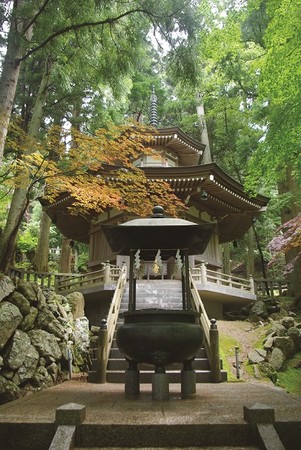
The tradition of “Sanjukudo” (overnight prayer vigil) continues to this day
Koganeyama Shrine is an island shrine, and staying overnight for a “Sanjukudo” prayer vigil is a traditional custom that has continued since ancient times. During shrine festivals, many worshippers stay overnight in the assembly hall, purify themselves at the ritual cleansing area, and then participate in the “Harae” purification ritual of the First Grand Homa Prayer at dawn, creating a lively atmosphere.
The “Assembly Hall,” opened in July of Showa 47 (1972), is a five-story reinforced concrete building with an impressive thatched “gassho-style” roof decorated with bonito logs. The Sanjukudo rooms consist of 24 rooms (15 tatami-style rooms), accommodating up to 250 people. The facility also includes a large assembly hall, small assembly hall, lobby, dining hall, ritual cleansing area (gender-separated large baths), shrine office, and more, all designed with modern amenities to provide a comfortable and enjoyable Sanjukudo experience.
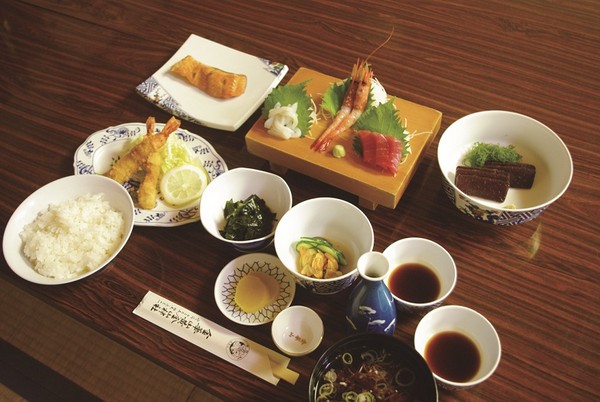
Dinner consists of simple dishes mainly featuring local seafood, so “whale sashimi” must be reserved in advance, while lunch can also be enjoyed at the on-site restaurant. The third floor of the building has a connecting corridor leading to a separate “ritual cleansing area.” From the west-facing windows of the cleansing area, you can gaze out at the Ojika Peninsula and the strait, allowing your mind to heal while you purify your body.
The water used at Koganeyama Shrine comes from Kanayama Island, and the water in the ritual cleansing area is spring water from the mountain. This clear water is considered a type of spiritual spring, known as “Golden Light Water,” and many people visit specifically to collect it. Aside from the shrine and one guesthouse, the island has few residents—usually only about 25 shrine staff members stay overnight. On quiet, sparsely populated nights, the atmosphere feels especially mystical.
The liveliest time of year on Kanayama Island is during the “First Snake Festival” held for one week starting from the first Mi (Snake) day of May each year. Based on the ancient belief in Benzaiten, the festival honors her messenger, the snake (Mi), and follows ancient rituals to conduct a solemn and grand celebration. Also, only during the festival period are registered worshippers permitted to enter the Main Hall for prayer, and Sanjukudo participants can attend the daily “Main Hall Opening Ceremony” at dawn.
[Koganeyama Shrine Assembly Hall]
Address: 5 Kanayama, Ayukawahama, Ishinomaki City, Miyagi Prefecture
Phone: 0225-45-2301 (main) / 0225-45-2264 (reservation line)
Accommodation Fee: 9,000 yen and up (one night with two meals, includes offering fee, tax included)
Website: http://www5.ocn.ne.jp/~kinkasan/
Share
This article is published by HowToTrip. Sharing and reposting are welcome — please credit the source.
Article URL: https://www.howtotrip.net/views-29233
Related Articles
- Shaoxing's "Grandpa Gourd" hangs the gourds back up: "If there are too many people, we'll interact less — just take a quick look from afar"
- Chinese authorities announce "reciprocal adjustment" to Japan visa fees — single-entry visa jumps from 2,250 to 16,750 yen!
- The "health stones" carried by a traveler were found to have radiation levels exceeding safety limits by a thousand times, potentially endangering fellow passengers on the same flight. Customs issues warning!
- Shenzhen Airport Issues Late-Night Notice: Unidentified Aerial Object Detected, Causing Widespread Flight Delays!
- “They only said it cost money after I opened the box and washed it!” 200g of grapes sold for 60 yuan on a high-speed train—12306 responds!
- Can't buy an airline ticket? Denied exit? Blocked from boarding? A large number of Chinese tourists have mysteriously become "discredited individuals"
- Adverse weather and economic fluctuations impact Colombia's coffee market
- Beach bathing area responds to 2 yuan/30 seconds fee for freshwater foot rinsing: Clearly priced!
- Taking off with an improperly closed cabin door? Wing malfunction? Multiple flights made emergency returns mid-journey!
- Experience the gifts of nature! A countdown of the world’s ten most stunning coastlines