Graffiti artist Candy Bird invents "Hmph People" to depict Taiwan society’s dark humor on street corners
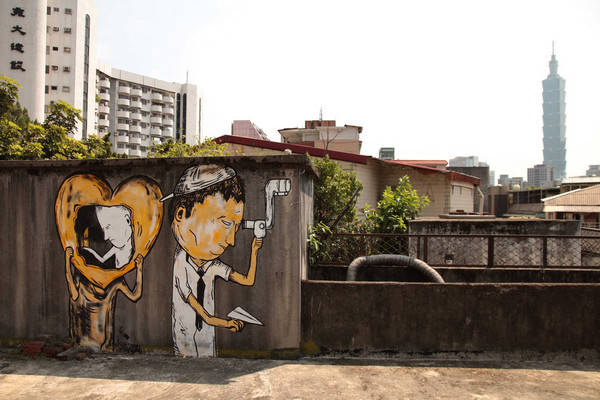
▲ The observer of the city: a street graffiti artist. (Photo courtesy of Candy Bird)
Reported by You T-Ru / Taipei
In Taiwan’s graffiti scene, there’s a popular story about a "vigilante" incident. A graffiti artist was caught painting on a wall late at night and reported by a passing driver. When the police arrived, they took a look at the young artist’s street art in the dim light, noticed his nervous expression, then turned to the driver—who was waiting to collect a reward for the tip-off—and said, "The kid just likes to draw. Why bother him?"
A similar incident happened to graffiti artist Candy Bird. One evening, while painting in an abandoned military camp, a police officer spotted the young artist after noticing his parked motorcycle. "Kid, what are you doing?" "I’m drawing." "Alright, got it. You can leave now." After hearing the "kid’s" explanation, the officer walked away with Candy Bird. "I waited in a convenience store for a few minutes, then returned to the camp to finish my painting. The police never came back," Candy Bird recalls, calling it a uniquely gentle approach by Taiwanese police toward young people.
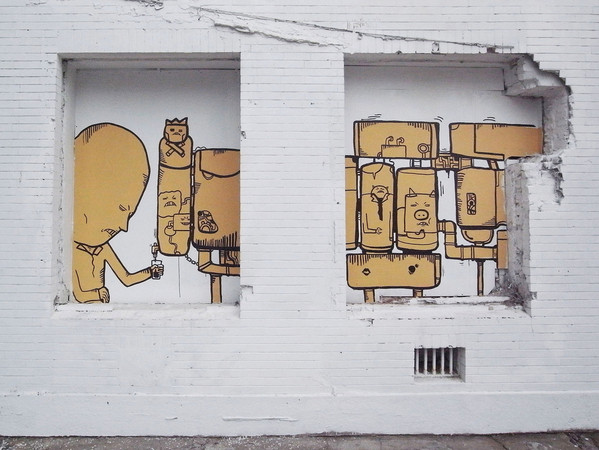
▲ Near Taipei’s Huashan Station, you can see Candy Bird’s series of "Hmph People" drinking machine water. (Photo courtesy of Candy Bird)
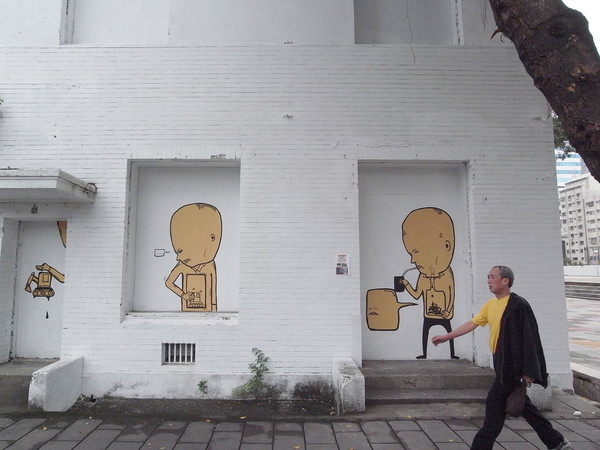
▲ The "Hmph People" who drink machine water end up with bellies full of "machines" and "excavators." (Photo courtesy of Candy Bird)
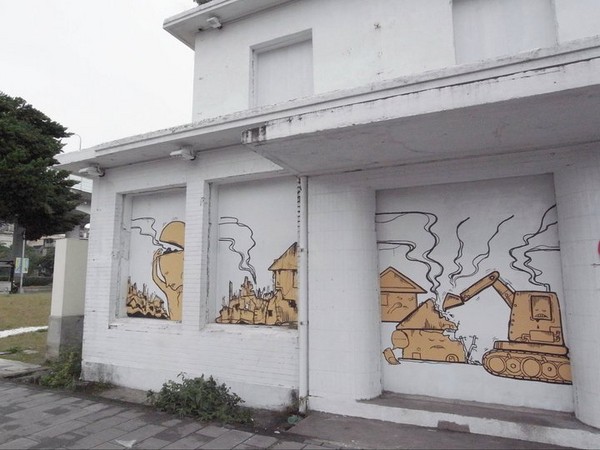
▲ Excavators demolish helpless houses—an example of Candy Bird’s resigned dark humor. (Photo courtesy of Candy Bird)
If you’ve ever paid attention to street art, you’ve likely seen Candy Bird’s work. Huge heads with skinny limbs, the heads split open to reveal a jumble of imaginative thoughts inside—plus a touch of dark humor. That’s Candy Bird’s signature style. Some netizens call these figures "carrot people" or "sweet potato people," but Candy Bird’s favorite name is "Hmph People."
"When you look closely at Candy Bird’s works, you can’t help but let out a little 'hmph' or 'hmm' laugh," a bystander shared during an interview with the artist. Observing his pieces closely makes you emit a nasal "hmph" chuckle—because his unique dark humor provokes an involuntary snort of satire.
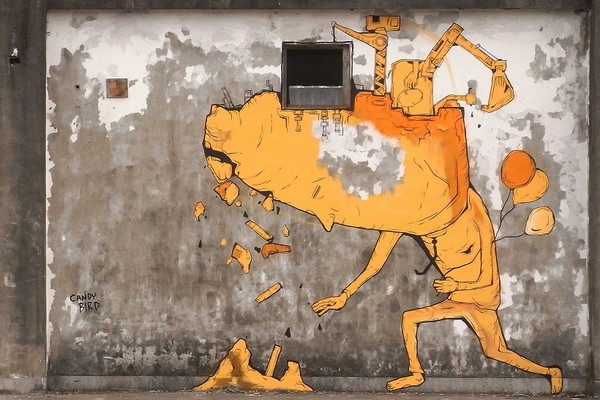
▲ Huge heads with skinny limbs, heads split open to show a chaotic mix of thoughts—that’s the "Hmph People." (Photo courtesy of Candy Bird)
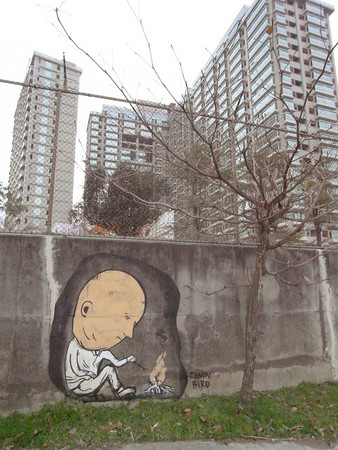
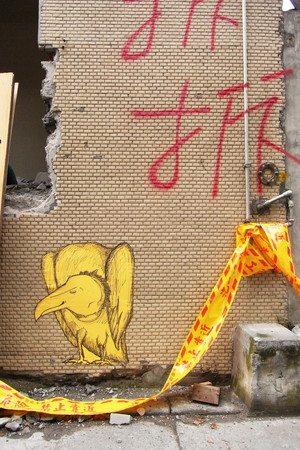
▲ Painting in harmony with the surrounding urban scenery is a hallmark of street art. (Photo courtesy of Candy Bird)
Having been a "street graffiti artist" for three years, Candy Bird’s first piece was created in a ruin next to the Contemporary Art Center. At the time, the Taipei Contemporary Art Center had just opened, and Candy Bird thought, "If there’s a contemporary art center, I should have a graffiti center too." So he found a wall in the ruin, wrote "Taipei Contemporary Graffiti ‘Duck’ Center" (he even misspelled "duck" as "鸭"), and began his graffiti journey.
Preferring the feel of a paintbrush over spray cans, Candy Bird uses cement paint instead. His interest in social movements actually predates his graffiti work. "My first encounter with land issues was when I joined drummer Zheng Kaitong from a band to support the Sanying Tribe. We formed an anti-eviction group and started closely observing the lives of vulnerable residents." After witnessing the helplessness of marginalized communities through his first social movement experience, Candy Bird became actively involved in various causes. "Once you start caring about something, you can’t stop."
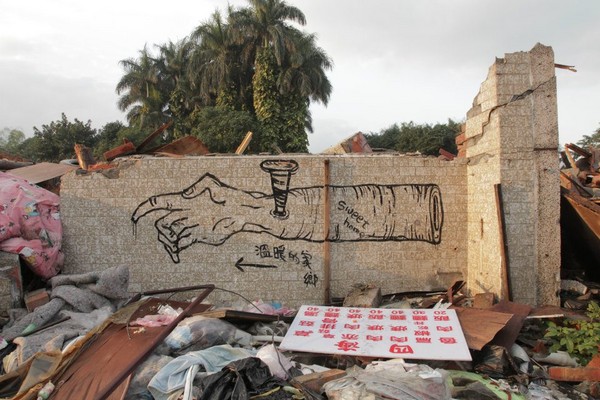
▲ After engaging with social movements and witnessing the struggles of the vulnerable, Candy Bird became actively involved in various causes. (Photo courtesy of Candy Bird)
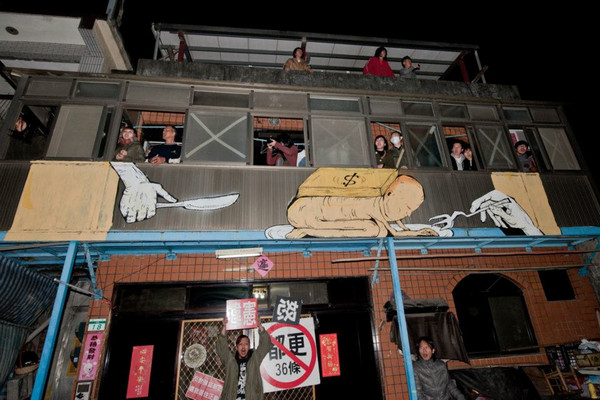
▲ A mural by Candy Bird on the exterior wall of the Wang family home: a figure curled up carrying money, flanked by giant hands holding forks and knives ready to carve it up. This was painted the night before the demolition. (Photo courtesy of Candy Bird)
During the controversy surrounding the Shilin Wenlinyuan incident last year, Candy Bird participated in the protests and even left a mural on the Wang family’s wall: a figure curled up carrying money, with giant fork-and-knife hands ready to divide it up—classic Candy Bird style, simple yet satirical "hmph" humor. "Graffiti lets me say a lot of things I want to express and allows my imagination to run wild."
After the Shilin Wang family incident, the Urban Nomad Film Festival approached Candy Bird to collaborate on a cardboard wall graffiti project. He chose to depict the Wang family’s story. Though he initially thought few would understand the piece, it sparked widespread discussion. "Using images to connect people’s thoughts—that’s when I realized how many actually care about society."
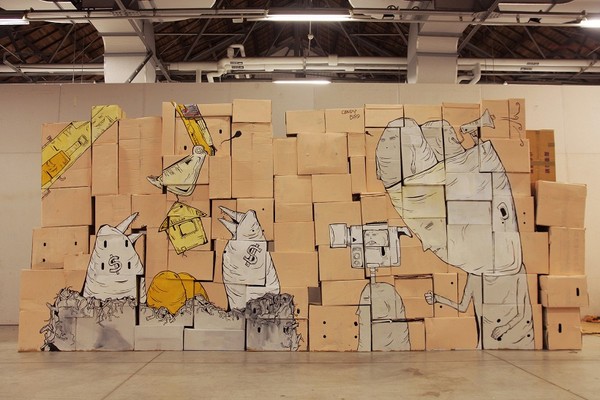
▲ Cardboard wall graffiti: Candy Bird’s depiction of the Shilin Wang family story. (Photo courtesy of Candy Bird)
Candy Bird creates graffiti in response to current events, earning a living through illustration commissions and street art. After covering living expenses, he saves money to travel abroad. "Whenever I go overseas, I always sneak cement paint in a plastic bottle to paint there." His work can be found on streets in Japan, Germany, and beyond—on street corners, in restrooms, on pipes, construction sites, and rooftops.
"I once saw an online auction photo where someone was taking a picture in front of one of my walls. It felt surreal." His art, while relatable, also carries a detached sense of societal helplessness. Candy Bird’s pieces always manage to highlight the voices of ordinary city dwellers through seemingly mundane urban details. "Graffiti appeals to me because it’s also a form of ‘social issue’ that’s close to life," he says. He once attended a high-end artists’ gathering but couldn’t stand the "weird atmosphere." After drawing a "Hmph Person" expressing his frustration on the kitchen wall, he decided to leave—because for him, the real stage is the streets and sidewalks.
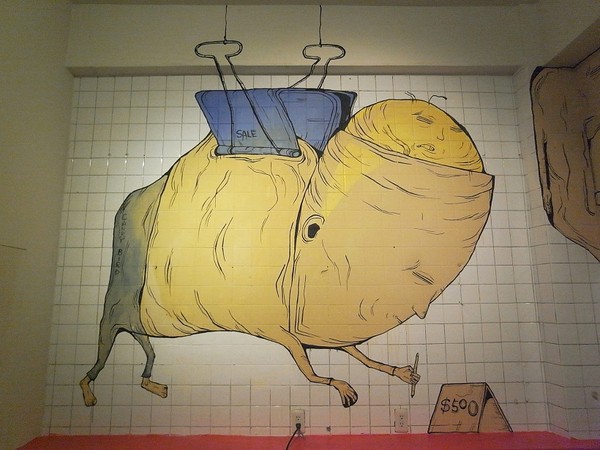
▲ "I’ve been labeled for sale, so cheap at just 500 dollars." At an artists’ gathering, Candy Bird expressed his frustration by drawing a "Hmph Person" on the kitchen wall—and then left. (Photo courtesy of Candy Bird)
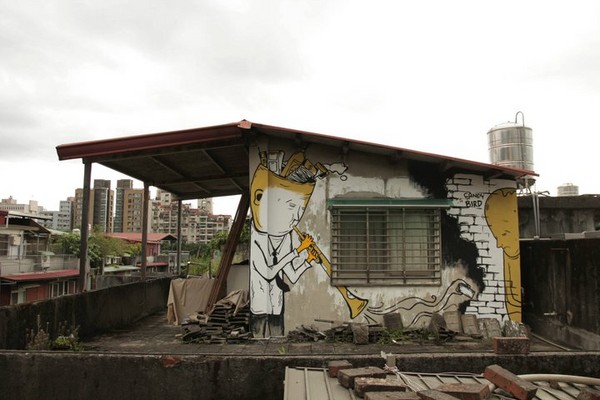
▲ Rooftop graffiti. (Photo courtesy of Candy Bird)
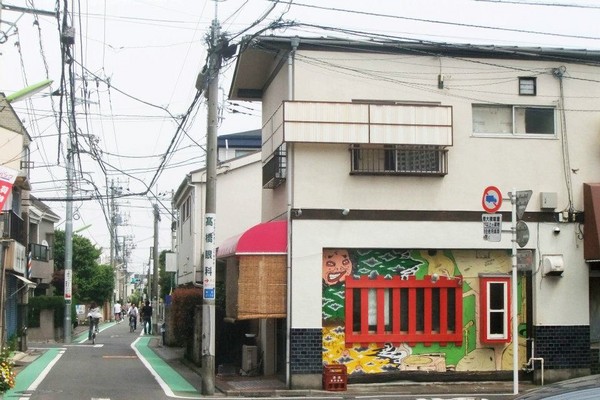
▲ A collaborative street graffiti piece in Japan with Taiwanese artist "Black Chicken." (Photo courtesy of Candy Bird)
The day before the interview, Candy Bird had just finished a new piece on land issues, painted on the brick wall of the Huaguang Community, a site facing forced eviction. An obese figure wields an excavator, ready to demolish a flower-growing girl on the other side of a seesaw, while bystanders watch in silence, wearing blindfolds. Yet, the weight of love outweighs greed, so the seesaw tilts toward the flowers, not the fat man. "I chose to explore social issues and graffiti because I believe images can move and inspire more people," Candy Bird explains.
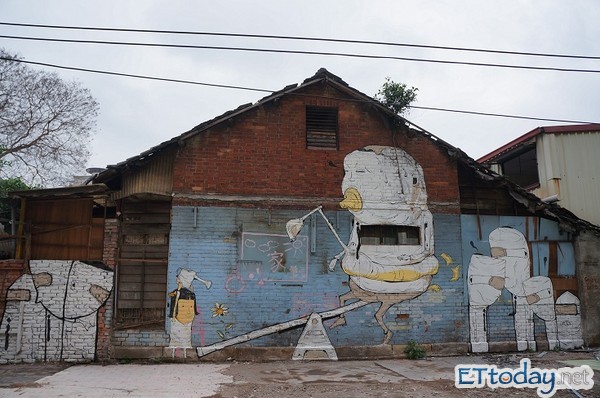
▲ An obese figure raises an excavator toward a flower-growing girl on the other side of a seesaw, while bystanders watch silently, wearing blindfolds. (Photo by reporter You T-Ru)
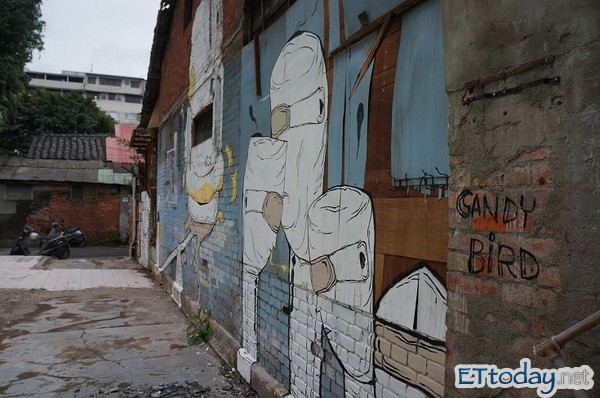
▲ Have you seen Candy Bird’s socially engaged graffiti about land? (Photo by reporter You T-Ru)
Share
This article is published by HowToTrip. Sharing and reposting are welcome — please credit the source.
Article URL: https://www.howtotrip.net/views-29123
Related Articles
- Shaoxing's "Grandpa Gourd" hangs the gourds back up: "If there are too many people, we'll interact less — just take a quick look from afar"
- Chinese authorities announce "reciprocal adjustment" to Japan visa fees — single-entry visa jumps from 2,250 to 16,750 yen!
- The "health stones" carried by a traveler were found to have radiation levels exceeding safety limits by a thousand times, potentially endangering fellow passengers on the same flight. Customs issues warning!
- Shenzhen Airport Issues Late-Night Notice: Unidentified Aerial Object Detected, Causing Widespread Flight Delays!
- “They only said it cost money after I opened the box and washed it!” 200g of grapes sold for 60 yuan on a high-speed train—12306 responds!
- Can't buy an airline ticket? Denied exit? Blocked from boarding? A large number of Chinese tourists have mysteriously become "discredited individuals"
- Adverse weather and economic fluctuations impact Colombia's coffee market
- Beach bathing area responds to 2 yuan/30 seconds fee for freshwater foot rinsing: Clearly priced!
- Taking off with an improperly closed cabin door? Wing malfunction? Multiple flights made emergency returns mid-journey!
- Experience the gifts of nature! A countdown of the world’s ten most stunning coastlines