Certified by Japan's Sakura Association – Domestic Amusement Park Recognized as a Cherry Blossom Destination
Tourism Center / Nantou Report
No need to travel all the way to Japan for cherry blossom viewing in spring. A domestic amusement park has not only specially grafted and cultivated the rare double-petal Beni-shidare cherry blossoms seldom seen in Japan, but has now also been certified by the Japan Sakura Association as an overseas "Preferred Cherry Blossom Site." A cherry blossom monument has been erected to commemorate the bond of cherry blossom friendship between Taiwan and Japan. On the day of the unveiling ceremony, four Japanese cherry blossom queens—past, present, young, and old—rarely gathered together to witness this beautiful connection forged by cherry blossoms.
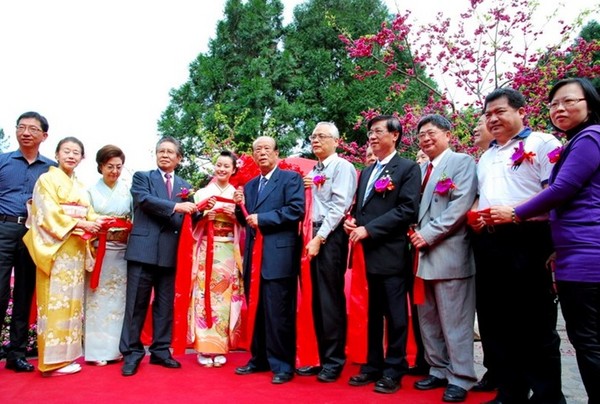
▲ Zhang Rongyi (6th from right), Chairman of Formosan Aboriginal Culture Village, along with Shinsuke Hasumi (4th from left), CEO of the Japan Sakura Association, and Yoko Kawase (5th from left), current Japanese Cherry Blossom Queen, unveil the "Cherry Blossom Site" certification plaque. (Photo / Provided by the operator)
Formosan Aboriginal Culture Village stated that following the 1990 certification of the "100 Best Cherry Blossom Sites in Japan" within Japan, this is the first time the Japan Sakura Association has certified an overseas cherry blossom site. This recognition places the cherry blossom scenery of Formosan Aboriginal Culture Village on par with Japan’s top 100 cherry blossom viewing spots. Currently, the park is home to 5,000 double-petal Beni-shidare cherry blossoms, which are rare in Japan and were specially grafted and cultivated. As such, they have been uniquely named the "Formosan Hundredfold Cherry Blossoms" to commemorate the significance and status these blossoms hold in developing cherry blossom culture in Taiwan.
Although the Japan Sakura Association is a public interest incorporated foundation, it holds a highly prestigious status in Japan. The association’s president is always the Speaker of the House of Representatives of Japan, making it a key semi-official organization for promoting cherry blossom culture in Japan. The "100 Best Cherry Blossom Sites in Japan," certified by the association, are now iconic destinations for both Japanese tourists and Taiwanese visitors chasing cherry blossoms in Japan. This certification of Formosan Aboriginal Culture Village as a cherry blossom site not only holds special significance for Taiwan’s tourism marketing, but Sun Moon Lake will also promote the cherry blossom site to Japanese tourists.
Shinsuke Hasumi, CEO of the Japan Sakura Association, said that 10 years ago, at the invitation of the Sun Moon Lake National Scenic Area Administration and Formosan Aboriginal Culture Village, he led the Japanese Cherry Blossom Queen to attend the Formosan Aboriginal Culture Village Cherry Blossom Festival for the first time. He was deeply impressed by the warmth and love for cherry blossoms among the Taiwanese people, as well as the stunning beauty of the double-petal Beni-shidare cherry blossoms planted in the park. This year marks the 10th anniversary of this exchange, and the title of "Preferred Cherry Blossom Site" is a special recognition of Formosan Aboriginal Culture Village’s dedication, serving as a lasting memento.
Also accompanying the Japan Sakura Association on this visit was Yoko Kawase, the current 24th-generation "Cherry Blossom Queen," who serves as a goodwill ambassador representing Japan in promoting cherry blossom diplomacy worldwide. Notably, former cherry blossom queens, including Hisako Hasumi, Sonoko Kudo, and Koga Junko, were also present. The four Japanese cherry blossom queens—past, present, young, and old—gathered together to witness this extraordinary bond of cherry blossom certification between Taiwan and Japan.
Share
This article is published by HowToTrip. Sharing and reposting are welcome — please credit the source.
Article URL: https://www.howtotrip.net/views-29119
Related Articles
- Shaoxing's "Grandpa Gourd" hangs the gourds back up: "If there are too many people, we'll interact less — just take a quick look from afar"
- Chinese authorities announce "reciprocal adjustment" to Japan visa fees — single-entry visa jumps from 2,250 to 16,750 yen!
- The "health stones" carried by a traveler were found to have radiation levels exceeding safety limits by a thousand times, potentially endangering fellow passengers on the same flight. Customs issues warning!
- Shenzhen Airport Issues Late-Night Notice: Unidentified Aerial Object Detected, Causing Widespread Flight Delays!
- “They only said it cost money after I opened the box and washed it!” 200g of grapes sold for 60 yuan on a high-speed train—12306 responds!
- Can't buy an airline ticket? Denied exit? Blocked from boarding? A large number of Chinese tourists have mysteriously become "discredited individuals"
- Adverse weather and economic fluctuations impact Colombia's coffee market
- Beach bathing area responds to 2 yuan/30 seconds fee for freshwater foot rinsing: Clearly priced!
- Taking off with an improperly closed cabin door? Wing malfunction? Multiple flights made emergency returns mid-journey!
- Experience the gifts of nature! A countdown of the world’s ten most stunning coastlines